ATLAS. Physical research at the LHC
The main purpose of the international ATLAS experiment is investigation of proton-proton interactions at unprecedented energies at the LHC collider (from 7 to 14 TeV).
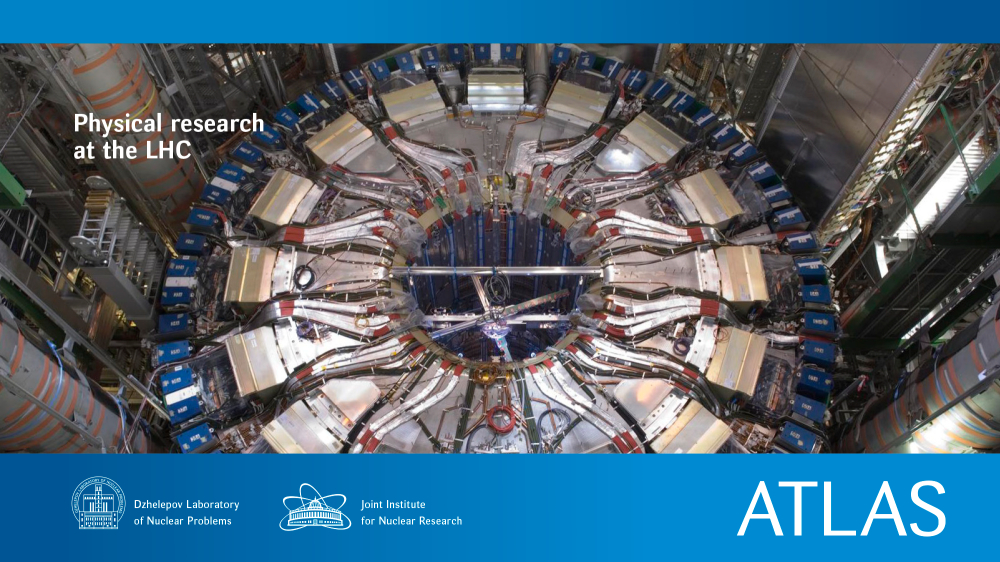
The main purpose of the international ATLAS experiment is investigation of proton-proton interactions at unprecedented energies at the LHC collider (from 7 to 14 TeV center-of-mass energy). These interactions are the source of different (including unknown) physical processes between elementary particles. Study of such processes and their description within a common framework represent the main problem of the modern physical science.
The ATLAS experiment is performing a number of precision tests of the Standard Model, probing the limits of its validity and searching for the answers to the key questions of the modern physics like the nature of the dark matter, existence of additional spacial dimensions, etc.
The ATLAS multipurpose facility is unique and unprecedented w.r.t. its performance and complexity. It combines the most up-to-date advances of science, technology and communication. Participation in such large-scale international project gives access to the cutting-edge technologies of the physical experiment, gaining experience in real data analysis, precision modelling of the physical processes, software and theoretical support of experiment and looks absolutely necessary for such international organisation as JINR.
Expected results upon completion of the project:
Analysis of pp-collisions data at 13.6 TeV as well as High-Luminosity LHC (HL-LHC) data are going to provide the new and unique experimental results. The most important among them are – investigation of the proton structure, in particular, the transverse momentum density of gluons in proton; studies of the heavy hadron spectra, including beauty mesons and exotic tetraquark and pentaquark states; precision SM tests at LHC energies and searches beyond the SM. High Luminosity regime of LHC will allow studies of the rare processes, e.g., Higgs-boson production in association with single top-quark.
Achieving these goals is impossible without developing new methods of data processing analysis. The active participation of JINR physicists is planned in the trigger software support, developing new methods of detector simulation, application of the machine learning techniques in physics analysis.
The implementation of this Project aimed at solving highly significant scientific problems will yield unique applied results. Among these 'byproduct' results are the experience in operation of remote monitoring systems for technically complicated devices, big data processing and development and practical use of distributed comtputing systems (GRID) and database monitoring applications in long-term large-scale experiments.
Applications of this experience if possible in other JINR projects.