

GDH&SPASCHARM
Experimental study of one-spin asymmetries in the production of various light particles using a pion beam with an energy of 28 GeV at the first stage, and the study of one-spin and two-spin asymmetries in dozens of reactions, including those with theformation of charmonium, using a polarized proton beam (SPASCHARM project).
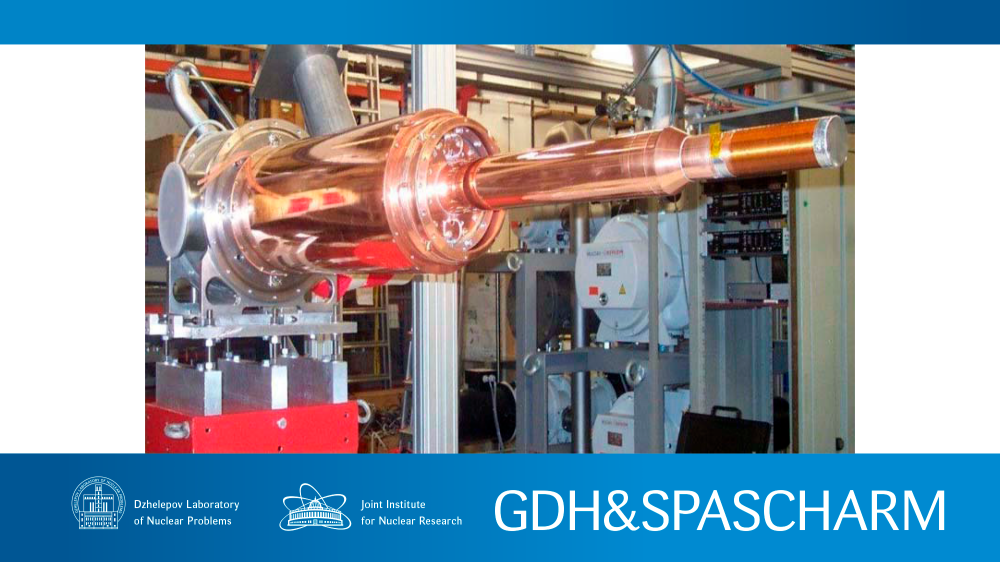
The ultimate goal of the SPASCHARM project is to study the spin structure of the proton, starting with determining thecontribution of gluons to the spin of the proton at large values of the Björken variable x by studying the spin effects in theformation of charmonium. This will make it possible to understand the hadronic mechanism of charmonium production and toisolate the gluon polarization Δg(x) at large values of x.
Experiments with a real photon beam: photoproduction of mesons on nucleons and nuclei and Compton scattering onnucleons. Main objectives: experimental confirmation of the Gerasimov-Drell-Hearn (GDH) sum rule, investigation of thehelicity structure of partial reaction channels, resolution of the excitation spectrum of baryons from light quarks, search formissing baryon resonances and exotic states (dibaryons, narrow nucleon resonances), study of the structure of hadrons.
Measurement of ΔσΤ and ΔσL in an experiment on the transmission of polarized neutrons through a polarized deuteron targetat neutron energies <16 MeV, where there are limited experimental data and where theory predicts a significant effect of three-nucleon forces (3NF). This part of the project (NN) is a continuation of measurements of the same quantities in the scatteringof neutrons by protons, which were carried out earlier.
Research and development of polarization equipment for MESA.
To date, there is no theory that gives a complete and consistent description of all the observed polarization effects in thehadronic sector. Therefore, a systematic experimental study of polarization effects in a wide variety of reactions usingpolarized beams and polarized targets is of great importance for the development of a theory that consistently describes all theobserved spin phenomena.
The observed polarizations are the paramount characteristics of the interactions of elementary particles and nuclear reactions.Formally, the measurement of spin-dependent parameters imposes additional restrictions on the proposed reaction mechanism,the structure of the microobject under study, and the very nature of the fundamental interaction. It should be noted thatmodern experiments aimed at searching for the effects of CP violation and T invariance violation outside the Standard Model, as well as CPT violation, are based on polarization measurements.
Expected results upon completion of the project:
- Development and construction of a new cryostat for a polarized "frozen" target of the SPASCHARM installation.
- Development and construction of the main components of a powerful 3He/4He dilution refrigerator for the "MESA" facility.
- Completion of work on the creation of a cryostat for a polarized target at the University of Bonn.
- Return transport and full launch of the polarized target in Mainz for the "GDH" project.
- Carrying out polarization studies using a polarized "frozen" target at the "MAMI C" accelerator.
- Carrying out polarization studies on a new polarized target at the Bonn University accelerator, "ELSA".
- Assembly, installation and testing of a powerful 3He/4He dilution refrigerator on the beam channel of the MESA setup.
- Launch of the modified polarized target of the "SPASCHARM" facility and the beginning of the collection of physicalstatistics on the accelerator.
- According to the NN-interaction program, channeling experiments will be carried out after the upgrade of the stand for thesource of polarized deuterons, - 2024–2025.
- Carrying out precise measurements of vector and tensor polarizations of the deuteron beam at the VdG accelerator.
- Preparation of a special device for using a new target material based on trityl-doped butanol.
- Manufacture and installation of equipment for measuring polarization of neutrons using scattering on a 4He target.
- Depreservation of the polarized deuteron target and the beginning of measuring the difference between the cross sections ΔσΤand ΔσL in the experiment on transmission of at neutron energies <16 MeV.