

CEPC Project. Development of the physical program and detectors for experiments at CEPC
The discovery of the Higgs boson at the LHC marked the beginning of a new era in high-energy physics. The proposed 100-km-circumference Circular Electron-Positron Collider (CEPC) program in China aims to make unprecedentedly precise measurements of the Higgs boson, test the predictions of electroweak theory, flavor physics, QCD, and explore new physics beyond the Standard Model (BSM).
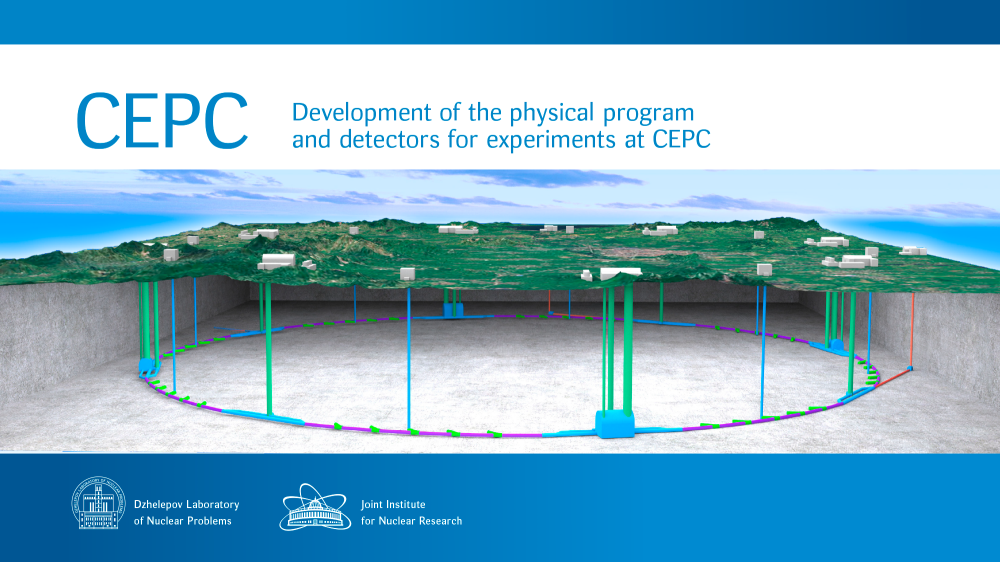
The objectives of this project are to prepare proposals for a programme of research into the properties of Higgs bosons, study their exotic decays and search for new BSM physics phenomena, participate in software development, and perform a series of studies of new detectors for further use in experiments at the CEPC.
Expected results upon completion of the project:
Study of ${e}^+$${e}^-$→ZX processes for precise determination of properties of the Higgs bosons, study of their exotic decays and search for new BSM physics phenomena using Monte Carlo generators. Theoretical support in the development of a physics programme, creation of modern Monte Carlo simulation tools, assessment of the collider luminosity.
Creation and research of prototypes of detector systems, development of methods for their calibration based on the particleflow algorithm.