Nuclear spectrometry for the search and investigation of rare phenomena
The project comprises six main experiments: LEGEND (Large Enriched Germanium Experiment for Neutrinoless double betaDecay), TGV (Telescope Germanium Vertical), SuperNEMO (Neutrino Ettore Majorana Observatory), MONUMENT (MuonOrdinary capture for the NUclear Matrix elemENTs), Zr-BNO, and Se-LSM.
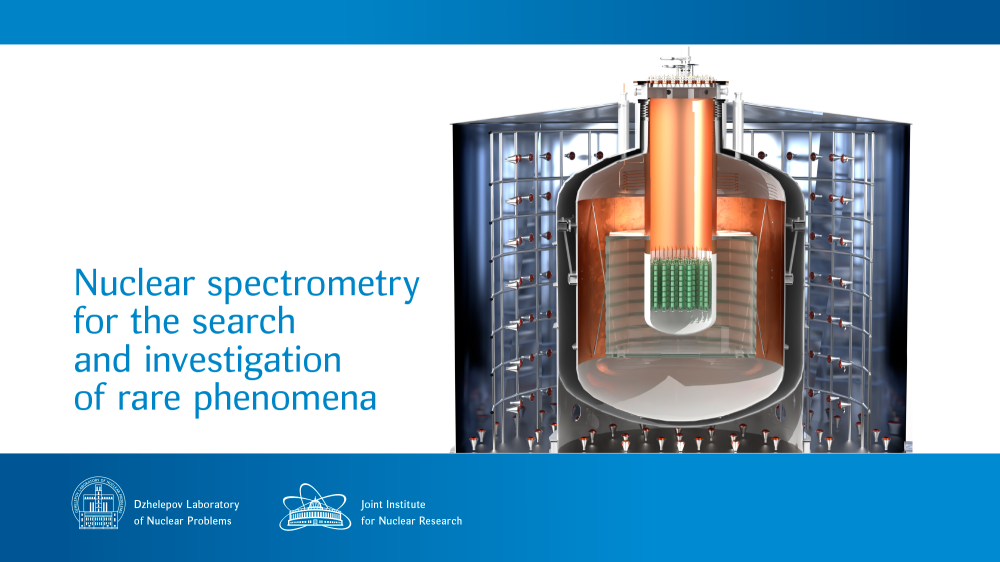
The experiments solve the problems of searching for different modes of double beta decay and studying them (two-neutrino (2νββ) and neutrinoless (0νββ)) using nuclear-spectroscopy methods. The detection of double beta decay will allow us to answer the question about the neutrino nature (the process is possible only for Majorana particles) and will undoubtedly indicate the New Physics beyond the Standard Model.
Development of a compact spherical modular muon detector DSTAR (Detection System for Tracking Angular Radiation) based on plastic scintillators and silicon photomultipliers. The detector is designed for the precision measurement of the flux of cosmic muons and their angular distribution, as well as for the development of muography techniques for solving applied problems.
Expected results upon completion of the project:
The LEGEND experiment, the successor of the GERDA and Majorana projects, is designed to search for the neutrinolessdouble beta decay of ${}^{76}Ge$ (0νββ). LEGEND is based on bare detectors of isotopically enriched
${}^{76}Ge$ immersed in liquid argon. The experiment is performed in two stages. At the first stage – LEGEND-200 – it is intended to use about 200 kg of ${}^{76}Ge$, with the aim to reach the sensitivity of ${10}^27$ years over five years of accumulating data. At the second stage –LEGEND-1000 – the measurement will be conducted using 1 tonne of enriched germanium for 10 years. A low backgroundlevel, high-energy resolution, and efficient discrimination using the event topology will ensure the possibility of unambiguousdetection of 0νββ with T1/2 = $10^{28}$ years.
The programme of the SuperNEMO Demonstrator includes precision measurements of the two-neutrino double beta decay(2νββ) and is aimed at reaching the best limits on 0νββ for the isotope $^{82}Se$.
The purpose of the MONUMENT experiment is to measure muon capture by several daughter nuclei, the candidates for the 0νββ decay.
Within the project, rare double beta decays of several isotopes are investigated. At present, two experiments, Zr-BNO and Se-LSM, are being performed.
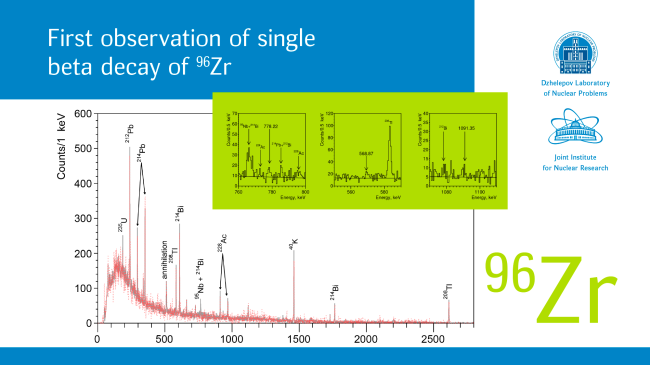
The Zr-BNO experiment is aimed at the search for the double beta decay of $^{96}Zr$ into exited states of
$^{96}Mo$ and at the searchfor the beta decay of $^{96}Zr$ into $^{96}Nb$ using a unique sample of enriched zirconium, produced for the first time in Russia by the centrifuge method.
The Se-LSM experiment is aimed at the search for double beta decay of $^{82}Se$ into exited states of $^{82}Kr$ with the OBELIX, a low-background spectrometer at the underground laboratory LSM in Modane, using a sample of enriched selenium weighing 6.5 kg.
The TGV spectrometer will be used for further investigations of the ECEC decay of $^{106}Cd$ and
$^{130}Ba$. According to estimations and theoretical predictions considering these rare processes, we hope to detect these decays for the first time in thedirect experiment.
A muon detector DSTAR comprising 64 scintillator modules, with a unified time synchronization and coincidence event triggering system, will be created and tested. The project plans to establish a reference dataset from terrestrial, underground, and deep-underwater measurements; to develop algorithms for the inverse problem of muon tomography to reconstruct matter density distributions; to create the necessary software; and to prepare methodological documentation. First, muon fluxes at different depths in Lake Baikal will be measured, as well underground measurements at the Baksan Neutrino Observatory will be conducted; the muon background at the Kalinin NPP will be monitored; atmospheric muons at northern latitudes will be investigated (subject to agreement with Rosatomflot).