Investigations of reactor neutrinos on a short baseline DANSS, Ricochet, νGeN
The project combines the experiments DANSS, Ricochet and νGeN focused on the study of antineutrino fluxes from nuclear reactors at distances of less than 20 m. The experiments are united by a common area of research, by scientific problems overlapping and coinciding in many respects and by the ways to solve them. In addition, these studies are united by the common JINR staff and infrastructure resources.
DANSS is an experiment using an antineutrino spectrometer based on plastic scintillators, with a sensitive volume of $1 м^{3}$, located at Power Unit 4 at the Kalinin NPP. The lifting mechanism moves the spectrometer in the online mode 2 m vertically, enabling measurements at the distance of 11–13 m from the reactor. A high-segmented detector and combinedactive and passive shielding suppress the background down to several percentages relative to ~5000 neutrino-like events recorded per day.
The νGeN experiment is aimed at studying fundamental properties of neutrinos, in particular, at searching for the neutrinomagnetic moment, coherent elastic neutrino scattering (CEvNS), and other rare processes. The νGeN spectrometer is placed under the reactor core of Power Unit 3 at the Kalinin NPP. Neutrino scattering is detected with a specialized low-threshold, low-background germanium detector. Active and passive shielding from background radiation guarantees a low level of background in the region of the search for rare events. The detection of events of interest ensures the search for New Physics beyond the Standard Model, and, in addition, can also be applied to practical tasks, for example, to developing new-generation detectors to monitor the operation of the nuclear reactor using the antineutrino flux.
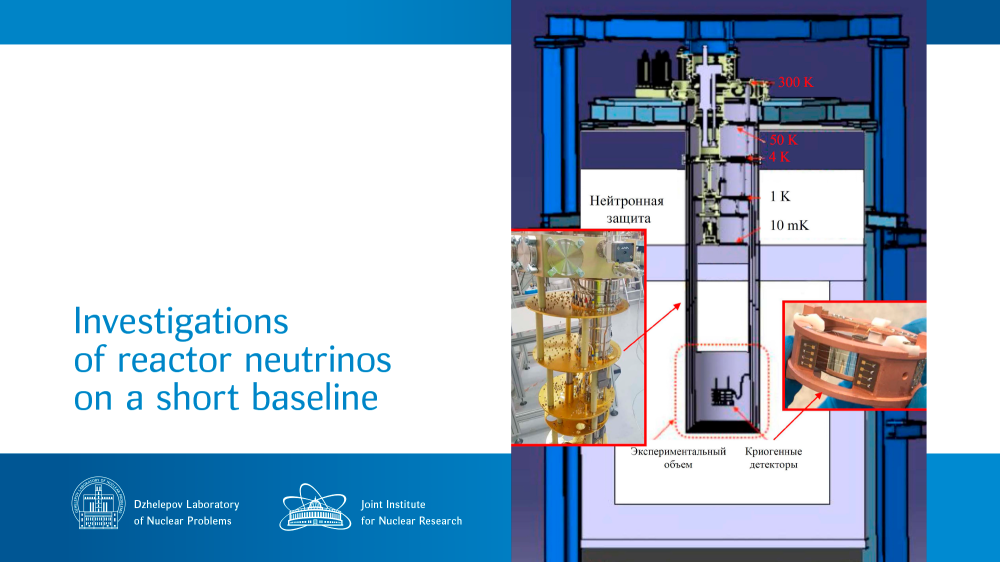
Ricochet is a new-generation reactor neutrino experiment aimed at the one-percent-precision measurement of coherent elastic neutrino-nucleus scattering (CEνNS) in the sub-100-eV recoil nucleus energy region, which could reveal New Physics in the electroweak sector. It is planned to install the facility near the research nuclear reactor at the Laue-Langevin Institute (ILL) until the end of 2024. Ricochet will host two cryogenic detector arrays: CRYOCUBE (Ge bolometers based on those developed by the EDELWEISS experiment) and Q-ARRAY (superconducting Zn).
Expected results upon completion of the project:
The main goals of the DANSS experiment are to test the hypothesis of oscillations of reactor antineutrinos into a sterile state and to precisely monitor the operation of the nuclear reactor by measuring the antineutrino flux for a long time. In few years, it is planned to make a new upgraded setup DANSS-2. The aims of the upgrade are to improve energy resolution and to increase the detection volume, thus, the sensitivity to sterile neutrinos will be significantly higher. The search for oscillations into the light sterile neutrino ($\Delta m_{14}^{2} \sim 0,1-10$ eV) is one of the current trends in fundamental neutrino physics. The existence of a sterile neutrino could explain several contradictory observations, first of all, the reactor and gallium (anti)neutrino anomalies, and at the same time become a revolutionary discovery of New Physics. Reactor experiments with a short baseline (<30 m) have several competitive advantages in this area of research: a giant antineutrino flux from the most intense available artificial sources of (anti)neutrinos on Earth and a small distance from the radiation source where the hypothesized oscillation pattern is not smeared yet. It should be noted that the DANSS spectrometer is the leader among the facilities of this type.
It is expected that the νGeN project will detect coherent scattering of reactor antineutrinos for the first time and increase the sensitivity to the neutrino magnetic moment to $1 × 10^{-11}$ $m_{B}$ during several years of measurements to come, which will greatly improve the present-day best limit.
In the Ricochet experiment, according to the elaborated and experimentally proven background model, the statistical significance of the CEνNS detection after only one reactor cycle will be between 7.5 and 13.6 σ, depending on the effectiveness of the muon veto. The targeted ~1%-precision measurement is expected to be reached after about ten reactor cycles (3–5 years onsite). It will increase the probability of discovering New Physics by an order of magnitude compared to that of the ongoing experiments.