

Сreation of test benches for testing individual systems of the MSC-230 cyclotron
The project is aimed at creating the medical superconducting cyclotron MSC-230 and the infrastructure for radiobiologicalstudies. The project implementation will allow continuing at a new level the research in proton-beam therapy, conducted withproton beams of the Phasotron at DLNP JINR over decades. The planned high intensity of the proton beam — with themaximum current of 1 μA in the continuous mode and of 10 μA in the pulsed mode — will allow to research the new FLASHtherapy method.
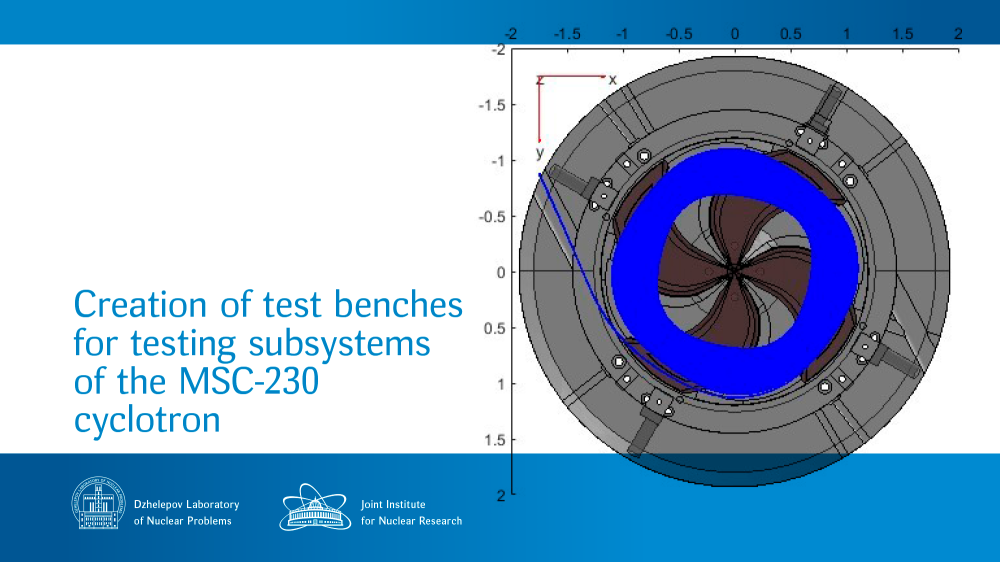
It is necessary to simulate and test prototypes elements of the cyclotron, such as the superconducting coils, the proton source,and the deflector for successful commissioning of the MSC-230.
- The development of MSC-230 superconducting proton cyclotron will create a source of intensive proton beam, opening uppossibilities for modernization of equipment for precise control and high dose rate for Flash therapy method studies. Theresearch in the field of proton radiation therapy, which was carried out for many years on proton beams of Phasotron at DLNPJINR will continue. Due to the planned high intensity of proton beam on the new accelerator it is possible to implement atransition to the so-called Flash therapy. Flash radiation is performed at a high dose rate (40 Gy/s) for a very short time (10-50ms). This radiation method significantly reduces the damage to the healthy tissue surrounding the radiated tumor. There are no proton beam therapy centres in the world that can implement this radiation technique currently.
- The proton cyclotron MSC-230 will implement: the conduction of the broad-spectrum radiobiological studies; improvementof the efficiency of irradiation by protons using the heavy metal nanoparticles; practical challenges of space radiobiology;enhancing radiation protection systems of spacecraft for near-Earth pilot flights; development and calibration of new detectorsfor the space industry; study of effects of ionizing radiation on animal behavior (monkeys, rodents).
- The proton cyclotron MSC-230 will implement of the breakthrough R&D in the field of superconducting magnetictechnologies for accelerators of the future, including technologies based on high-temperature superconductors (HTSC),ultracompact cryogenic supply systems, use artificial intelligence (AI) technologies in the modeling of cyclotrons for appliedpurposes, irradiation planning and radiobiology. To implement artificial intelligence (AI) technologies in the simulation ofcyclotrons for applied purposes, irradiation planning and radiobiology.
Expected results upon completion of the project:
Creation of the medical superconducting cyclotron MSC-230 and infrastructure for radiobiological
research. Radiobiological studies, medical certification of the proton beam and dosimetry equipment.