TARDISS. Protection against physical and chemical stresses with tardigrade proteins
Study of the mechanisms of adaptation of extremophilic organisms to physicochemical stresses and their use to protect other organisms.
Mechanisms of adaptation of living organisms to existence in extreme conditions are of great interest for applied and fundamental research, in particular, mechanisms of resistance to ionizing radiation, high mineralization of the environment, effects of heavy metals, high and low temperatures and high pressure. Under the conditions of an increasing level of radiation background due to various man-made components, the problem of cosmic radiation, which prevents the long stay of living organisms in space, the need to protect healthy tissues from radiation during radiation therapy of tumours, and a number of general mechanisms underlying cell aging and their damage by ionizing radiation, the study of new mechanisms for increasing radioresistance is one of the most important areas of molecular biology and radiobiology.
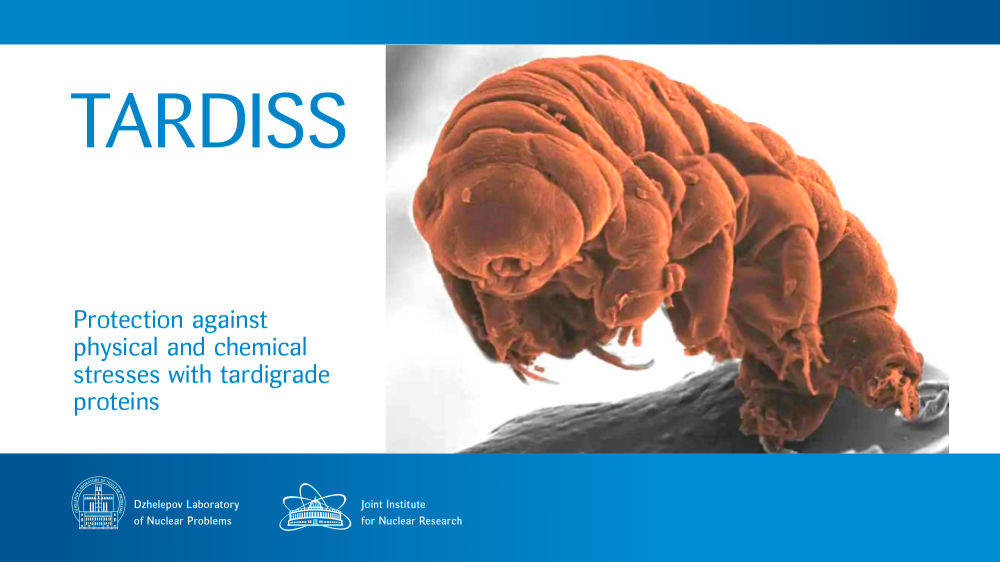
Representatives of Tardigrada (tardigrades) belong to the group of animals most resistant to various types of stress on Earth. Tardigrades are able to survive after exposure to both rare and dense ionizing radiation at doses of about 5 kGy.
The Dsup protein is a new protein discovered in 2016 in the tardigrade Ramazzottius varieornatus, one of the most radioresistant species of multicellular organisms. Previously, we created the D. melanogaster lines and the HEK293 human cell culture expressing this protein, for which a significant increase in radioresistance was shown when exposed to various types of ionizing radiation. For the D. melanogaster lines expressing Dsup, the transcriptomic analysis was performed, which revealed the effect of the Dsup protein on a number of processes at the cellular and organism levels. Our results were published in 2023 in iScience (Q1). In the course of the experiments to determine the structure of the Dsup protein, the physical dimensions of the Dsup protein molecule were estimated for the first time, some parameters of the DNA-Dsup complex were established, and the existence of a possible secondary structure of the Dsup protein was shown.
The problems to be solved during the implementation of the project are new and important not only for fundamental molecular biology and radiobiology but also for applied areas of biotechnology, space research and other disciplines that require an increase in the level of radioresistance of organisms.
Expected results upon completion of the project:
Creation of a regulated scheme for the expression of the gene encoding the Dsup protein in the melanogaster model object to develop a controlled system for the temporary increase in radioresistance of the whole organism.
Evaluation of the effect of the Dsup protein on chromatin compaction in cells to establish the fundamental characteristics of the Dsup protein and map new regulatory elements in the D. melanogaster genome.
Obtaining data on the stability and properties of the Dsup protein during exposure to high temperatures and ionizing radiation to evaluate the use of this protein in pharmacology and medicine as a cryoprotectant, preservative and stabilizer for vaccines and other DNA/RNA-containing drugs, and as a protective agent for radio- and chemotherapy.
Development of a technique and a material for purification of nuсleic acids from solutions and concentrating DNA and RNA from various biological fluids using the Dsup protein.
Obtaining hybrid molecules of Dsup-antitumor drug and development of a system for the effective delivery of hybridmolecules to the cell nucleus.