Development of experimental techniques and applied research with slow monochromatic positron beams (PAS)
Applied research in the field of solids by PAS methods and the development of experimental techniques using these methods are among the goals of the project.
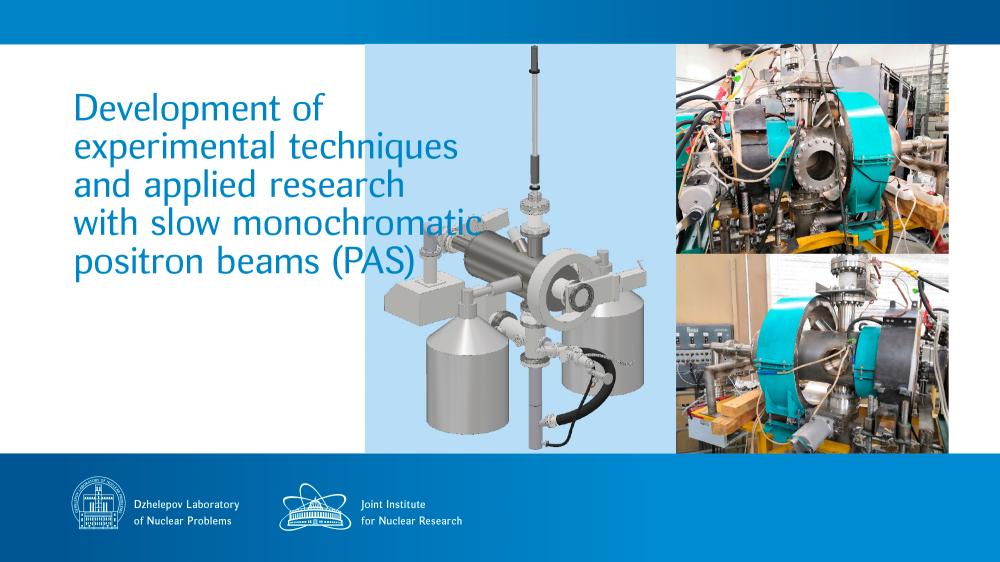
Applied research in the field of solids by PAS methods and the development of experimental techniques using these methods are among the goals of the project. To study defects in materials, the annihilation line Doppler broadening (DBAL) method is used, which is implemented on a flow of slow monochromatic positrons. The DBAL spectrometer is made according to the standard scheme. The Positron Annihilation Lifetime Spectroscopy (PALS) method implemented on an autonomous $^{22}Na$ source is also used. To develop the experimental base, the PALS method is being introduced on a flow of slow monochromatic positrons. The group proposed an original version of this method based on the formation of an ordered stream of slow positrons.
Expected results upon completion of the project:
Improvement of the DBAL spectrometer by adding to the measurement scheme the possibility of registering the coincidence of two annihilation gamma quanta.
Completion of the positron ordering system and commissioning of the PALS spectrometer on a monochromatic positron beam.
Development of the ion etching technique using the created etching system and its application to the study of thin-film multilayer materials.
There is a problem of high-temperature vacuum heating, which can be solved by heating samples with an electron beam. The available technical capabilities make it possible to implement this heating method.