First observation of a $B_{c}^{*+}$ meson
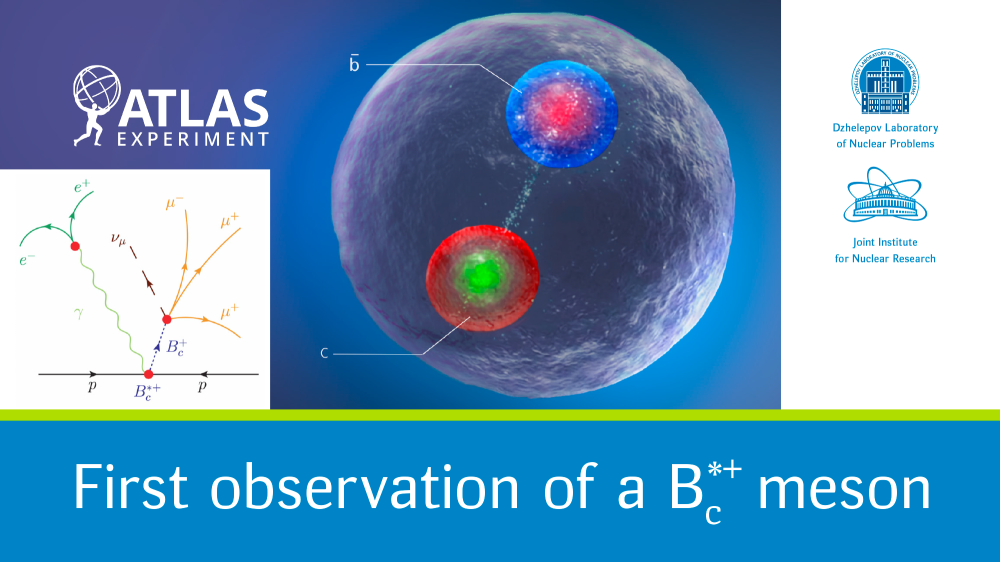
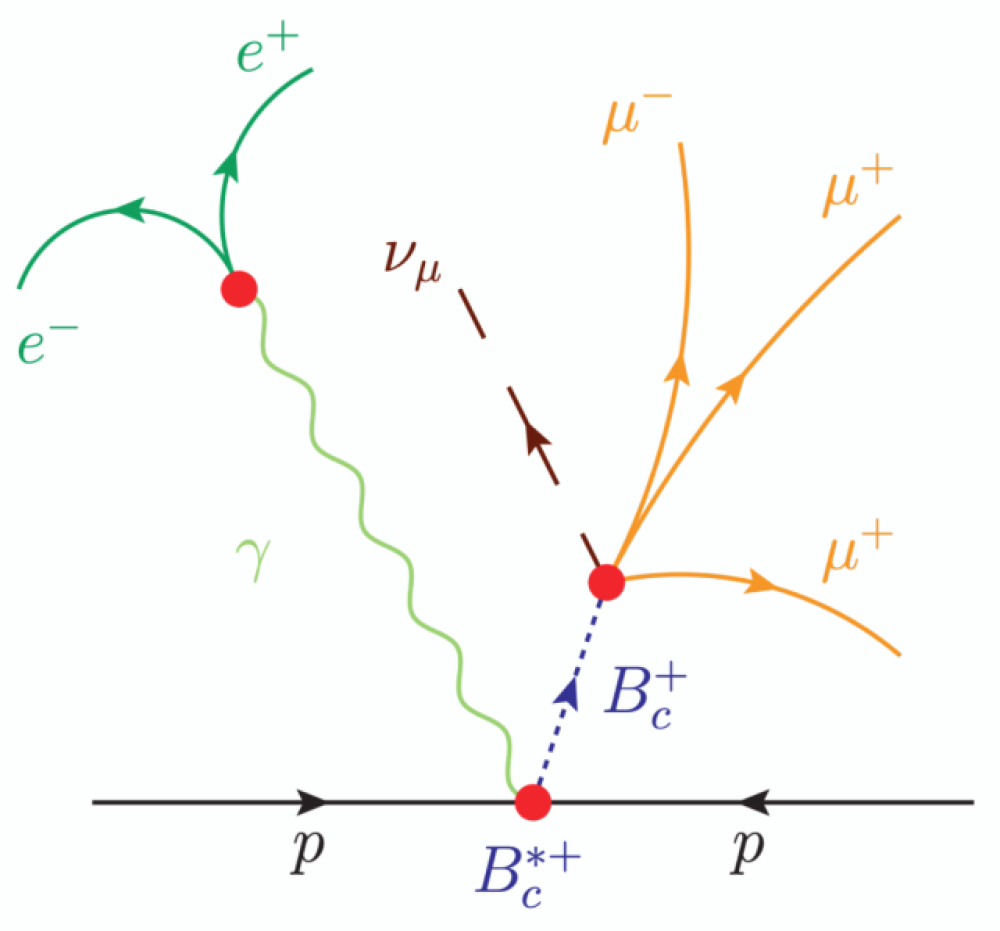
In a new result presented at the Large Hadron Collider Physics 2026 conference, physicists from the ATLAS collaboration reported the first observation of a particle with properties corresponding to the $B_{c}^{*+}$ meson, the lightest excited meson of the $B_{c}^{+}$ meson family. What makes this particle unique? Most known mesons consist of light quarks, but the new $B_{c}^{*+}$ meson is special. It consists of two heavy quarks of different flavors: the bottom antiquark $\overline{b}$ (the second most massive in nature) and the charm quark $c$ (the third most massive particle). Inside this new particle, the quarks rotate around each other. Scientists discovered a state in which the spins (intrinsic angular momenta) of these quarks are codirectional, making the particle a "vector" meson. In the ground state of $B_{c}^{+}$, their spins are oriented oppositely.
Physicists searched for a new particle decaying to its ground state with the emission of a photon. The difficulty lies in the fact that the difference in mass between the ground and excited states of the $B_{c}^{+}$ meson is only about 64.5 MeV. As a result, the photon is produced with an energy that is low for collider physics. "The conventional LHC detectors simply don't notice such a 'soft' photon: it gets lost in the billions of other collision signals. Then scientists from the ATLAS collaboration used a clever trick. Instead of the usual photon detection based on its energy deposition, they reconstructed photons that, on interaction with the detector's material, transform into electron-positron pairs. Using the trajectories of these charged particles in the internal tracker, the scientists were able to reconstruct the energy of the 'invisible' photon," says T.V. Lyubushkina, a researcher at the DLNP Department of Colliding Beams.
In microscopic physics, a discovery is recognized if its statistical significance exceeds 5 standard deviations. The significance of this signal was greater than 8 standard deviations. This means that the probability of error or random fluctuation in the data is negligible.
This discovery provides new valuable information for theoretical models describing the mass spectra of heavy hadrons and helps get a better insight into the strong interaction, the force that binds quarks together and keeps atomic nuclei from disintegrating. A system of two heavy quarks of different flavors is an ideal "natural laboratory". It can be used to test theoretical calculations of quantum chromodynamics (QCD) with unprecedented accuracy.
It should be noted that the work on analyzing the experimental data was carried out with the decisive contribution of staff members from the Dzhelepov Laboratory of Nuclear Problems at JINR, leading researcher L. K. Gladilin and researcher T.V. Lyubushkina, in close cooperation with colleagues from the EventIndex group at MLIT JINR under the leadership of I. N. Aleksandrov.
Science news