

Radiochemistry and spectroscopy for astrophysics and nuclear medicine
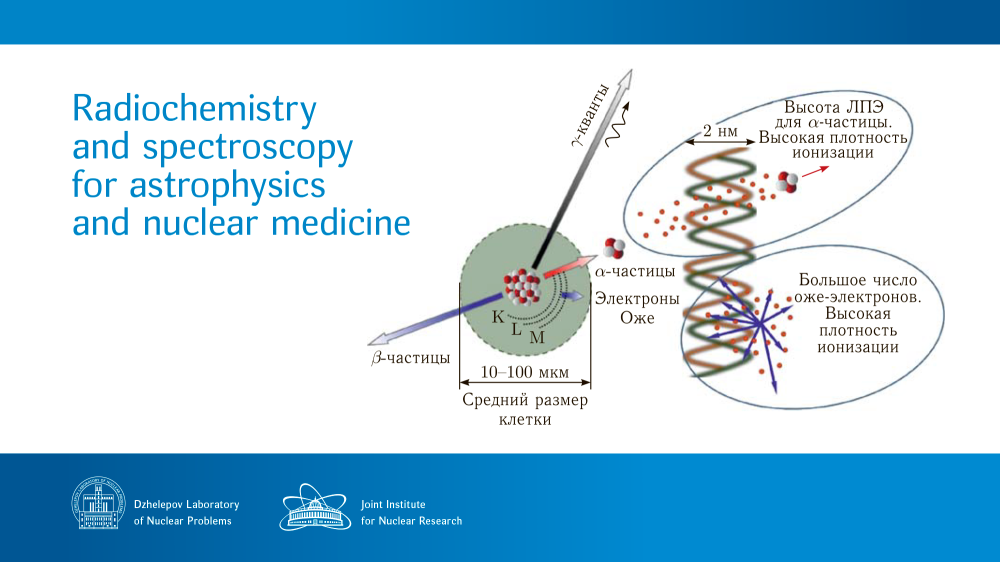
The project is aimed at developing methods of nuclear spectroscopy and radiochemistry for the use in nuclear medicine, astrophysics and neutrino physics. The project involves novel techniques for particle detection, calibration of experimental facilities, determination of background and also the design of uniquely pure materials, etc., as well as development of methods for nuclear medicine – such as production and purification of radioisotopes, development and synthesis of radiopharmaceuticals, study of mechanisms affecting the tissues at radionuclide decay locations, etc.
Specific area:
- novel detectors (semiconductor detectors, liquid and plastic organic scintillators, composite scintillation detection systems, neutron and radon detectors, etc.).
- post-decay spectroscopy of electrons and other emissions, with the focus on extremely low energies.
- standard gamma-spectroscopy based on semiconductor particle detectors (SPDs), with the focus on precision measurements of emission energy and source activity (of both point-like and volume sources) in order to study decay modes and to determine cross sections of nuclear reactions.
- methods of hyperfine interactions using radioactive tracers, namely the Method of Perturbed Angular Correlations (PAC) and Emission Mössbauer Spectroscopy to study radiopharmaceuticals and their precursors in aqueous systems and other matrices.
- methods for production and purification of radionuclide preparations to synthesize radiopharmaceuticals, including their production with generators, physicochemical methods for evaluating properties of radionuclides and radiopharmaceuticals (their precursors) in homogeneous and heterogeneous systems.
- methods and techniques for production and analysis of low-background materials with a uniquely low content of radioactive impurities, in particular, using Inductively Coupled Plasma Mass Spectrometry (ICP-MS), as well as other analytical techniques and those of nuclear spectroscopy.
Methods of nuclear spectroscopy and radiochemistry for studying neutrino properties, searching for dark matter particles and investigating rare physical processes have long and deservedly proved effective in numerous experiments in fundamental physics and nuclear medicine. The relevance of this topic is certain. The focus on the development of methods and techniques expanding the horizon of the experiments being performed at DLNP JINR guarantees the scientific novelty of the project.
Expected results upon completion of the project:
New detectors:
- detectors based on silicon carbide (SiC) will be designed and then applied to the detection of nuclear radiation; SiC detectors with a high radiation hardness and good operability at high temperatures (> 400°C) are intended to be used for monitoring the operation of high-current accelerators, nuclear reactors, as well as for diagnostics of hot plasma;
- liquid tellurium-loaded scintillators are expected to be designed and applied to search for the neutrinoless double β-decay, as well as other types of liquid and plastic scintillators;
- composite scintillation detection systems will be developed for neutrino experiments;
- $^{3}He$ counters will be developed and applied to the detection of low neutron fluxes (of below $10^{-6} n×{см}^{-2}×c$); a compact sensitive radon detector will be designed, as well as the technology to produce low-level radioactive components using 3D printing.
It is planned to experimentally study the spectra of low-energy electrons (0–50 keV) with the ESA-50 spectrometer and the spectra of gamma and X-ray radiation with SPDs during radioactive decay in order to obtain new data on low excited states of nuclei and post-decay relaxation of atomic systems, as well as to search for ways to perform the spectrometry of post-decay photons (from the edge of infrared radiation up to soft X-rays) in the energy range of 1–200 eV.
The method for using the codes (Geant4, MCNP and FLUKA) to simulate parameters of HPGe spectrometers both at the LINAC-200 Electron Accelerator intended to determine yields of photonuclear reactions, and also at other basic facilities of JINR will be developed; decay modes of a wide range of radionuclides will be studied, and their content in samples (${}^{96}Zr, {}^{40}K, {}^{138}La$, etc.) will be determined in order to investigate rare processes.
It is expected that the methods of Perturbed Angular Correlations (PAC) and Emission Mössbauer Spectroscopy using radioactive tracers ${}^{111}In, {}^{152}Eu, {}^{154}Eu, {}^{119}Sb, {}^{119m}Sn, {}^{57}Co, {}^{161}Tb$, etc., will be mastered in order to study radiopharmaceuticals and their precursors (components) in aqueous systems and other matrices; physicochemical methods to evaluate properties of radionuclides and radiopharmaceuticals in homogeneous and heterogeneous systems will be improved.
Radiochemistry and nuclear medicine:
- sorption processes in various solution-sorbent systems as a chemical basis of methods for purification of radiopharmaceuticals (also of low-background materials) are planned to be studied, and radionuclide generators for production of radiopharmaceuticals to be designed;
- methods for production of radionuclides and their separation (including mass separation) from targets irradiated with protons, neutrons and gammas for production of radiopharmaceuticals (${}^{103}Pd, {}^{119}Sb, {}^{161}Tb$, some alpha emitters, etc.) will be developed;
- on the basis of reverse-tandem schemes, the development of a wide range of radionuclide generators will be continued in order to expand the possibilities of producing medical radionuclides; the possibility of producing 1–2 generators of significant activity for external users will be considered;
- methods for radiolabelling based on chelators with "slow" kinetics for synthesis of radiopharmaceuticals will be developed; radium chelation will be investigated.
Methods for producing samples (${}^{82}Se, {}^{96}Zr$, shielding materials, solder, etc.) with a new ultra-low content of impurities (from mBq/kg to μmBq/kg of Th and U) to solve problems in astrophysics and neutrino physics will be developed and employed; reverse chromatography will be used, low-boiling and other reagents, prepared or selected, will be utilized, as well as reactor materials, selected and prepared;
- it is planned that the methods for the analysis of samples at an ultra-low level of sensitivity (mBq/kg – μmBq/kg of Th and U) using ICP-MS, the neutron activation analysis (NAA) and other techniques will be developed and employed; that the methods for precise determination of the chemical and isotopic composition of materials used in astrophysical and neutrino experiments will be designed.