First observation of single beta decay of $^{96}Zr$
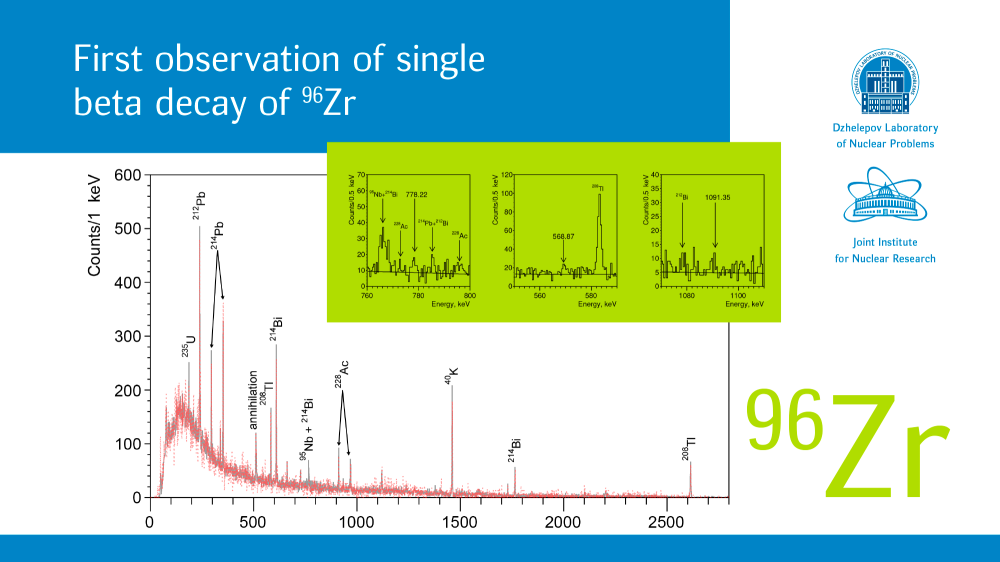
The experiment was carried out at a depth of 4,900 meters of water equivalent in the Baksan Neutrino Observatory of INR RAS. The low-background SNEG facility based on a high-purity germanium detector was used in the experiment the main aim of which was to study the double beta decay of zirconium-96.
The search for neutrinoless double beta decay (0νββ) is one of the most urgent problems in nuclear and particle physics. This decay is a hypothetical process that goes beyond the Standard Model. Its discovery would demonstrate the possibility of lepton number violation, and prove the Majorana nature of neutrinos (i.e., that neutrinos and antineutrinos are identical). Observation of the 0νββ-decay would provide an answer regarding the neutrino mass hierarchy, and place into scientists' hands a crucial key to understanding why there is so much more matter than antimatter in the Universe. Thus, spectroscopic searches for the neutrinoless mode of double beta decay connect nuclear physics with astrophysics and cosmology, representing entirely new and fascinating physics.
Currently, zirconium-96 is the most promising candidate for future experiments on double beta decay. Zirconium-96 (Zr-96) is an unstable isotope of zirconium with an extremely long half-life: approximately one billion times the age of the universe. In natural zirconium, the fraction of Zr-96 is about 2.8%.
The probability of such decay for zirconium-96 (with the same mass of detectors) is almost a hundred times higher than for germanium-76 (another promising nucleus). Moreover, the decay energy of zirconium lies above the upper limit for gamma rays from natural radioactivity.
In 2022, by order of JINR, Rosatom developed a method for enriching zirconium-96 and supplied unique samples of this isotope to Dubna. The samples were studied first at JINR and then at the underground Baksan Neutrino Observatory of the INR RAS.
The first result of these studies was the discovery of the single beta decay that is the rarest in existence. The observed transition occurs even more rarely than the double beta decay of this isotope with the emission of two antineutrinos. It took several years of continuous measurements to confidently declare this discovery. A description of the research and the obtained results have been posted in the electronic archive and will be published in a prestigious physical journal.
Why is the beta decay with the longest half-life, now discovered, of interest? Essentially, this is a study of the laws of the universe. The decay process is very rare because the initial and final states differ quite significantly. At the same time the transition between the states nevertheless occurs and agrees well with theoretical predictions. It means that our explanation of the laws of nature still works, even over timescales vastly exceeding the age of the Universe. The data obtained will allow for more reliable interpretation of the results of the searches for the neutrinoless double beta decay.
The scientists' plans include searching for double beta decay to excited states of molybdenum-96, creating specialized detectors that would allow studying its double beta decay to the ground state with greater precision and searching for the 0νββ-decay.
Currently, JINR is implementing one of the world's leading programs in neutrino research. The presented experimental discovery of the longest-lived beta decay once again confirms the high standard of research conducted at the institute.


Science news