Nature cover: First JUNO results set a new precision level in neutrino physics
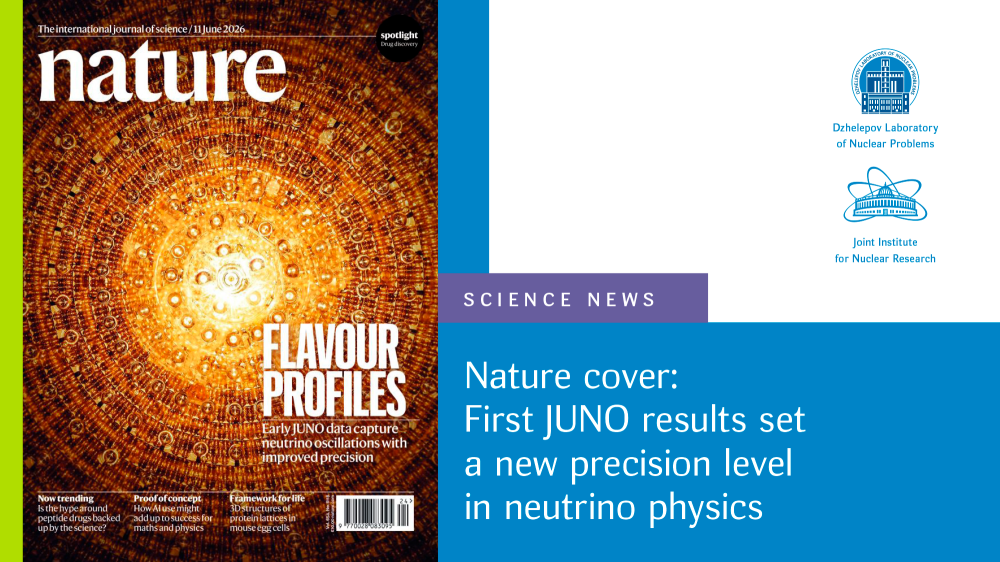
The JUNO collaboration started data acquisition in August 2025. Almost 60 days of operation demonstrated that the detector is operating at its designed characteristics and can measure neutrino oscillations with a record precision. For ten years of the JUNO experiment preparation a team of 50 physicists and engineers from JINR have been participated in planning, developing and assembling detectors and electronics, in creation and development of the computer centre (one of three in Europe), in development and implementation of event selection and reconstruction algorithms, and in statistical analysis.
Neutrinos are among the lightest and most weakly interacting fundamental particles. They pass through matter almost freely, making their properties extremely difficult to measure. The primary tool of the JUNO experiment is the precision measurement of reactor antineutrino oscillations. Oscillations are a quantum phenomenon in which neutrinos change their flavor as they propagate. By analyzing the characteristic shape of the antineutrino energy spectrum, it is possible to reconstruct the parameters of these transitions and approach closer to determining the neutrino mass ordering.
The JUNO detector is located in China, at a depth of about 700 meters underground. Its central component is a gigantic spherical tank filled with 20,000 tons of liquid scintillator. When an antineutrino interacts with the detector substance, a tiny flash of light occurs. It is captured by tens of thousands of photosensors, allowing the neutrino energy to be reconstructed with high precision.
JUNO's first data have already provided the most precise neutrino energy measurement to date: the energy resolution is approximately 3% at 1 MeV. This meets the project’s design goal and is a fundamental prerequisite for solving JUNO's primary task: determining the neutrino mass ordering.
Furthermore, JUNO has, for the first time, performed a simultaneous, high-precision measurement of two key neutrino oscillation parameters. Despite the relatively small amount of the data obtained, the errors of these parameters were reduced by about a factor of 1.6 compared to the combined results of experiments from previous decades.
The publication of JUNO's first results in Nature, along with a photograph of the detector on the cover of this issue, marks a significant milestone: the experiment has not just begun operating but has already demonstrated its capability to perform world-class measurements. As more statistics are accumulated, JUNO will be able to test the three-flavor theory of neutrino oscillations with unprecedented precision, get closer to solving the neutrino mass ordering problem, and potentially point to manifestations of new physics.
"Having been involved in the JUNO project since the very first day, JINR has made a significant contribution to the construction of the facility and the preparation for measurements," says Dr. Dmitry Naumov, leader of the JUNO group at JINR.
"At present, our institute is actively engaged in data analysis and physical interpretation, continuing the traditions of neutrino research established in Dubna many years ago," notes Maxim Gonchar, candidate of sciences (physics and mathematics), deputy leader of the JUNO group at JINR.
“It is also remarkable that throughout the preparation and operation of the experiment, our team has gained invaluable experience in constructing the experimental facility, analyzing data, and working within a large international collaboration. This experience will certainly prove beneficial for the Laboratory's future projects,” added Nikolai Anfimov, deputy leader of the JUNO group at JINR, candidate of sciences (physics and mathematics).
Article: JUNO’s first data advance neutrino physics, Nature, 10 June 2026.
https://www.nature.com/articles/s41586-026-10538-z
Science news