The 2026 Breakthrough Prize in Fundamental Physics has been awarded to the Muon g-2 collaboration
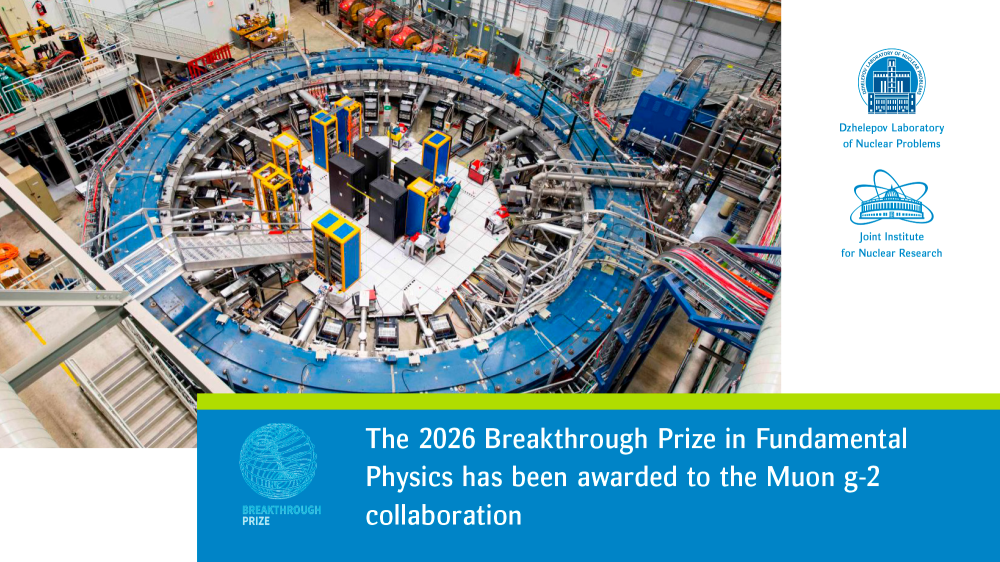
The 2026 prize was awarded for the whole series of studies of the muon anomalous magnetic moment, conducted over more than 60 years at three leading research centers: the European Organization for Nuclear Research (CERN) and two national laboratories of the U.S. Department of Energy – Brookhaven National Laboratory (BNL) and Fermi National Accelerator Laboratory (Fermilab). The $3 million prize will be divided among the living co-authors of publications presenting the results of experiments at CERN, BNL, and Fermilab. In total, more than 380 physicists have been awarded the prize.
A group of scientists from the JINR Laboratory of Nuclear Problems, who are the members of the Muon g-2 collaboration at Fermilab (V. A. Baranov, V. P. Volnykh, V. N. Duginov, V. A. Krylov, N. A. Kuchinsky, N. V. Khomutov), participated in the creation of a prototype of the track detector and in the development of a data collection and visualization system.
The anomalous magnetic moment of the muon, $a_{\mu} = (g-2)/2$ (where $g$ is the gyromagnetic ratio of the muon), is the difference between the observed muon magnetic moment and Dirac's quantum mechanical prediction ($g = 2$). The non-zero value of $a_{\mu}$ is due to the contribution of various virtual particles in the physical vacuum. Therefore, accurately measuring the muon's anomalous magnetic moment is crucial for the search for new physics beyond the Standard Model (SM).
For the reference
The Breakthrough Prize is sponsored by Sergey Brin, Priscilla Chan and Mark Zuckerberg, Pony Ma, Jack Ma, Yuri and Julia Milner, and Anne Wojcicki. Selection committees, that comprise past Breakthrough Prize laureates, are responsible for selecting the winners from the list of nominations received. Each award carries a cash prize of $3 million. The Breakthrough Prize, also known as the "Oscars of Science", hosts an annual awards ceremony to recognize the outstanding achievements of the laureates, attract additional support for scientific endeavors, and inspire the next generation of scientists.
Science news