RUS | ENG
Joint Institute for Nuclear Research
11.11.2026
11:00 - 13:00
Конференц-зал ЛЯП
Радиотерапия нейродегенеративных заболеваний: реалии и перспективы
Кохан В. С.
Общелабораторный семинар

На семинаре будут представлены результаты исследования влияния комбинированного ионизирующего излучения (γ-квантов и высокоэнергетических ядер 12С) на течение нейродегенеративного процесса. Эксперименты выполнены на трансгенной модели, воспроизводящей патофизиологическую и клиническую картину тяжёлых таупатий, – мышах линии Tau P301S. Будут рассмотрены не только поведенческие эффекты, вызванные радиацией, на ранних и поздних стадиях патологии, но и сопутствующие биохимические и молекулярные изменения. Кроме того, будут предложены рабочие гипотезы, объясняющие механизмы наблюдаемого нейропротекторного эффекта комбинированной радиотерапии. В ходе дискуссии участники смогут обсудить перспективы использования полученных результатов и потенциал лучевой терапии как физического инструмента в патогенетическом лечении тяжелых нейродегенеративных заболеваний ЦНС.

Подключиться к конференции Zoom

Идентификатор конференции: 499 697 5981 
Если вы запланировали провести онлайн-семинар...

Шаг 1. Заранее согласуйте его дату и время проведения с руководителем семинара.

Шаг 2. Сообщите Елене Дубовик не менее чем за неделю следующую информацию и предоставьте  материалы (dubovik@jinr.ru):

  • Ф.И.О. выступающего,
  • название семинара,
  • аннотацию к семинару на русском и английском языках,
  • несколько изображений или скринов презентации для анонса в соцсетях.

Презентация должна быть в соотношении 9:16. Мы рекомендуем присылать презентации заранее. Они обычно размещаются на странице семинара. Любой из слушателей всегда сможет при необходимости открыть и полистать слайды. Это удобно, когда подводит качество связи и можно упустить что-то важное, а также когда слушателю необходимо вернуться на один из предыдущих слайдов для уточнения каких-либо данных.

Обратите, пожалуйста, внимание на то, что специально для Лаборатории были разработаны разнообразные шаблоны для презентаций. Единое стилевое решение с использованием логотипа Лаборатории, ее цветов и шрифта могут помочь вам при оформлении презентаций. Шаблоны можно скачать здесь, предварительно авторизовавшись.

Не забудьте сжать вашу презентацию, это можно сделать при сохранении файла или с помощью онлайн сервиса, например, https://www.ilovepdf.com/ru/compress_pdf Сжатие не влияет на качество презентации, но влияет на размер файла.

Документы:

Распоряжение №116 от 25.12.2023
11.11.2026
12.11.2026
15:00
Научно-технический совет

Seminars

02.09.2026
A calibration stand for calibrating Hall sensors was created. A magnetic measurement stand was modernized. The magnetic measurement system developed at CAS Ion Medical and Technical Devices Co., Ltd. (Hefei, China) for measuring magnetic field maps at the MSC-230 isochronous cyclotron was tested.
26.06.2026
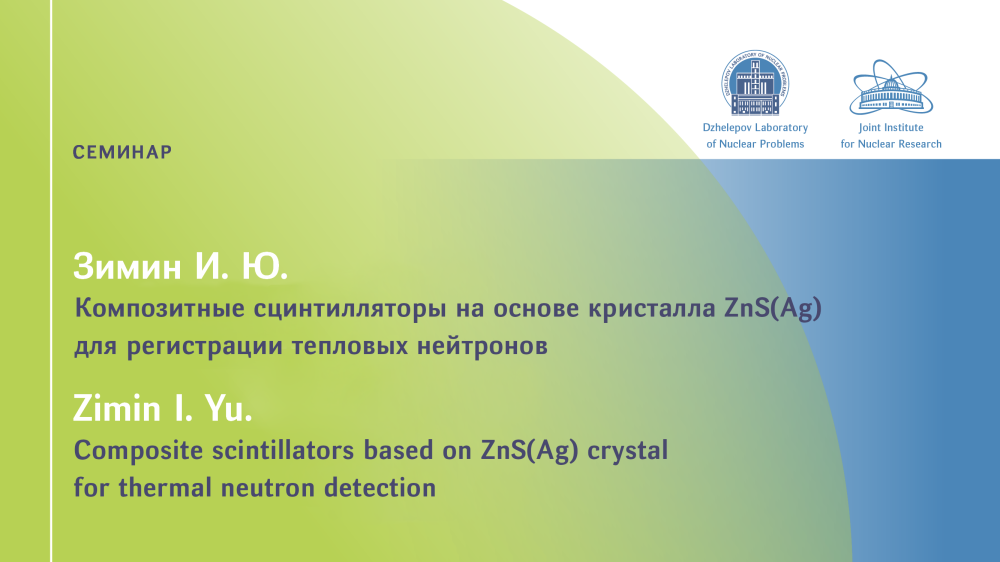
Results of a comparative study of two heterogeneous neutron scintillators based on ZnS(Ag) crystals, each differing in the material used for neutron conversion are presented.
26.06.2026
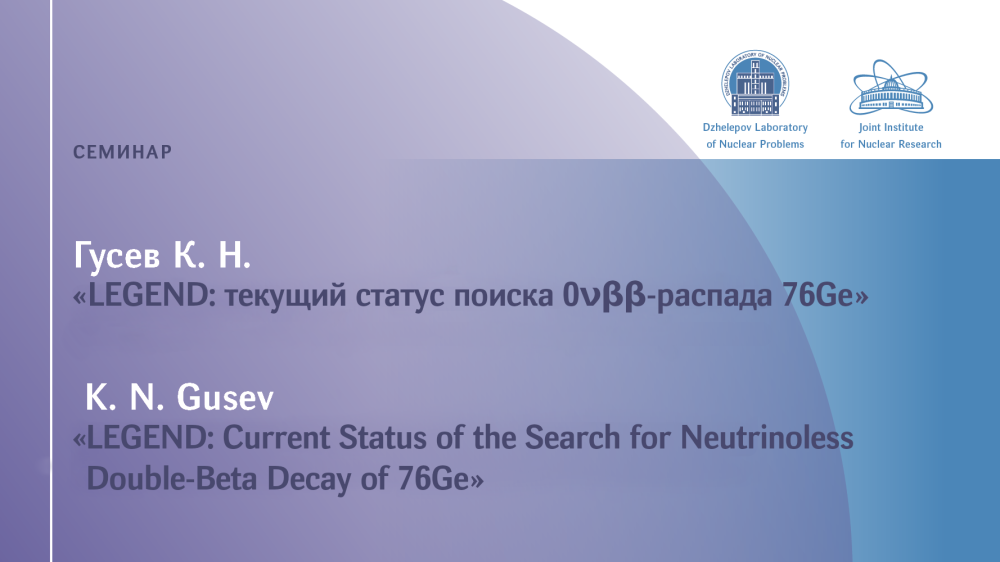
Thanks to the excellent energy resolution of germanium detectors, which serve both as the source and detector of the decay, LEGEND has the highest discovery potential for neutrinoless double-beta decay among current and planned experiments. Both phases of the project, LEGEND-200 and LEGEND-1000, are located at the LNGS underground laboratory in Italy.
25.06.2026
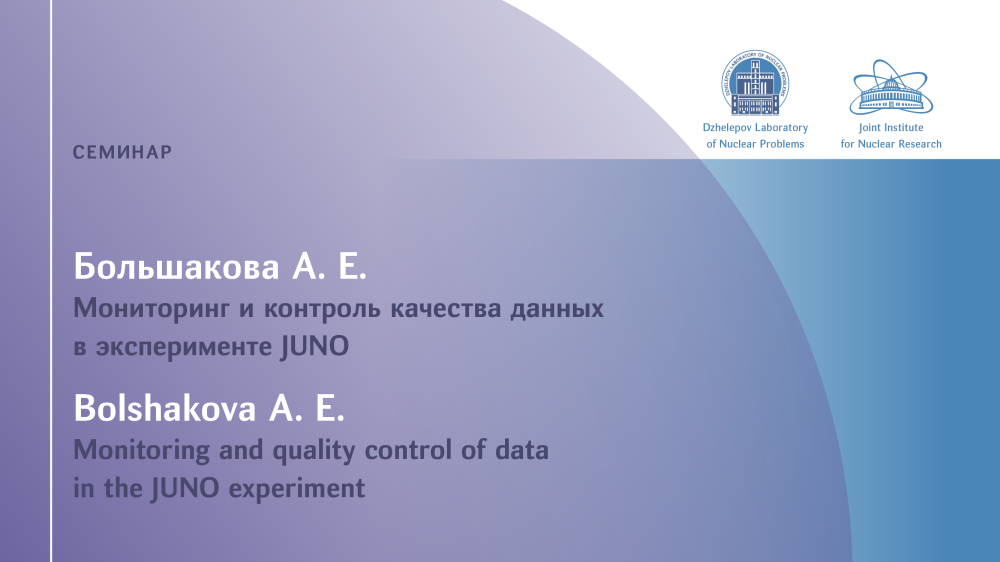
To obtain a more accurate definition of the hierarchy of neutrino masses, the JUNO experiment needs a high energy resolution, which directly depends on the degree of coverage by photomultipliers and their technical characteristics.
19.06.2026
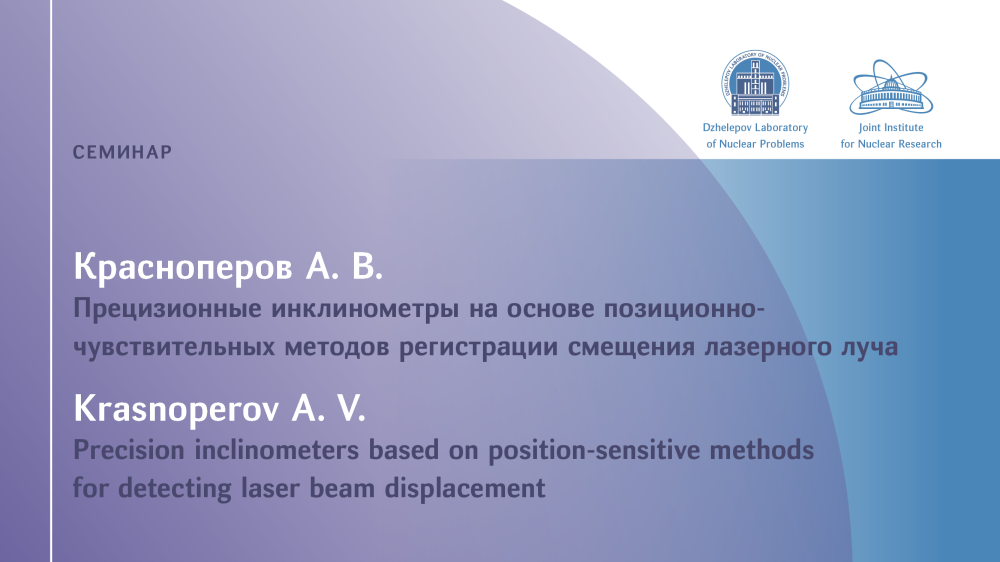
The operation of the Precision Laser Inclinometer (PLI) is based on recording the reflection of a laser beam from a horizontal liquid surface perpendicular to the gravitational acceleration vector. Measuring the spatial displacements of the reflected beam allows for a high-precision estimation of the angular oscillations of the surface on which the PLI is installed.
18.06.2026
The experimental high energy physics in India was initiated by Dr. Homi Jahangir Bhabha (who is known for the Bhabha scattering) using the balloon flights as well as GM counters in commercial flights.
27.05.2026
The hypothesis of isospin symmetry breaking in pp and AA collisions during K-meson production was discussed, which assumes the equality of the cross sections of charged and neutral kaons.
13.05.2026
Dark matter and neutrinos are elusive neutral matter filling up our Universe. A global scientific endeavor, located in deep underground laboratories, aims to uncover dark matter particles and elucidate the fundamental nature of neutrinos.
23.04.2026
On the seminar the contribution of intrinsic energy resolution (IR) to the total scintillation linewidth for liquid argon (LAr) detectors is estimated. A complete statistical model of the scintillation process is used, accounting for LAr-specific characteristics. This model establishes the fundamental limits of the energy resolution for large-scale LAr detectors used in particle physics experiments.
22.04.2026
The report presents the results of a study of two-particle Bose-Einstein correlations in proton-proton collisions at energies 0.9, 7 and 13 TeV in the ATLAS experiment at the LHC. The Bose-Einstein correlation parameters characterizing the source radius and correlation strength are investigated depending on the multiplicity of charged particles (up to 300) and the average transverse momentum of a pair of particles (up to 1.5 GeV).
15.04.2026
Firmly established in astrophysical observations, dark matter evades direct detection in experiments. Axions and axion-like particles as well as dark photons are among the leading dark-matter candidates, and numerous attempts to detect them in laboratories have been performed.
14.04.2026
TAIGA (Tunka Advanced Instrument for cosmic rays and Gamma Astronomy) is an observatory located in the Tunka valley (Buryatia, Russia), near Lake Baikal. It is a hybrid detector complex designed to study the most extreme phenomena in the Universe by detecting ultra-high-energy cosmic rays, primarily gamma rays in the range from ~1 TeV to several PeV.