Francis Halzen wins 2026 Nobel Prize in Physics
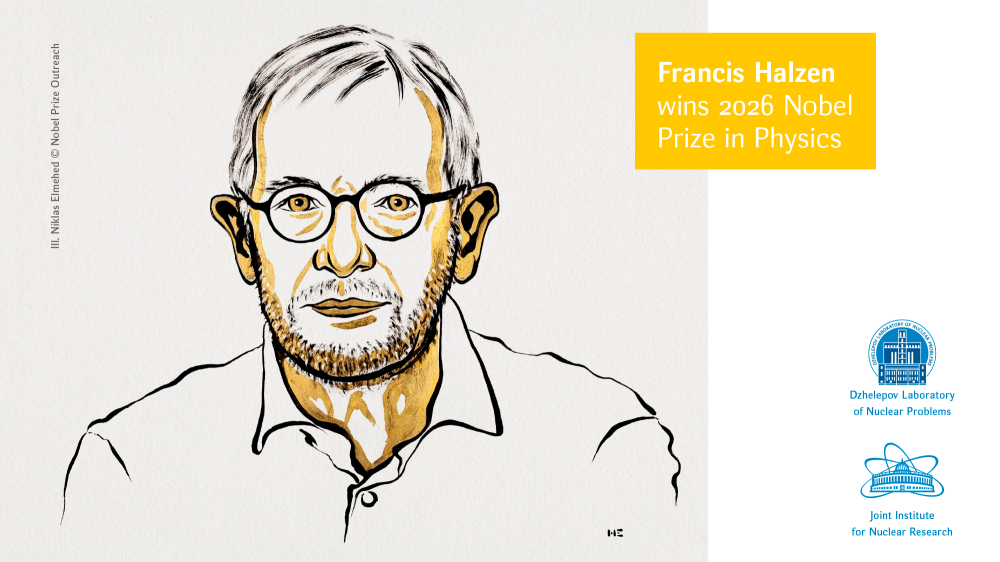
According to the communique of the Nobel Committee, Francis Halzen has laid the foundation for an entirely new type of astronomy. His idea was to use glacial ice at the South Pole to capture the secretive particles called neutrinos. The result was the IceCube Neutrino Observatory, which can track neutrinos that originate in the distant cosmos.
It is worth noting that in 2018, Francis Halzen received the Pontecorvo Prize “for significant contribution to the IceCube detector construction and experimental discovery of ultrahigh-energy astrophysical neutrinos”.
During the operation of the IceCube observatory, key discoveries were made that changed the understanding of high-energy astrophysics.
In 2013, for the first time, the IceCube collaboration detected a high-energy neutrino flux of astrophysical origin. The analysis of ten years of data allowed scientists to observe a precise peak in the neutrino energy spectrum at 30 TeV. Instead of decreasing in intensity with increasing energy, as previously assumed, researchers noticed that the neutrino flux reaches a peak and then decreases. This spectral kink indicates that neutrinos are produced as a result of several different astrophysical processes and sources, rather than a single mechanism.
IceCube managed to link some of the neutrinos detected with specific cosmic objects:
- The NGC 1068 galaxy. One of the brightest neutrino point sources in the Northern Hemisphere. The signal originates from the region where a supermassive black hole is located in the centre of the active galaxy, confirming the theory that such objects are powerful particle accelerators.
- Blazar TXS 0506+056. In 2017, IceCube detected high-energy neutrinos that came from the direction of this blazar, marking the first identification of the source with a specific astrophysical object.
Although high-energy neutrinos generally come from other galaxies, IceCube helped to make the first map of neutrino glow of our own Galaxy, the Milky Way. This discovery confirmed the prediction that neutrinos are produced as a result of cosmic rays interacting with interstellar gas.
In addition to astrophysics, IceCube made a contribution to particle physics:
- Tau neutrinos of astrophysical origin. The existence of high-energy tau neutrinos of astrophysical origin was confirmed, which may be regarded as evidence of neutrino oscillations over cosmological distances.
- Glashow resonance. Scientists detected a rare interaction between an electron antineutrino and an electron, the so-called Glashow resonance. This resonance gives information about the properties of the weak interaction.
The discoveries transformed neutrino astronomy into a full-fledged channel for observing the Universe that takes its place alongside optical telescopes, radio telescopes, and gravitational-wave detectors.
Science news