Data acquisition starts at the JUNO experiment
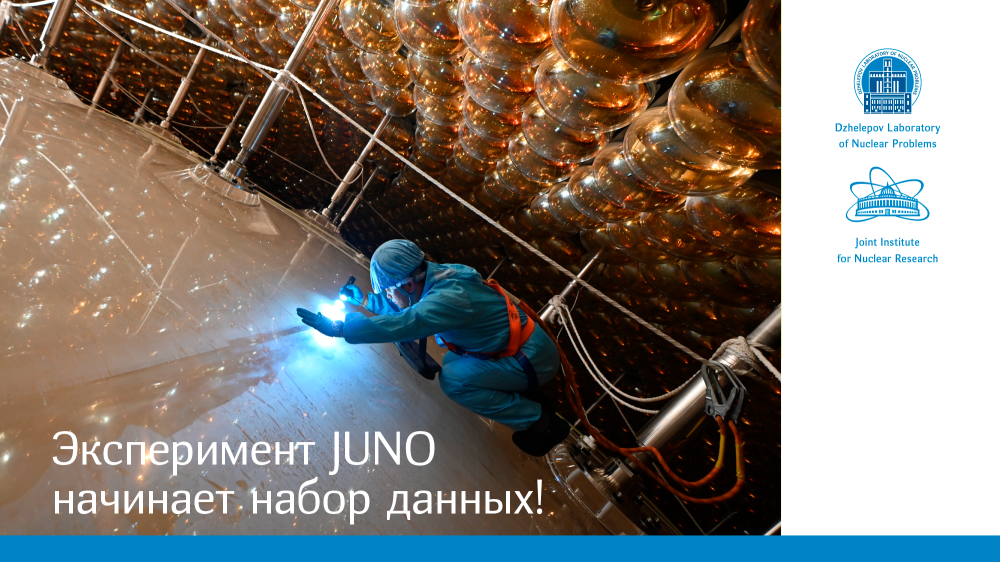
Construction of the Jiangmen Underground Neutrino Observatory (JUNO) has been finished in China, 150 km west to Hong Kong. It is the world largest experiment of this kind and the first to start acquiring data among the new generation of experiments. The JUNO experimental hall is protected from cosmic muons by 700 m of rock formation. The detector, filled with 20 thousand tonnes of liquid scintillator, uses 20 thousand twenty-inch photomultipliers and about 25 thousand three-inch ones for detecting interaction of antineutrinos radiated by high-powered reactor complex. The mean distance between JUNO reactors and detectors is about 53 km that provides maximum experiment sensitivity to determination of the neutrino mass hierarchy, the core objective of the collaboration. JUNO together with more than 700 scientists from 17 countries will study neutrinos from supernovae, Sun, and Earth, discovering the new horizons of fundamental physics.
On 26 August 2025, the Jiangmen Undeground Neutrino Observatory completed filling the central detector with 20 thousand tonnes of liquid scintillator and started the detection of physical events. Preliminary test data acquisition showed that main characteristics of the detector operation correspond to project expectations and exceed them. It will allow JUNO to solve one of the most important problems of the modern particle physics, that is to determine neutrino mass hierarchy, whether the third state (ν₃) is heavier than the second one (ν₂).
The researcher from the Institute of High Energy Physics of the Chinese Academy of Sciences, head of JUNO Professor Yifang Wang noticed: "Completion of JUNO's detector filling and the start of data collection is a historic milestone. For the first time in the world, a detector of such scale and precision, specifically designed to study neutrinos, has been launched. JUNO will allow answering the most fundamental questions about nature of the Universe and matter."
Unlike other experiments that determine neutrino mass hierarchy, JUNO does not rely on the effects of neutrino spreading in the Earth's substance and it is mostly free from uncertainties connected with that. Apart from that, JUNO will raise 10 times the accuracy of determining fundamental parameters of the Standard Model lepton sector and will become a key instrument in studies of neutrinos from supernovae, Sun, and Earth and also in search for sterile neutrinos and proton decay.
The JUNO head engineer, doctor Xiaoyan Ma pointed out: "The JUNO construction turned out to be a very difficult task. It required not only new ideas and technologies but many years of thorough planning, testing, and persistence. Strict requirements for purity, stability, and safety were successfully met thanks to devoted work of hundreds of engineers and technicians. Their teamwork and dedication transformed a bold project into the operating detector ready to open a window into a world of neutrinos."
JUNO is designed up to 30 years of scientific operation with the potential to be upgraded to become the world's leading experiment in the search for neutrinoless double beta decay. This upgrade will allow studying absolute scale of neutrino masses and checking whether the neutrino is one of the Majorana particles. It includes fundamental problems at the nexus of particle physics, astrophysics, and cosmology and may radically change our understanding of the Universe.
"The outstanding event we have achieved today became possible thanks to fruitful international cooperation in which many research groups outside China contributed to JUNO by bringing their expertise from the previous liquid scintillator experiments. “The global community of liquid scintillator experts has pushed this technology to its limits, opening the way to the experiment’s ambitious physical goals,” said Professor Gioacchino Ranucci, Deputy Director of JUNO and Professor at the University of Milan and INFN Milan.
"Photomultipliers are the eyes of the detector. Photomultipliers (PMTs) with a record-breaking sensitivity to light detection are used in JUNO. JINR staff members developed and applied a unique methods of their studying and testing. Our staff members developed and put into operation the supply system for the large and small PMTs, and muon veto-detector. They also made a significant contribution to the development and creation of the TAO detector and in assembling many other systems of the experiment," says Nikolai Anfimov, Candidate of Sciences (Physics and Mathematics), Deputy Head of the JUNO Project at JINR.
"We also created a computing center in Dubna for data storage, modeling, reconstruction, and analysis. Our group is actively participating in the analysis of the JUNO experimental data. Now all the efforts are devoted to researching oscillations of reactor antineutrinos observed in our detector," added Maxim Gonchar, Candidate of Sciences (Physics and Mathematics), Deputy Head of the JUNO Project at JINR.
Doctor of Sciences (Physics and Mathematics), head of the JUNO Project at JINR Dmitry Naumov pointed out, "JUNO is the result of real international efforts, and JINR has been involved in this project from the very beginning. Our team made a contribution to some key elements of the project. Apart from our institute there are two other groups from Russia involved: Skobeltsyn Institute of Nuclear Physics of Lomonosov Moscow State University and Institute for Nuclear Research of the Russian Academy of Sciences. Working together with colleagues from China and other countries was both challenge and honor. It is a pleasure to see that all efforts paid off in the detector which will serve science for decades."
For the reference
The experiment was suggested at 2008 and was supported by the Chinese Academy of Sciences and Guangdong province in 2013. Construction of the underground laboratory started in 2015. Installation of the detector was started in December 2021 and completed in December 2024 and then gradual process of filling began. Over 45 days, the team poured 60 thousand tonnes of ultrapure water, keeping the difference in liquid levels inside and outside the acrylic sphere within a few centimeters and maintaining a flow rate accuracy of better than 0.5%, ensuring the structural integrity of the detector. During next six months the acrylic sphere with a diameter of 35.4 m was filled with 20 tonnes of liquid scintillator while water was displaced. At the same time, strict requirements for purity and transparency were met together with achieving extremely low radioactivity of water and scintillators. In parallel, work was carried out on calibrating, commissioning and optimizing the detector, which made it possible to immediately move to full-fledged work upon completion of filling. The acrylic sphere with a liquid scintillator is viewed by 20 thousand 20-inch and more than 25 thousand 3-inch photomultipliers. All photomultipliers work simultaneously detecting scintillation light from neutrino interactions and transforming it to electrical signals. The acrylic sphere together with read-out electronics, cables, and coils for magnetic field compensation is supported by a stainless steel framework.
Photo provided by the JUNO collaboration
Science news