Metagenomic study has revealed a unique transitional ecosystem in an underground spring of the Baksan Neutrino Observatory
The deep biosphere, whose biomass is estimated at $12–20\%$ of the global total, comparable to the biomass of all forests or marine ecosystems, remains one of the least studied ecosystems on Earth. It is primarily inhabited by microorganisms, bacteria and archaea, the vast majority of which (over $99\%$) cannot be cultivated in the laboratory, leading scientists to metaphorically call it the "dark matter of the biological universe". Each new study of such ecosystems, especially those forming at the boundary between anoxic and oxic biosphere, makes an important contribution to understanding the biogeochemical processes occurring in the lithosphere.
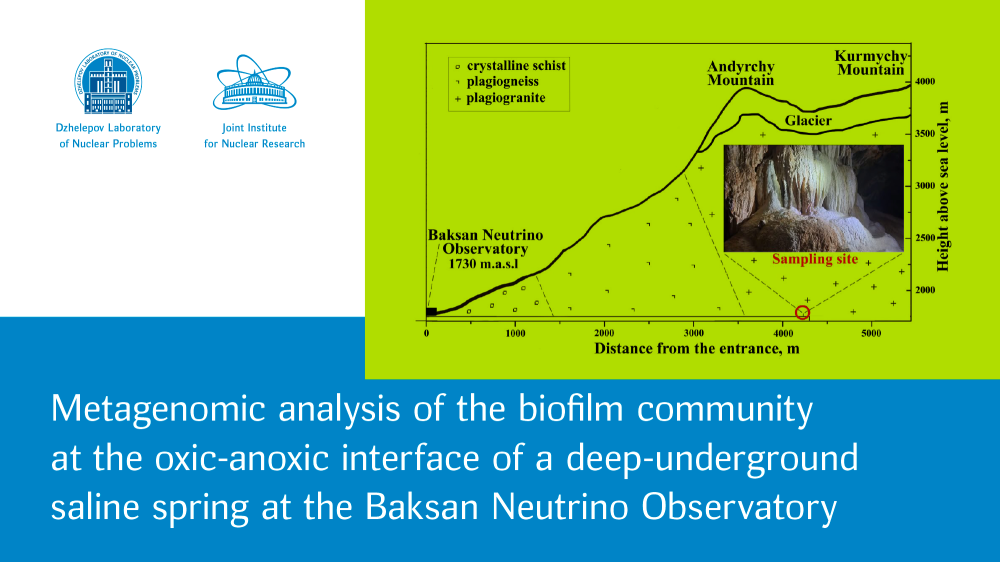
Scientists from the DLNP Sector of Molecular Genetics of the Cell and the Baksan Neutrino Observatory (BNO INR RAS) have conducted research at a unique site: a hydrothermal underground spring located in a distant, unused part of the tunnel of the BNO INR RAS (village ofNeutrino, Kabardino-Balkaria, Russia). The spring formed at a depth of about 2 km at the point of contact between deep anaerobic waters, saturated with volcanic gases from the peripheral magma chamber of Mount Elbrus, and atmospheric air. Metagenomic sequencing was used to study the spring's microbial community. Unlike traditional microbiological methods that require cultivating microorganisms in the laboratory (which is impossible for the vast majority of natural communities), this approach allows studying the genetic material of all organisms directly in a sample collected at the research site.
Using metagenomic sequencing of the biofilm found in the spring, 19 metagenome-assembled genomes (MAGs) belonging to various bacterial groups were obtained. Reconstruction of metabolic pathways showed that the microbial community of the BNO spring demonstrates high metabolic diversity, with key processes linked to the transformation of compounds originating from the magma chamber: organisms capable of utilizing energy from the oxidation of hydrogen, methane, ammonia, and ferrous iron dominate the community. The biofilm also contains both aerobic organisms and groups of bacteria carrying out anaerobic processes, indicating the existence of zones with and without oxygen access. Interestingly, predatory cyanobacteria that feed on other bacteria were found within the bacterial community. A comparative analysis with metagenomes from communities in deep granite formations (anaerobic conditions) and karst caves (aerobic conditions) showed that the BNO spring community is unique due to its specific geochemical conditions (constant flow of reduced substrates of volcanic origin + O₂ access + neutral pH of the spring water).
This study characterizes, for the first time, the structure and functioning of a microbial community at the boundary between the deep underground and the surface biosphere.
"The obtained data describe a new type of biological community and offer a model for studying microbial colonization in transition zones where inhabitants of two different ecosystems meet", says Elena Vladimirovna Kravchenko, candidate of sciences (physics and mathematics), head of the DLNP Sector of Molecular Genetics of the Cell.
Based on the classification of the metagenome-assembled genomes, six new bacterial genera were identified, for which candidate names have been proposed: Candidatus Neutrinobacter, Candidatus Jinrextremum, Candidatus Inralta, Candidatus Jinrbaksania, Candidatus Neutrinellum, and Candidatus Inrsubterrania.
The etymology of the names reflects the location of the research (village of Neutrino, Baksan Neutrino Observatory) and the names of the institutions involved in the work, combined with key characteristics of the studied microbial community's habitat.
The study was supported by the Russian Science Foundation (Project No. 24-24-00003).
Article: https://journals.asm.org/doi/10.1128/spectrum.02103-25
Science news