Scientists speak about the advantages of the Baikal deep underwater telescope
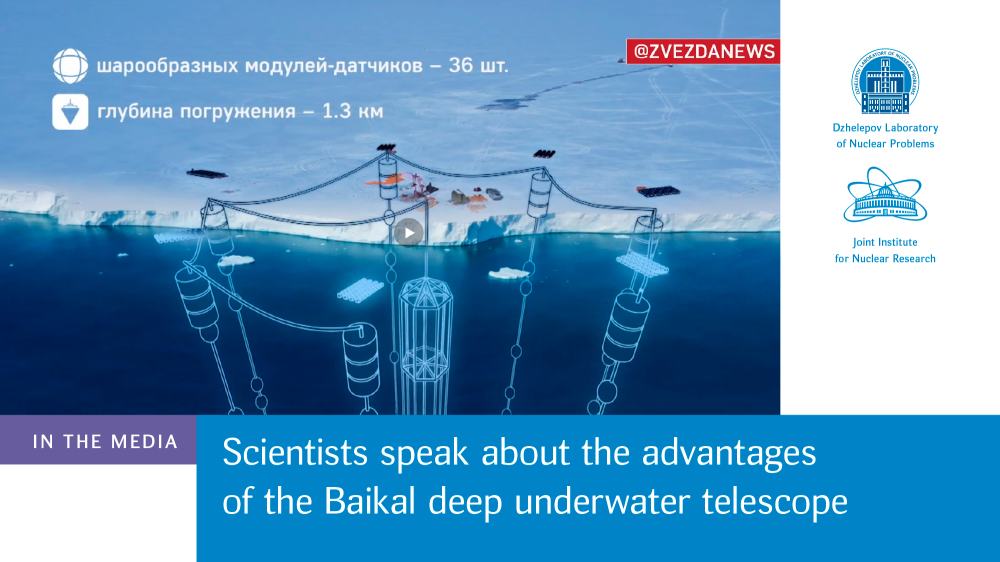
The world's largest deep underwater neutrino telescope, costing 30 billion rubles, will be installed on the bottom of Lake Baikal to see through the entire planet. While the ice is strong – and that's only for two months, February and March – they need to assemble the already finished elements of the telescope and submerge new ones underwater. At the very beginning of the expedition, a cable is laid: it will power the parts of the installation and transmit the received data to the shore center.
"There is a special machine that cuts the ice with a cutter 1.20 meters in diameter. It's attached to a tractor, and behind it a winch with a cable, with about seven kilometers wound on it, follows along," explained Igor Belolaptikov, Deputy Head of the Baikal-GVD expedition.
On the shore, there are monitors that analyze the information received via the cable. The main goal is to detect neutrinos – fundamental particles. The telescope can trace their path and identify natural accelerators, cosmic objects like black holes or active galactic nuclei that generate elusive particles at energies unattainable on Earth.
It turns out that the depth of Lake Baikal can stop neutrinos. Despite their high energy, some of them, as it were, stumble upon molecules of the fresh water and produce flashes of light, which the telescope then detects.
"This was the main task of the first generation of the detector. We used the Earth as a filter, looking at particles coming from the opposite side of the Earth. They came to us from space, passed straight through the Earth, and somewhere in the last kilometers of the detector, some of them triggered. We saw that the particle was coming from below; that could only be a neutrino," assured Konstantin Konishchev, a researcher at JINR.
Neutrinos are detected by optical modules. They consist of two glass hemispheres. In the lower one is a photomultiplier, shielded from the Earth's magnetic field. In the upper one is the electronics that receive the signal, process it, and transmit it to the shore.
"This glass withstands pressure of hundreds of atmospheres; inside, the pressure is slightly below atmospheric. We submerge them, and the lake depth is up to 1,360 meters, but actually, they could be lowered even deeper; the glass would withstand it," promised Dmitry Zaborov, senior researcher at INR RAS.
Over the past 10 years, the Baikal Neutrino Telescope collaboration has brought together more than 80 researchers from five countries. Among them are Chinese specialists. In the unfamiliar freezing conditions, they spend as much time on the ice as their Russian colleagues.
"Lake Baikal is the deepest in the world. China also has a neutrino telescope in the Tibetan mountains, but here on Baikal, the conditions are completely different. It seems to me this is the most suitable place for our experiments," believes Yu Xiaohao, Research Assistant for the Baikal-GVD expedition.
A pilot string for the next generation of the detector was also placed on the Chinese cluster. The project for the new international telescope, "Baikal-Hunt", was approved only this year.
“The ice on Baikal is a very solid platform; from it, it's simple and inexpensive to deploy such a giant facility as a neutrino telescope. We are currently building a telescope with a volume of one cubic kilometer, and we've been doing it for almost 10 years. Baikal-Hunt plans building a telescope that would be 30 times larger”, explained Bair Shaybonov, senior researcher at the Dzhelepov Laboratory of Nuclear Problems.
The installation of the new deep underwater neutrino telescope could take about five years. But the wait will be worth the result – if the project succeeds, Lake Baikal will become a place for constructing the most powerful, largest instrument in the world for studying our planet and the Universe.
Based on materials from the TV channel "Zvezda". Report from March 16, 2026.