Ayagoz Baimukhanova: In the JINR big family, there are no barriers, neither national nor gender, for talent and hard work
Remember the heroine played by Lyubov Orlova in Grigory Aleksandrov's film Spring? A female scientist in round glasses, with furrowed brows, speaking only in scientific terms.
Filmmakers deliberately created this flat character; it became part of the USSR's fight for gender equality, a fight, it's worth noting, that was quite successful.
In the Soviet Union, female researchers, bright and multifaceted individuals, made great and small discoveries alongside their male colleagues.
This trend continues today. In Russia, women now make up approximately 38.6% of the total number of researchers, a figure quite comparable to other developed countries.
Therefore, the International Day of Women and Girls in Science has taken root in our country and is celebrated alongside The Day of Russian Science.
Just before The International Women's Day we are going to introduce readers of the "Women of Russia" web portal to fair representatives of the staff membes of the Joint Institute for Nuclear Research*.
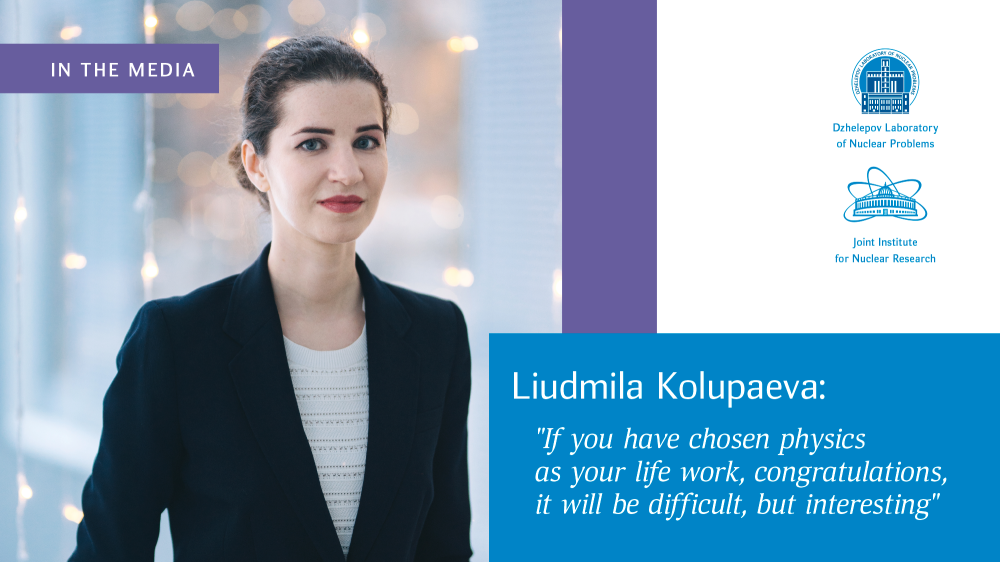
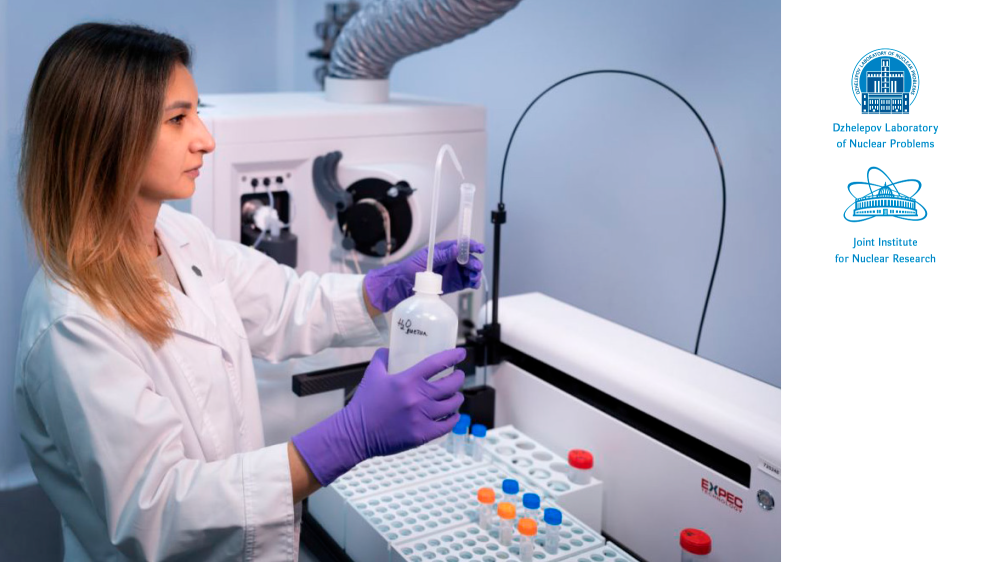
Our first heroine is Ayagoz Baimukhanova, Candidate of Chemical Sciences, Assistant Director for International Cooperation, Innovation and Education Programmes at the Laboratory of Nuclear Problems.
- How did you come to science? What difficulties did you encounter along the way? Was there anything that disappointed you and/or pleasantly surprised you?
It all began not with a formula, but with wonder. My path to science formed progressively, at the intersection of a deep fascination with the fundamental laws of the universe and a conscious desire for their practical application. School culminated in a gold medal, but the true outcome of that period was the realization that physics and chemistry offer the most precise and honest tools for understanding reality.
At university, I chose nuclear physics to gain a strong theoretical foundation. But over time, I wanted to see the practical application of knowledge. This led me to radiochemistry – a field that creates radioactive substances for medicine. I completed my postgraduate studies at D. Mendeleev University of Chemical Technology of Russia, where I received excellent fundamental training, largely thanks to the strong Russian scientific school, with its deep traditions and exceptionally high teaching standards.
Naturally, there were difficulties along the way. Beyond the objective challenges of scientific research, when an experiment stubbornly fails and the reason is unknown, there were also external challenges. Sometimes I encountered the stereotypical perception of work in the nuclear field as exclusively "male", which required extra effort to prove my professional competence. There were moments of fatigue when everything seemed too difficult. But what surprised me more, and continues to surprise me, is scientific solidarity. At JINR, this unique international institute, colleagues from different countries, with different backgrounds, work together to solve the same problem. As a specialist from a member state – Kazakhstan – I found my place at JINR.
- In the minds of many, scientists are demigods, possessors of knowledge inaccessible to the "mere mortal," constantly solving the most complex scientific puzzles. It's hard to imagine such people in everyday life. How does a female scientist manage (or does she manage) to successfully combine highly intellectual work with the roles of wife, mother, and keeper of the home? That is, switching from solving complex scientific problems to simple household chores. How do you spend your leisure time?
Thank you for such an important and personal question. Let's agree right away: a scientist is not a demigod, but a multitasking system. In my daily planner, equations coexist with a list that says "pasta, yogurt, call the school". The main thing is not to switch between roles, but to allow them to enrich each other. Sometimes the best idea comes not in the laboratory, but while cooking, on a mountain slope, or while riding a motorcycle. My hobbies help me in my work. Snowboarding is both feeling physics in action and a way to distract yourself. A motorcycle requires total concentration on the road, and it clears my head, allowing me to return to work with fresh eyes.
I don't have a secret to balance. There is constant movement, a bit of chaos, collisions, energy that flows from one form to another. Being a scientist, wife, and mother means not perfectly performing each role individually, but creating from them a single, albeit perhaps a bit noisy, system full of life. And in this system, there are no "simple" household tasks.
- Recently, the President of Russia, while awarding young scientists, joked: "I can't even pronounce what you do". So, if possible, explain the complex simply: what is the area of your scientific interest? Why did you choose these directions?
To put it simply, I work with atoms that glow from within. Imagine a tiny luminous dot that can be attached to a medicine and sent into the body. It becomes both a beacon, showing where the disease is hiding on scans, and a sniper, striking precisely at the diseased cell without touching healthy ones.
My field is radiochemistry and nuclear medicine. My colleagues and I create these "glowing" atoms, radionuclides, in reactors and accelerators, and then we figure out how to turn them into smart drugs. The same particle can help find a tiny tumor at an early stage and then destroy it. Yes, we work with dangerous materials, behind thick glass, following strict protocols. But the end product is not a weapon; it's hope. There is a special honor and responsibility in that.
- There are more and more women in Russian science. But this is only a quantitative indicator. In your opinion, is there a "glass ceiling" for women's career advancement in science? There is a prevailing opinion that science, especially physics, is a "male" domain. What do you think needs to be done (and does anything need to be done) to break such stereotypes?
Yes, there are more women in Russian science, and the figure of 40% is an important, but still quantitative, indicator. As for the "glass ceiling", I see it not as an impenetrable barrier, but rather as atmospheric resistance that is still felt when moving upward. It manifests not in official orders, but in stereotypes: in doubts about whether a woman has enough "leadership grit" to manage a complex project, in the surprise when you find yourself the only woman at the meeting table.
My own path from a researcher to Deputy Director of the Laboratory of Nuclear Problems is not a story of being "allowed" to do something. It's a story of how professional competence, perseverance, and responsibility for results led to new challenges and greater responsibility. In science, especially in our field where everything is determined by the precision of an experiment and the depth of understanding, gender is as inappropriate a parameter for evaluation as the color of a lab coat when working in the laboratory. When I manage the process of obtaining a radionuclide or participate in the strategic planning of the laboratory's development, it's not a "male" or "female" approach that works, but simply a scientific one.
To break stereotypes, we don't need to create special conditions, but consistently do two things. First, evaluate people solely on their intellectual contribution, ideas, and work results. Second, stop viewing women in science as a “special category”. We are not "women scientists". We are scientists.
- What would you say to a schoolgirl who dreams of dedicating her life to science? What life hacks would you share? What would you warn her about?
If I had the chance to speak to a schoolgirl who is getting excited about science, I would tell her this. Don't be afraid of your passion and never hide your intelligence, it is your greatest strength, not something to be embarrassed about. Boldly seek out your people in Olympiс clubs, summer schools, and specialized programs. Forget the myth that science is the domain of geniuses visited by sudden flashes of insight: the real work of a scientist is ninety percent persistent, even routine effort, absolute precision, and what is called resilience, the ability to get up and try again after every failure, and there will be many. Be sure to learn languages and information technology: today, these are as fundamental a tool for a researcher as the slide rule once was.
- How do JINR staff celebrate the International Day of Women and Girls in Science? Are there any traditions for celebrating this date?
For us, it's not just a formal date. Traditionally, the Joint Institute organizes lectures and meetings called “Women in Science at JINR”, where we, scientists of different ages and nationalities, communicate with schoolchildren, students, and residents of Dubna and neighboring towns. We don't lecture; we simply talk about our projects in plain language. We show that science is about creativity, teamwork, and global challenges, and that in our large international JINR family, there are no barriers, neither national nor gender, for talent and hard work.
To be continued...
The Joint Institute for Nuclear Research (JINR) is a world-renowned international scientific center located in Dubna, Moscow region. Today, it is Russia's only intergovernmental scientific organization, uniting scientists from more than 30 countries. The international organization comprises 15 member states, as well as 8 associate members and partners.
Author: Elena Chernysheva
Source: "Women of Russia" Web Portal