Development by Russian physicists will improve the performance of particle accelerators
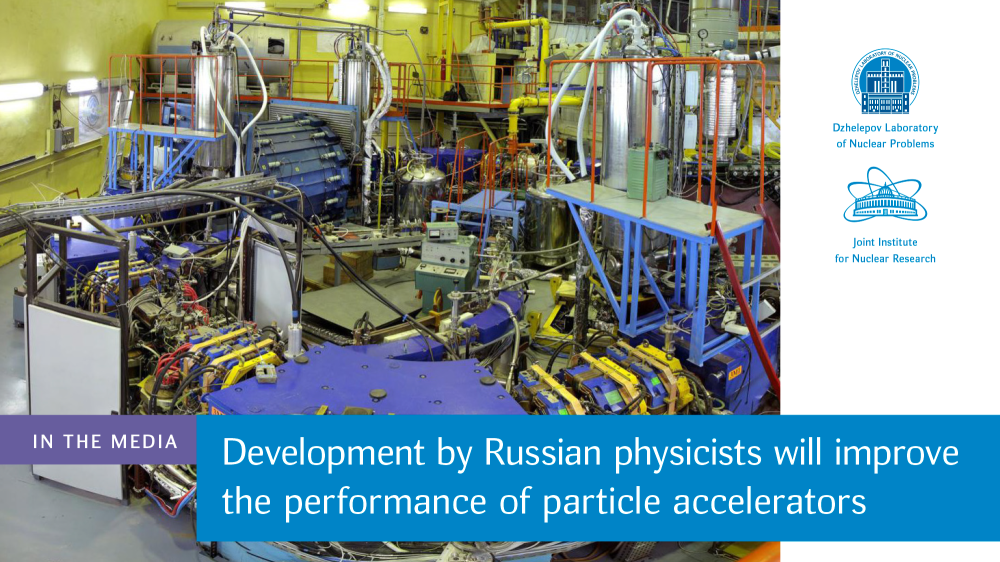
Russian researchers have developed a method that allows determining the degree and direction of the "twist" of electron and ion beams. The approach will simplify the study of high-energy particle properties in modern accelerators and also help improve the operation of electron and ion microscopes, reported the press service of ITMO University.
"The novelty of our work is that we are the first to propose a method for detecting the 'twist' of electrons and ions that works at high energies. Previously, similar approaches were actively studied for light – photons, or for electrons, but at low energies. And in the range where modern accelerators operate, there was no simple way to determine the parameters of such particles," explained ITMO engineer Maksim Maksimov, as quoted by the university's press service.
As scientists note, so-called "twisted" matter waves are now being actively studied in several branches of physics. This is how scientists refer to particle beams with a special helical profile, which makes them interesting for many applications in quantum computing, lithography, and microscope development. Until now, physicists lacked a simple and reliable way to determine the direction in which such a beam, accelerated to high energies, is "twisted".
Researchers from ITMO University and the Joint Institute for Nuclear Research (JINR) discovered that this parameter can be determined very accurately by passing "twisted" matter waves through a microscopic triangular hole. During interactions with this hole, these particles behave like waves, leading to diffraction – the formation of a clear pattern of bright spots resembling a triangle made of microscopic dots.
Article from TASS.
You can read about the study of twisted quantum states on our website: Diffraction of twisted particles.