Liudmila Kolupaeva: If you have chosen physics as your life work, congratulations, it will be difficult, but interesting
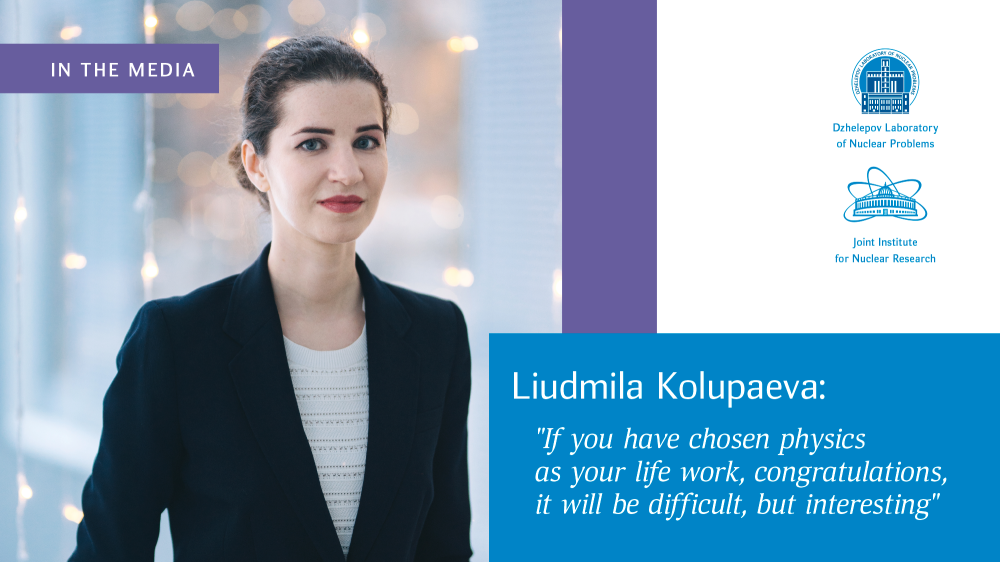
We continue our conversation about the role of women in Russian science with staff members of the Joint Institute for Nuclear Research (JINR), which began in a previous article. Today's interviewee is Liudmila Kolupaeva, Deputy Head of the Scientific and Experimental Department of Elementary Particle Physics at the Laboratory of Nuclear Problems (JINR). She is a Candidate of Physical and Mathematical Sciences (Ph.D. equivalent).
— How did you come to science? Was the path from dream to realization a thorny one? Were there any disappointments, or, on the contrary, pleasant surprises?
Since early childhood, without fully understanding why myself, when asked "What will you be when you grow up?" I would answer: a nuclear physicist. I probably just liked the sound of those words. So, when the time came to choose my path for university admission, the decision felt natural to me.
My parents always supported me and tried not to influence my decisions so that they remained truly my own — they simply accepted them and did everything in their power to help. Moreover, I had truly excellent teachers, which allowed me to successfully pass my exams and enter the Faculty of Physics at Moscow State University (MSU). It was very difficult at first: I graduated from a regular comprehensive school, and my level lagged significantly behind graduates of specialized schools who had already covered elements of the university curriculum. But by the end of my first or second year, I adapted and felt confident afterwards. Ultimately, my educational specialization became the physics of the atomic nucleus and elementary particles. The department where I studied was a base department for JINR, so my transition from university to science was integrated directly into the educational process.
I don't have any stories of disappointment; there's really nothing to regret. Perhaps, in retrospect, I would tell myself: try to accomplish more and participate more actively in various projects.
Of course, there have been inspiring examples of successful women scientists in my life. Both textbook examples of outstanding scientists from the past (M. Curie-Skłodowska, E. Noether, etc.) and colleagues you see here and now, observing how they live, work, and solve problems. Certainly, they all achieved something significant simply by demonstrating that being a woman scientist is fundamentally possible. This is the role model effect, and it's important for personal development in any field.
— How does a woman scientist successfully balance highly intellectual work with the role of keeper of the home hearth? Do you have any hobbies? How do you like to spend your free time?
This is a very complex question, because biologically, women indeed bear another existentially important task — childbirth and the primary role in raising children. Hence arises this concept of the second or even third shift for women: professional activity, the role of mother and wife, and domestic work. It's worth noting that women have been coping with this successfully for many years, which further underscores their stress resistance, focus, and immense capacity for work. And there is absolutely no problem with switching from one type of work to another.
As for leisure, if I manage to carve out time from work, it most often involves getting enough sleep, playing sports, reading books, or going to the theater.
— Making the complex simple: your field of scientific interest explained in simple terms. Why did you choose these particular areas?
My field of scientific interest is particle physics, specifically neutrino physics. I am interested in it because it concerns the most fundamental structure of the world that one can possibly imagine. And I think that there may still be secrets hidden there that could revolutionize humanity's way of life.
Currently, it is known that the smallest particles from which the entire universe is built are six quarks, six leptons, and the force-carrying particles for all possible interactions between them. These particles are called elementary, meaning they are not composite. More complex systems are built from these particles, such as nucleons — protons and neutrons. These, in turn, are constituents of atoms, along with electrons, which are leptons. As you know, all matter around us is made of atoms. Among all elementary particles, neutrinos are some of the most mysterious. Unlike the others, they have no electric charge, possess a very tiny mass, and participate only in weak interactions. These elementary particles have an unusual property — the ability to transform between types, to oscillate.
I work on the NOvA experiment, which studies neutrino oscillations in an accelerator neutrino beam that consists almost entirely of muon neutrinos. They travel a distance of 810 km and are detected in the experiment's detector. There, the effect of oscillations becomes apparent — neutrinos of other types are observed. My job involves data analysis and extracting the parameters that determine this process. The main difficulty in working with neutrinos is detecting them. It's a neutral particle, extremely light, and it barely interacts with matter. Matter is almost transparent to neutrinos, so detectors must have a huge volume. The NOvA detector can be compared in size to a standard five-story building: its cross-section is a square of 16 × 16 m, it is 60 m long, and its mass is 14 kt. This is one of the paradoxes of particle physics: to work with the smallest structures known to humanity, you need gigantic, technically complex, and unique facilities.
I don't know if I managed to explain complex things simply… (smiles)
— There are more and more women in Russian science. But this is only a quantitative indicator. In your opinion, is there a "glass ceiling" for women's career advancement in science? There is a prevailing opinion that science, especially physics, is a "male" domain. What do you think needs to be done (and does anything need to be done) to break such stereotypes?
Regarding intellectual work, dividing activities into female and male seems strange to me.
The "glass ceiling" in all areas — not just in science — exists primarily because, in most cases, a woman cannot afford to spend one hundred percent of her time solely on work: she also has the home, family, and children. In such a paradigm, a woman will naturally fall behind in the career race compared to a man who can work in that single-minded mode.
However, with the advancement of science and technology, more and more tasks can be delegated by women. Indeed, the technical progress of the 20th century significantly reduced the time people spent on housework — and we see more and more women successfully pursuing professional careers.
Regarding stereotypes, I haven't personally encountered them, but I have certainly heard about them. Today, women feel confident in science, act as equal partners, demonstrate the same level of competence, and are ready to work on equal terms — with full dedication and maximum involvement. I think that soon there will be no room left for such stereotypes.
— What would you say to a schoolgirl who dreams of dedicating her life to science? What life hacks would you share? What would you warn her about?
My advice to the younger generation would be mostly gender-invariant. First and foremost, I sincerely wish every student to find an activity that captivates them, and to do so as early as possible. As they say, find a job you love, and you'll never work a day in your life. If you have chosen physics as your life's work, congratulations, it will be difficult, but interesting. Be prepared to work hard, set only ambitious scientific goals for yourself, and pursue them despite any obstacles. If you don't succeed, don't give up, learn from past experience and try again.
I sincerely hope that among the young readers of your portal there will be the next Nobel laureate who will, in due time, advance science. Be active and curious.
To a girl, I would advise not to fixate on her gender. If you encounter people who, referring to your female gender, say things contrary to your beliefs, don't take it seriously. Do what you think is right, believe in yourself.
— How do JINR staff celebrate the International Day of Women and Girls in Science? Are there any traditions for celebrating this date?
There probably isn't a tradition as such, repeated year after year, but a few years ago at the JINR Laboratory of Nuclear Problems, where I work, there was a project dedicated to this holiday called "Charming Science" («Очаровательная наука»). You can learn more about it here.
Also, our institute has a Women's Committee. It focuses on supporting our female staff members, helping to create conditions for professional growth and developing a comfortable environment at the institute. The JINR Women's Committee organizes various cultural and educational events that bring colleagues together outside the laboratories. All this helps us feel not just like colleagues, but like one big, friendly family, and this is perhaps the best tradition that is currently taking shape.
We congratulate Liudmila and Ayagoz, and through them, all women in science, on the International Day of Women and Girls in Science! We wish you new brilliant ideas, bold hypotheses, successful experiments, and well-deserved recognition. And to the schoolgirls and female students who have chosen science as their life's work — we wish you to confidently pursue your goals, despite the difficulties.
Author: Elena Chernysheva
Source: "Women of Russia" Web Portal