“...A person lives as long as he is remembered…”
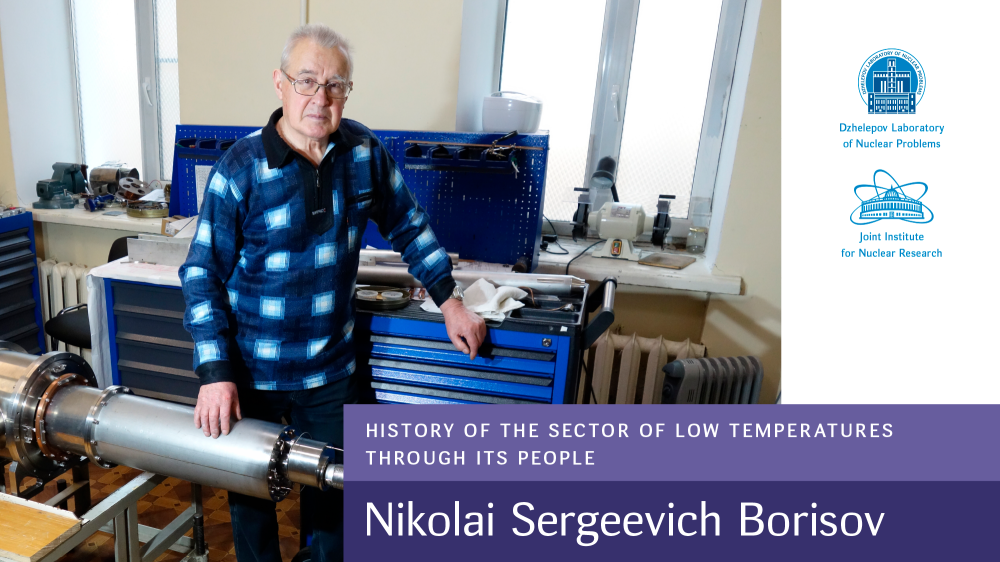
N. S. Borisov spent a long time working on the problems of achieving and utilizing ultra-low temperatures in experimental setups. He is a co-author of the pioneering work on implementing a fundamentally new method for achieving ultra-low temperatures (Не3/Не4 dilution refrigeration). It was this method, on the basis of which, with the decisive contribution of N. S. Borisov, the new-type facilities, polarized "frozen" targets, were created. Currently, these facilities are successfully used in polarization research in Protvino, Prague, Gatchina, VBLHEP JINR, Mainz, and Bonn.
The role of Nikolai Sergeevich in creating the polarized "frozen" target in Prague deserves special mention, as for this purpose he even had to organize a cryogenic laboratory at Charles University. As a result, polarization research has been conducted at the VdG accelerator in Prague since 1994 and continues to this day.
In 1994, a large team of specialists from various institutes in Russia, Ukraine, and France, with the support of the European INTAS fund, modified and launched the MPT facility, which was previously used at the Fermi National Accelerator Laboratory. The successful realization of this project was widely covered in various journals at the time: CERN COURIER vol. 35, #7, 1995; Scintillations, 24, juin, 1995, with a corresponding news report broadcast on TF-5 France). In these works, the role of N. S. Borisov was one of the key ones. Starting from 2004, Nikolai Sergeevich was one of the principal specialists in the work on creating a cryostat for a new polarized target in Mainz under the GDH&NN project and a separate JINR-Mainz contract. Since 2009, an experimental program utilizing this polarized target has been carried out on the MAMI C accelerator at this new facility.
Furthermore, Nikolai Sergeevich participated in work on creating a new cryostat for a polarized target in Protvino (IHEP) under the JINR-IHEP collaboration. In these works, the role of Nikolai Sergeevich Borisov was also very significant. The team of the Sector, with the active participation of N. S. Borisov, implemented a project to create a cryostat for a new polarized target at the University of Bonn (at the ELSA accelerator). This proposal from the German side became possible due to previously completed, similarly successful work with the University of Mainz. From a scientific point of view, the participation of the staff members of the Sector of Low Temperatures in creating a precision "Möller polarimeter" for the new superconducting MESA polarized electron accelerator at the University of Mainz is also of particular importance for the sector. The main component of such a polarimeter is precisely a powerful 3Не/4Не dilution refrigerator, and in this area, the Sector of Low Temperatures possesses unique experience and methodological developments.
Nikolai Sergeevich Borisov is a world-renowned specialist in the use of ultra-low temperatures in experimental physics, a laureate of several JINR Prizes (among them two first prizes), and an author and co-author of more than 150 scientific works.
Nikolai Sergeevich passed away on October 8, 2025.
"Nikolai Sergeevich's death marks an entire era of the creators of polarized targets coming to an end. A person lives as long as he is remembered. The memory of Nikolai Sergeevich Borisov, a wonderful, kind, reliable, wise man, a professional in cryogenics in the truest sense of the word, will forever remain in our hearts," shared Aleksandr Vasiliev, chief researcher at the Institute for High Energy Physics (Protvino).
Andreas Thomas, the Mainz spokesperson of the A2 collaboration, shared his condolences, “He worked in A2-collaboration for over 20 years. Nikolay was one of the world leading experts in the development of 3Helium-4Helium-dilution-refrigerators and frozen spin targets since the 1960'ies. We will miss him a lot and honour his memory.”