News
10.04.2018
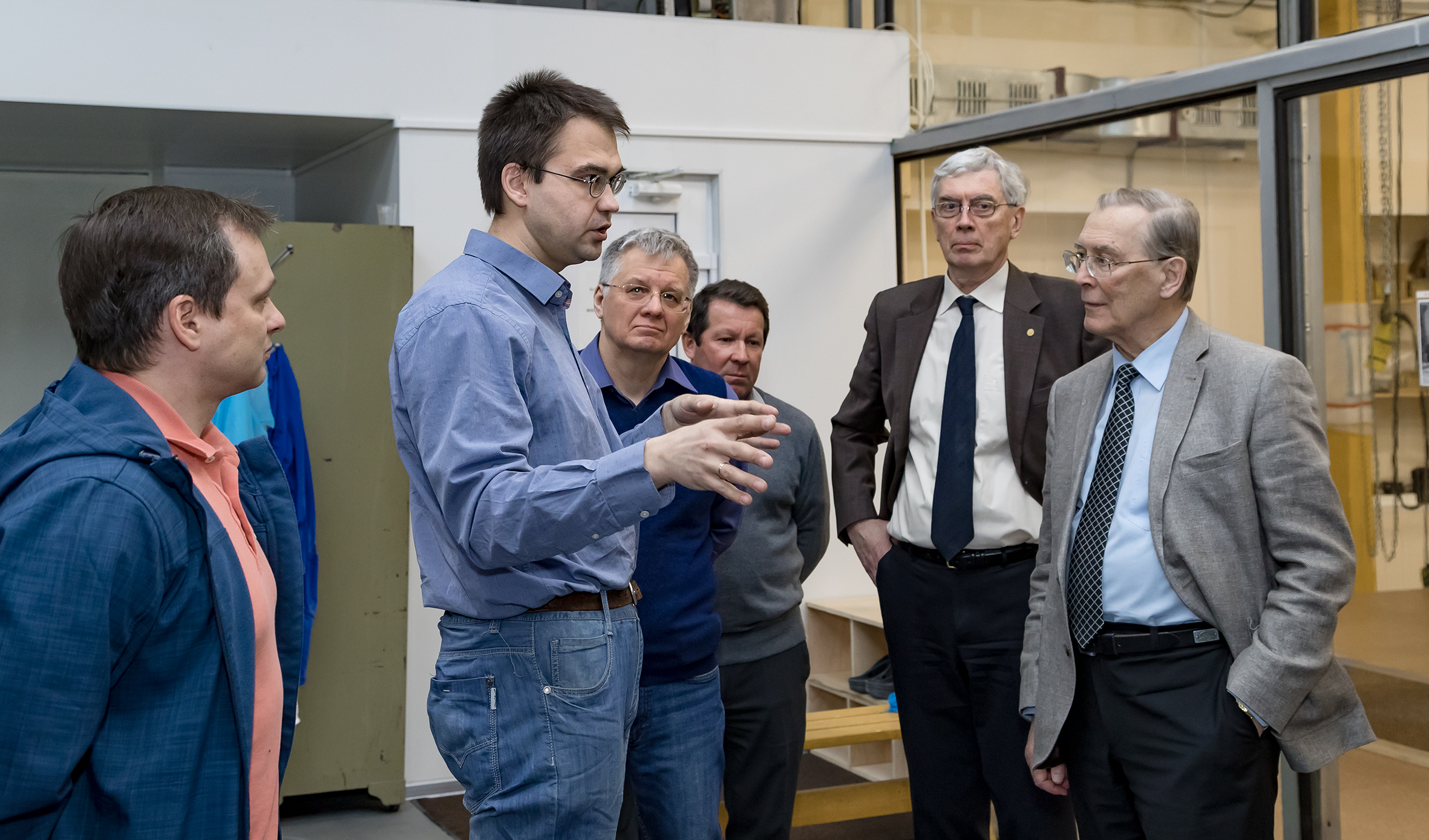
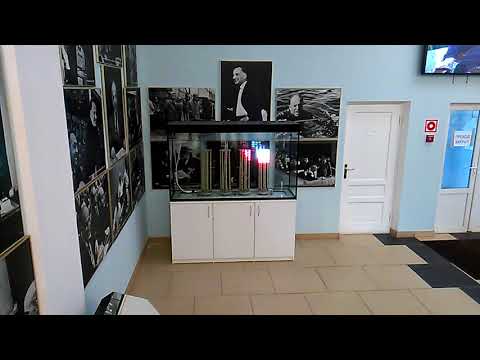
JINR Director V.A. Matveev and Vice-Director B.Yu. Sharkov visited the Dzhelepov Laboratory of Nuclear Problems, where they met with V.A. Bednyakov, D.V. Naumov, V.V. Glagolev, and A.A. Kul’kov. The guests were shown the operating mock-up of the Baikal Neutrino Telescope made by the DLNP staff members A.N. Borodin and D.V. Fedoseev. They also visited recently refurbished Building 4, where they assessed the quality of the refurbishment and got acquainted with new laboratories.
10.04.2018
At the end of last week, an operating mock-up of the Baikal Neutrino Telescope made by the DLNP staff members A.N. Borodin and D.V. Fedoseev appeared in the vestibule of the DLNP Administrative Building.
10.04.2018
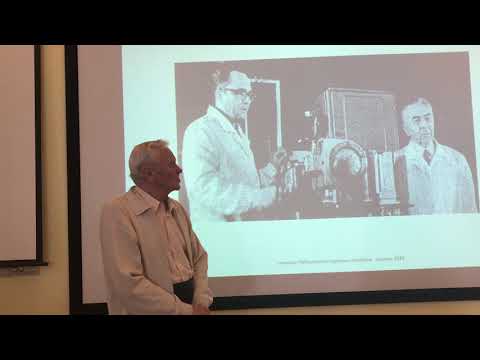
Today a terrific seminar was held, where Vladimir Ivanovich Komarov spoke about the history of the Medico-Technical Complex based on the proton beam of the DLNP synchrocyclotron, about the faith and hope that unites people and gives them strength to overcome the non-overcomable… Particularly valuable is that it was the story told by the one who directly participated in those almost half a century old events.
09.04.2018
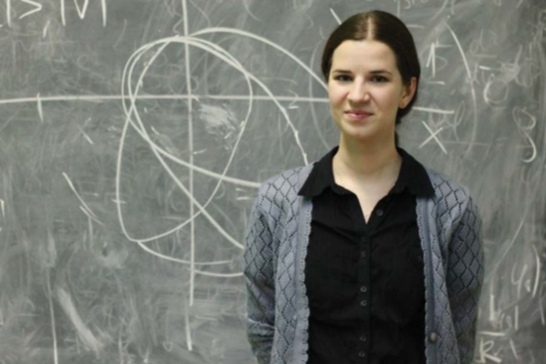
That a nice young scientist working in our laboratory!
An interview with Lyudmila Kolupaeva by the Moskovskii Universitet newspaper, February, 2018.
06.04.2018
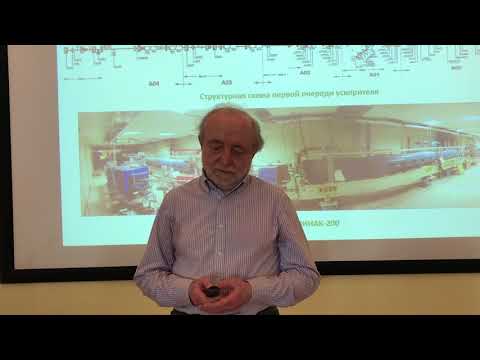
Valery Vasilievich Kobets about the projected upgrading of the LINAK-200 linear electron accelerator
The possibility of testing prototype detectors in test beams is of crucial importance for scientific methodological research. The fact that JINR is lacking facilities with test electron beams considerably slows down advance in development of new electromagnetic calorimeters, photon imagers, and radiation-hard detectors for future collider experiments.
DLNP is preparing a project for upgrading the LINAK-200 accelerator to produce test beams of electrons with energies of up to 800 MeV. It is planned to use LINAK-200 in applied research (radiation materials science, radiation genetics, etc.) and for purposes of education.
For more detail, see https://indico.jinr.ru/conferenceDisplay.py?confId=521
04.04.2018
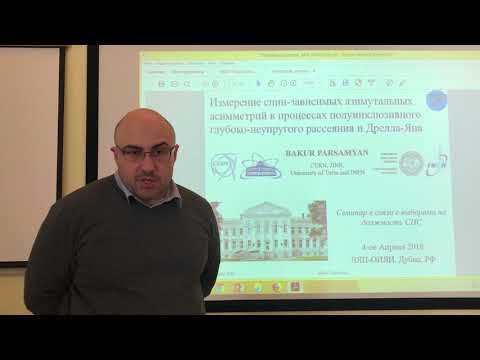
For a few past decades the spin structure of the nucleon has been one of the most important among still unraveled mysteries in high-energy physics. Experimental collaborations of the leading international and national laboratories (BNL, CERN, FNAL, DESY, JINR, JLab, KEK, etc.), as well theorists and phenomenologists from all over the world have concentrated their efforts to solve the problem.
03.04.2018
Igor Aleksandrovich Suslov made a review of the methods for top-quark mass measurement used in the CDF experiment and presented the latest published results obtained by the team of the Division of Multiple Hadron Processes, DLNP, from the analysis of the total experimental statistics for the dilepton decay mode.
02.04.2018
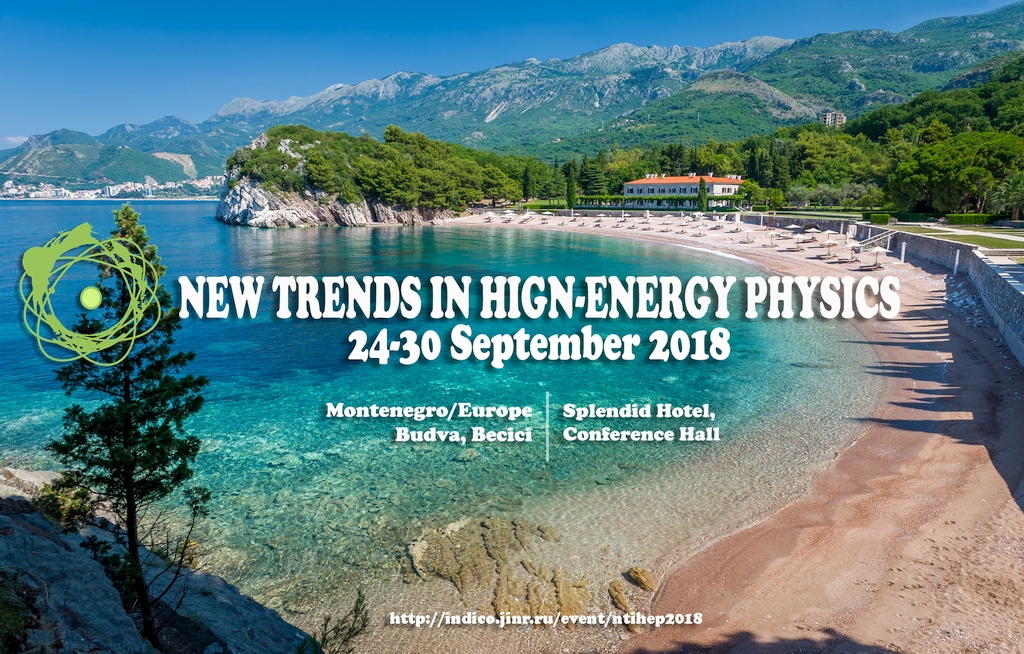
The Joint Institute for Nuclear Research, (JINR) organizes the conference "New Trends in High-Energy Physics". It will be held in Budva, Becici, Montenegro on 24 - 30 September, 2018.
Preliminary topics:
1) Test of the Standard Model and search for New physics 2) Multi-messenger astrophysics3) Neutrino physics4) Elastic and diffractive scattering of hadrons and nuclei 5) Deep inelastic scattering and multiparticle dynamics 6) Ion colliders for study of the baryonic matter at extreme conditions7) Computing for Large Scale Accelerator Facilities (LHC, FAIR, NICA, etc.) 8) New detector and data analyses technique
The program will include invited talks (30 minutes) and selected contributed reports (20 minutes).
The working language is English.

27.03.2018
Dear friends, colleagues!
I congratulate you on the 62nd anniversary of the Joint Institute for Nuclear Research!
We celebrate this event summing up the milestones of the 25-year stage of modern JINR development that is connected with political and economic changes in the USSR and some other JINR Member States. This process opened “a new era” of JINR international status development. In 2018, this 25-year jubilee will be celebrated on merit. In February, at the meeting of the JINR Scientific Council, we reported on numerous significant results in the main fields acquired during the past year that have been presupposed by the Seven-Year Plan.