Joint development by JINR Laboratory of Nuclear Problems and Dubna State University: Composite mirrors for the TAIGA telescopes
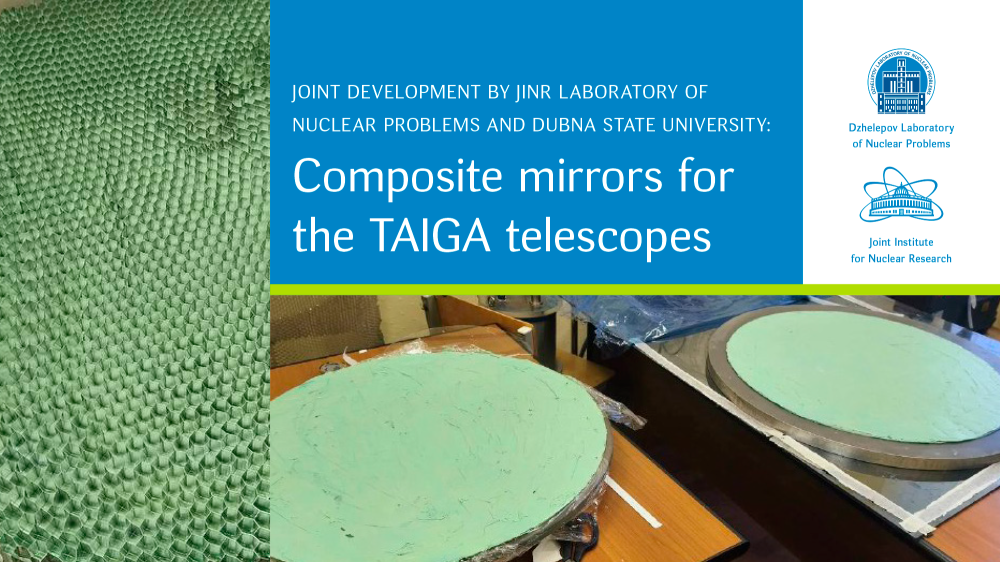
The mirrors under development have optical properties comparable to those of traditional glass mirrors, yet they offer an important advantage: lower weight. Furthermore, composite mirrors require less time to manufacture an individual element.
These advantages are especially crucial for designing the new 10-meter Cherenkov telescope which is planned to house about 200 mirrors. Reducing the structural weight and shortening mirror production time play a key role in the construction of a telescope of this scale.
Background information
The TAIGA international project (Tunka Advanced Instrument for cosmic rays and Gamma Astronomy) is designed to study the high-energy part of the spectrum of cosmic gamma-ray sources, primarily in the energy range of 10 TeV. The experiment is located near the southern tip of Lake Baikal at the astrophysical site in the Tunka Valley (Republic of Buryatia) and consists of several facilities that measure the parameters of extensive air showers resulting from the interaction of cosmic rays and high-energy gamma rays with the atmosphere. As a result of these measurements, the arrival direction, type, and energy of cosmic rays can be reconstructed. Measurement accuracy is enhanced by combining different detection systems.
Time-lapses from the Tunka Valley at the TAIGA Astrophysical Complex:
https://disk.jinr.ru/index.php/s/NwjHt6kKaAkirD8
https://disk.jinr.ru/index.php/s/Cc4sqfcAxCS766p
Time-lapse of manufacturing composite mirrors for the TAIGA telescopes:
https://disk.jinr.ru/index.php/s/nTcESKb9mmbzWwS
Photo by Andrei Shaikovsky
Video by Artur Borodin
Video editing by Anastasia Malyshkina