TAIGA is expanding: The first full-scale muon detector is ready for waterproofing
Today, the TAIGA experimental complex comprises five independent facilities: TAIGA-HiSCORE, Tunka-133, Tunka-Grande, TAIGA-Muon, and TAIGA-IACT. They are used to study high-energy and ultra-high-energy cosmic rays and gamma radiation by detecting the components of extensive air showers (EAS).
The joint operation of the TAIGA-HiSCORE wide-angle Cherenkov array (consisting of 120 optical stations) and four atmospheric Cherenkov telescopes of the TAIGA-IACT facility aims at a detailed study of cosmic gamma-ray quanta with energies above 40 TeV. For the region above 1 PeV, a system of cylindrical water Cherenkov detectors is planned to be deployed over an area of 0.5 km² within the complex to detect the muon component of EAS.
The detectors will be placed under a 2–2.5 m soil layer, which is sufficient to shield the electromagnetic component of the shower. The height of an individual detector is 1.2 m, its area is approximately 40 m², and the threshold energy for vertical muons is 1 GeV. In the hybrid operation mode, the TAIGA-HiSCORE data are expected to be used for the high-precision reconstruction of EAS parameters and primary particle energy. The data from the water detectors will provide information on the type of nucleus that initiated the shower, allowing for the separation of gamma-ray induced EAS from the background of events triggered by charged cosmic rays, as the number of muons depends on the type of the primary particle.
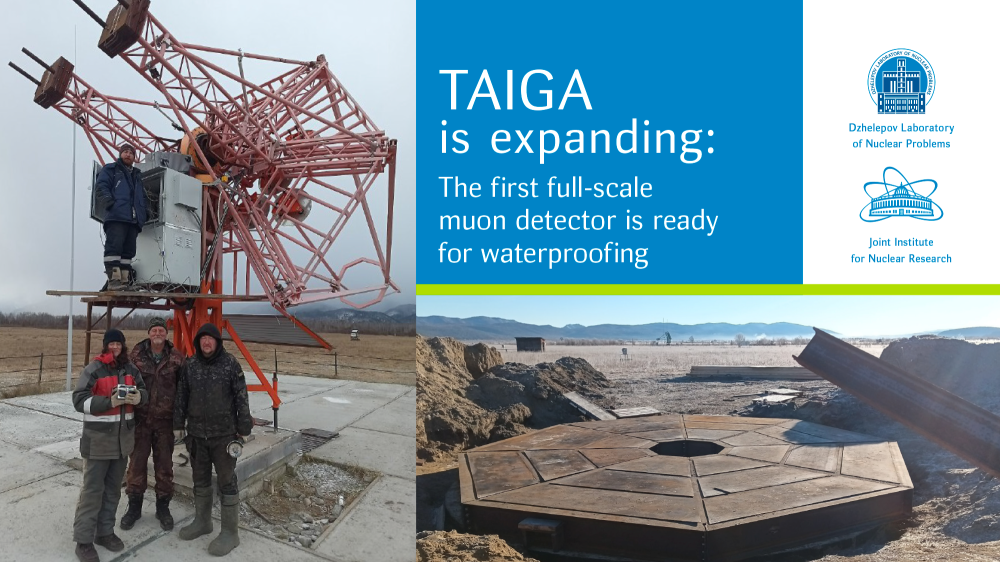
During the autumn business trip, JINR staff members mounted the lid of the first underground pool of the water Cherenkov detector complex. By the time of their arrival, one detector housing was fully ready for the lid installation, while the second one was at the stage of receiving 10.5 m³ of concrete. Meanwhile, during the trip, the staff members from the API ISU (Research Institute of Applied Physics of Irkutsk State University) assembled the cylindrical formwork on the third detector and poured concrete into it. The pool, which is planned to be commissioned into the TAIGA astrophysical complex for joint operation with TAIGA-HiSCORE, has been prepared for waterproofing, perimeter insulation, the installation of a flexible bladder for ultra-pure water and data acquisition (DAQ) electronics, as well as for backfilling with soil.
The new facility is potentially capable of efficiently detecting EAS muons and separating gamma-ray quanta from the charged cosmic ray background in the primary particle energy range of 1–10 PeV. In 2025, the first prototype of the detector with a smaller diameter was built: it was used to test the required technologies, and the detector is currently collecting experimental data.
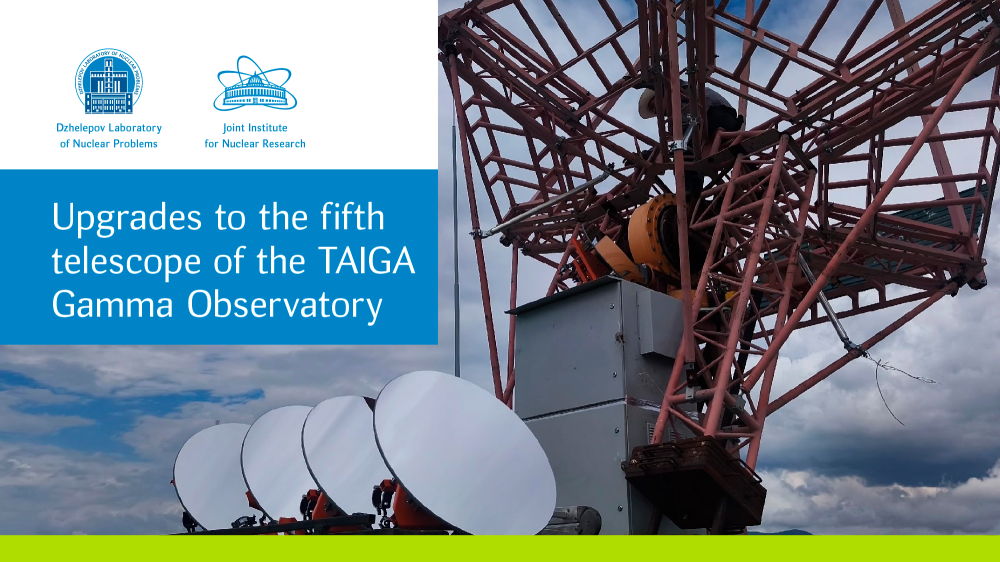
Another objective of the business trip was to prepare the fifth Cherenkov telescope for the observation season. The telescope's electrical equipment and limit switches were installed, cable lines were laid, and the telescope was connected to the power and fiber-optic communication lines. Axis position encoders were mounted and connected, and the mount drive systems were tested and configured. Additionally, two sets of remote mirror alignment systems were prepared. While the fifth telescope awaits its camera (its housing has already been delivered to the site, and SINP MSU (Skobeltsyn Institute of Nuclear Physics, Lomonosov Moscow State University) staff members are assembling the data acquisition and transmission electronics), it will be used to test systems that are to be implemented on the next Cherenkov telescope, which will feature a 10 m diameter and a 12 m focal length.