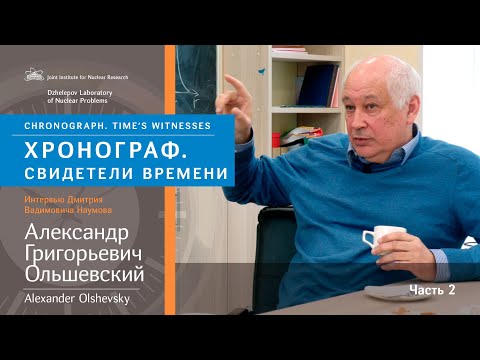
“Chronograph. Time’s Witnesses: Boris Zhanakaitovich Zalikhanov”

Boris Zhanakaitovich Zalikhanov graduated from Rostov State University (specializing at the Department of Experimental Nuclear Physics) in 1967. From 1968 to 1972, he was a postgraduate student at Rostov State University. To pursue his postgraduate studies in his specialty, he was seconded to DLNP JINR.
In 1972, he joined the staff of the Laboratory of Nuclear Problems at the Joint Institute for Nuclear Research as an engineer. He was engaged in developing and building an experimental facility connected to a computer to study reactions involving the production of neutral particles. All components of the developed facility featured record-breaking parameters.
In 1976, he was transferred to the position of researcher. In the same year, B. Zh. Zalikhanov commissioned an experimental facility used to measure the cross sections of the reactions $\pi^{-} p \to \pi^{0} \pi^{0} n, \pi^{-} p \to \pi^{0} \gamma n$ at an energy of 270 MeV at the DLNP accelerator.
In 1977, Boris Zhanakaitovich defended his dissertation for the degree of Candidate of Sciences (Physics and Mathematics) and was transferred to the position of senior researcher. In 1980, he was appointed head of the group for the development and creation of a vertex detector under the "Neutrino Detector" project.
In 1985, the multifunctional vertex detector was mounted on the "Istra-M" facility to conduct a joint experiment with the Institute for Nuclear Research of the USSR Academy of Sciences (Troitsk) to study rare decays of π and K mesons at the U-70 accelerator of the Institute for High Energy Physics (Protvino). B. Zh. Zalikhanov was the principal investigator responsible for upgrading the joint facility and conducting experiments on it on behalf of DLNP JINR.
To increase the sensitivity of the facility to various modes of rare K-meson decays, B. Zh. Zalikhanov developed and built next-generation high-rate multiwire coordinate detectors capable of operating efficiently at rates up to $10^{8} c^{-1} {см}^{-2}$ and featuring a time resolution of $5 нс$. Following the upgrade, the increased sensitivity gave the "Istra-M" facility new detection capabilities, making it the most powerful experimental facility in the field of rare K- and -meson decay research.
From 1995 to 1998 and from 2002 to 2003, B. Zh. Zalikhanov developed, manufactured, and commissioned $(8 + 14)$ next-generation high-rate two-coordinate narrow-gap chambers with a sensitive area of $500 \times 450 {мм}^2$ and a spatial resolution of $0.5 мм$ for the forward spectrometer of the ANKE facility (Forschungszentrum Jülich, Germany), where experiments were conducted on the internal beam of the COSY accelerator.
In 1998, while studying the operation of narrow-gap chambers in the pre-streamer region, B. Zh. Zalikhanov discovered and investigated eight previously unknown processes occurring in an avalanche at a gas gain of $\geq 10^{7}$. These newly observed processes did not correspond to any known gas discharge regimes; due to their characteristic properties, the region of their manifestation was termed the plasma regime region of gas discharge. The study and analysis of these processes enabled Boris Zhanakaitovich to conclude that they can essentially be considered accompanying processes ensuring the transition of an electron avalanche into a streamer, and can be interpreted as a manifestation of the properties of a double charge layer placed in an external electric field.
B. Zh. Zalikhanov developed a streamer model based on the hypothesis of a dipole forming within a developing electron avalanche, with charges $N_{e} \approx N_{i}$ separated by an ionization length of $\alpha^{-1} см$. Within this model, the field generated by the charges inside the dipole is completely compensated by the oppositely directed constant field from the power supply. The formation of such a dipole transforms the electron avalanche into plasma, whose plasma properties give rise to a double charge layer. In turn, the properties of this layer make it possible to systematize new experimental data on streamer formation and propagation.
Based on the results of his research, in 2007, B. Zh. Zalikhanov defended his dissertation "Next-generation high-rate wire chambers and features of gas discharge development in them" for the degree of Doctor of Sciences (Physics and Mathematics). In 2016, B. Zh. Zalikhanov was transferred to the position of leading researcher.
In 2023, using experimental data on the dependence of the reduced electron impact ionization coefficient $\alpha / N$ on the reduced electric field $E / N $ in $CF_{4}$ gas for a developing electron avalanche in a chamber with a known electric field distribution, Boris Zhanakaitovich identified a region in the electron avalanche where the field created by the total charge of the avalanche (the dipole) coincided exactly with the field produced in this region by the power supply. The obtained result confirmed the validity of the chosen hypothesis, which acquired the status of the streamer theory.
B. Zh. Zalikhanov is the author of 121 scientific papers and the co-author of two inventions and 10 patents. He has supervised one Candidate of Sciences and eight graduate students. B. Zh. Zalikhanov's works have been presented at international conferences, workshops, symposia, and seminars at research centers across the Russian Federation and Europe.
B. Zh. Zalikhanov's career has been recognized with the Jubilee Medal "For Military Valour," the "Winner of the 1979 Socialist Competition" badge, the "25 Years of JINR" anniversary badge, as well as the "Inventor of the USSR" and "Veteran of Nuclear Energy and Industry" badges. He has been awarded the JINR Certificate of Honour for services to the institute. B. Zh. Zalikhanov is the recipient of two prizes in the DLNP JINR scientific paper competition. In 2000, at the anniversary competition of scientific papers of the Institute for Nuclear Research of the Russian Academy of Sciences (INR RAS) dedicated to the institute's 30th anniversary, B. Zh. Zalikhanov, together with co-authors from INR RAS and DLNP JINR, was awarded a diploma and the second prize for the work titled "The ISTRA-M facility for studying rare decays of light charged mesons."
Video by Mikhail Zhukov, edited by Anastasia Malyshkina.