Multivariate amplitude analysis of the cascade particle decays based on the Nearest Neighbors fitting
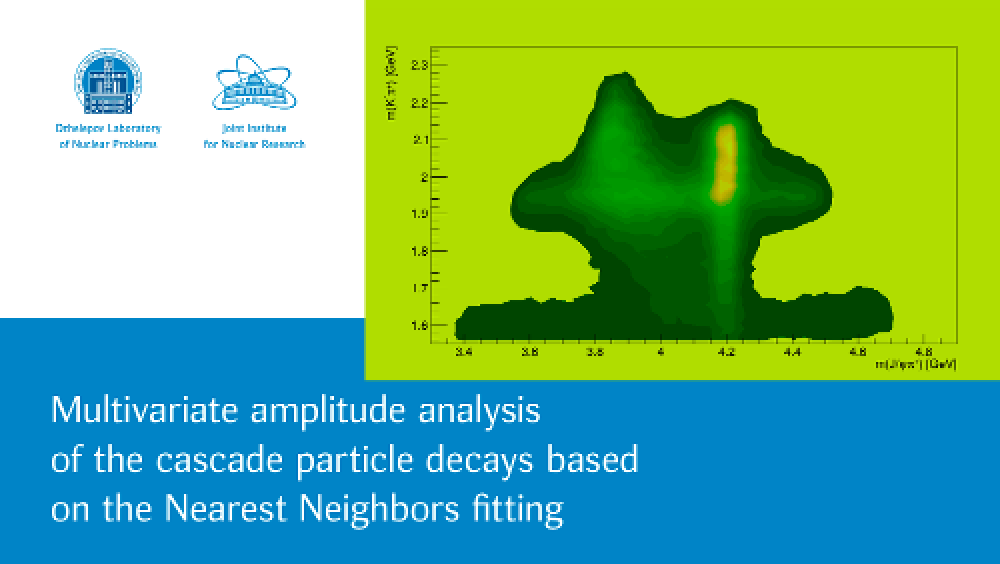
Physicists are increasingly in need of multivariate data analysis in order to understand how particles decay. Complex decay chains are described by dozens of parameters, extraction of which requires fitting several variables: mass spectra and angular distribution of decay products.
To reduce dimensionality and simplify the fits, the following methods are usually used: principal component analysis, decision trees, neural networks, etc. The neural network trained on models of studied processes can aggregate information from a dozen input variables and yield one/two parameters that can, for example, provide the best possible separation of the signal from background noise. However, complex situations when multivariate fits are impossible to avoid also exist. For example, if several signal processes and several background processes cannot be factorized (i.e., they are complexly mixed, mutually correlated), they can only be analyzed jointly in terms of all kinematic variables.
The study considers the situation when determining the parameters of the B-meson decay models simultaneously across several combined channels is carried out via a six-dimensional fit of kinematic variables. The fit selects the parameters of the decay matrix element and based on these parameters it assigns weights to Monte Carlo simulated events that are used to describe data observed. The Nearest Neighbors method is offered to carry out a quality estimation of such a fit. Each of such weighted events is considered as contributing to the N-dimensional probability density function in its neighborhood in the parameter space.
The method allows one to fit complex physical models with no analytical representation in multidimensional space and to accurately account for reconstruction effects in the experimental facility. It demands modest cpu resources and can be effectively multi-threaded.