JUNO: 10 years later

The historic press-conference of the JUNO international collaboration took place in Guangdong (China) in November 2025. The press conference announced the successful completion of the construction of the Jiangmen Underground Neutrino Observatory (JUNO) and publication of the first results based on data accumulated during two first months of collecting statistics.
Thanks to the unprecedented sensitivity of the JUNO detector, scientists will be able to determine the neutrino mass hierarchy and measure neutrino oscillation parameters with an accuracy of better than one percent, study neutrinos from the Sun, atmosphere, Earth's crust and mantle, supernova explosions, and also search for physics beyond the Standard Model. The detector is designed for a service life of about 30 years and can be upgraded to one of the most sensitive instruments for the search for neutrinoless double beta decay, which will allow the investigation of the absolute neutrino mass scale and test their possible Majorana nature. Great discoveries lie ahead!
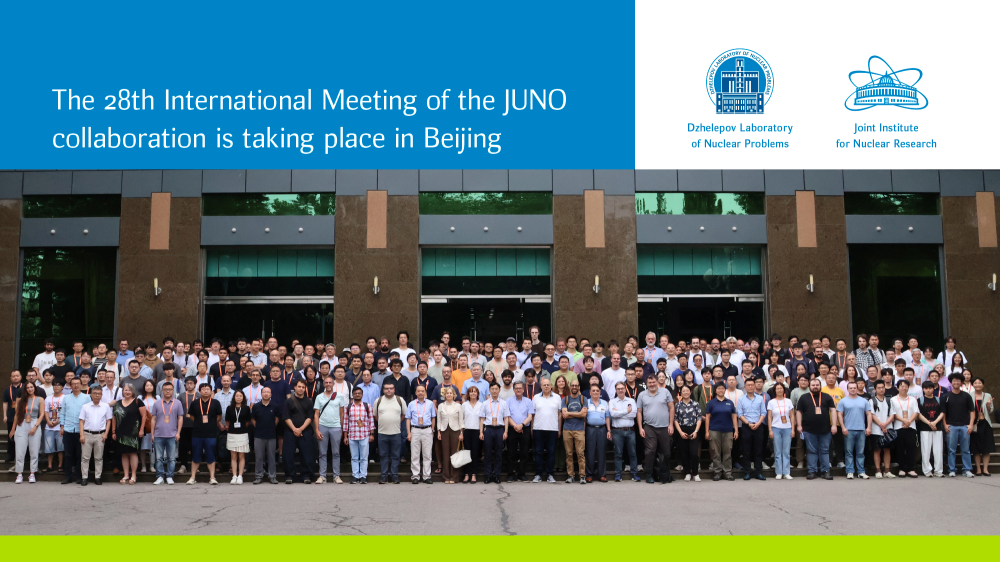
JUNO is a large international collaboration led by the Institute of High Energy Physics of the Chinese Academy of Sciences. The project involves more than 700 scientists from 74 institutes in 17 countries.
The Joint Institute for Nuclear Research stood at the origins of the JUNO project. Our institute has made a huge contribution to the development of detector systems, software, and the analysis of experimental data.
Link to watch the video on the JINR resource:
https://disk.jinr.ru/index.php/s/SLPiRRJ2xoo8Xo6
Video prepared by the JUNO collaboration
Translation into Russian and narration: Dmitry Naumov
Audio editing and soundtrack synchronization: Anastasia Malyshkina
Project monitoring: the DLNP Group of Scientific Communications
News of the laboratory