The full data archive of the unique Daya Bay experiment is open
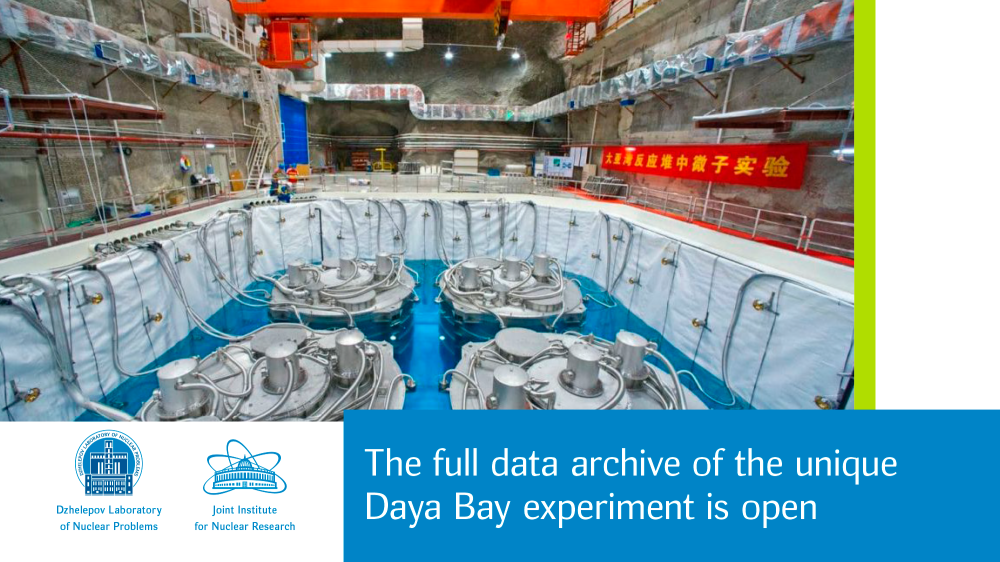
Over its ten years of operation, the Daya Bay experiment accumulated a record number of reactor electron antineutrino interaction events and provided the most precise measurement of the neutrino mixing parameter $\sin^{2}2\theta_{13}$ [1, 2]. The achieved precision of 2.6% remains definitive and will retain its significance for decades to come. The full data archive of the Daya Bay experiment, comprising 5.55 million events, has been placed in open access in the Zenodo repository.
This result was made possible by a combination of several factors: the optimal detector geometry providing sensitivity to oscillations; the high antineutrino flux from powerful nuclear power plants, reducing statistical uncertainty; and the use of eight identical low-background detectors at different distances, which significantly suppresses systematic uncertainties. The strict, multi-stage control of the analysis, conducted by independent groups at all its stages, also played an important role. After data collection ceased in 2020, ensuring the correct preparation of the experimental data for open access became a key task.
The data package includes:
- · A list of selected candidate events for inverse beta decay (antineutrino interactions) with subsequent neutron capture on gadolinium in the experiment's eight detectors (event time, energy, position within the detector, capture time), used in the analysis [1] (precision of the $\sin^{2}2\theta_{13}$ measurement — $2.8\%$);
- Daily detector efficiency and operational time parameters;
- Weekly antineutrino fluxes from each reactor;
- Background event spectra;
· A complete set of input data for conducting an oscillation analysis of the parameters $\sin^{2}2\theta_{13}$ and $\Delta m^{2}_{32}$, including antineutrino spectra and corrections to them, detector effects, systematic uncertainties, etc.
Special attention has been paid to the reproducibility of results. The dayabay-model software package [3] has been developed and opened, which reproduces the procedure for predicting antineutrino spectra and allows for an oscillation analysis to be performed on the open data. The software supports all four provided data formats.
The preparation of the data and software has been carried out by JINR staff members over three years. Daya Bay collaboration members from the Laboratory of Nuclear Problems participated in the project: Head of DLNP Sector No. 1 of Reactor Neutrino Physics Maksim Gonchar and junior researcher Vitaly Zavadsky. Nikita Tsegelnyuk, a junior researcher from the Laboratory of Theoretical Physics, made a significant contribution to developing the analysis framework, and Georgy Ponomarev, a student at the University of Dubna, contributed to its validation and profiling.
"These unique data, accumulated over a decade of continuous operation of one of the most precise neutrino experiments in the history of physics, will serve many generations of scientists," says Maksim Gonchar, candidate of sciences (physics and mathematics), head of the Daya Bay project at JINR. "And it is particularly gratifying to note that it was our team that ensured their preservation, quality, and accessibility for future research."
For the reference.
The experimental facility of the Daya Bay experiment, located 54 kilometers northeast of Hong Kong, in Guangdong Province, China, was created as a part of an international collaboration. The goal of the research was to study the property of neutrinos related to their transformation, or oscillations, into other types of neutrinos: electron, muon, and tau.
Eight Daya Bay detectors detected flashes of light in the working substance, liquid scintillator. The light signals arose from interactions of electron antineutrinos with hydrogen nuclei, protons. The detected antineutrinos were born in the reactors of the nearby Daya Bay and Ling Ao nuclear power plants. Conducted in one of China's underground laboratories, the experiment obtained enough data in the first 55 days of operation to announce an important discovery in early March 2012: the fundamental parameter of the Standard Model – the neutrino mixing angle $\sin^{2}2\theta_{13}$ – was reliably measured for the first time. In December 2020, the collaboration announced the completion of data collection.
News of the laboratory