New mirror alignment element for the Cherenkov telescopes has been tested in the TAIGA project
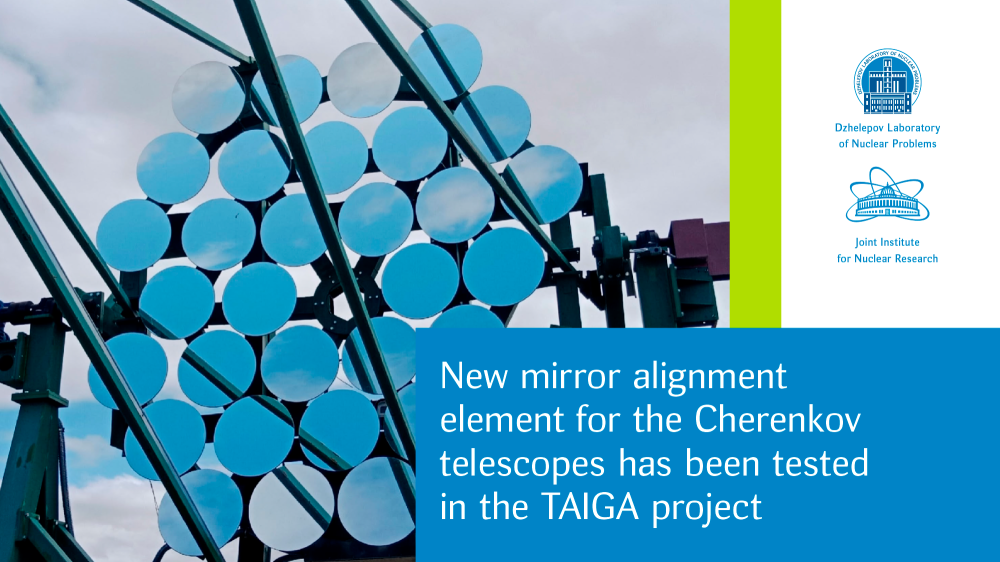
The mirror positioning accuracy is about 0.05 mm on unidirectional positioning. The movement of the actuator rod is controlled by optical and mechanical end-position sensors, one on each of the two actuators. This solution will allow for evaluating the effectiveness and prospects of their application both in terms of reliability and from the standpoint of dimensional constraints and price.
The unit was installed to conduct testing under real operating conditions for the entire 2025-2026 observation season. Satisfactory test results will allow for the full automation of the alignment operation for each telescope in the TAIGA project in the future.
For the reference:
The TAIGA project is designed to study the high-energy part of the Universe's gamma-ray spectrum, primarily the energy range above 10 TeV. The main research goal is to find an answer to the question of the origin of cosmic rays in the range from $10^{14}$ to $10^{18}$ eV. The experiment is located near the southern end of Lake Baikal at the astrophysical testing area in the Tunka Valley (Republic of Buryatia) and consists of several facilities that measure the parameters of extensive air showers generated by the interaction of cosmic rays or high-energy gamma rays with the atmosphere. From these measurements, the arrival direction, type, and energy of the cosmic rays can be reconstructed. Measurement accuracy is enhanced by the combination of different detection systems. Simultaneously, research is being conducted on the TAIGA prototype to increase the observatory's sensitivity through the use of new sensor technologies and more extensive effective areas of the facility – up to a tenfold increase.
Photo and text by Andrei Vladimirovich Shaikovsky, leading engineer of Sector 4 of the DLNP Department of Particle Physics.
News of the laboratory