JINR Youth Grants 2021: Artem Vasyukov
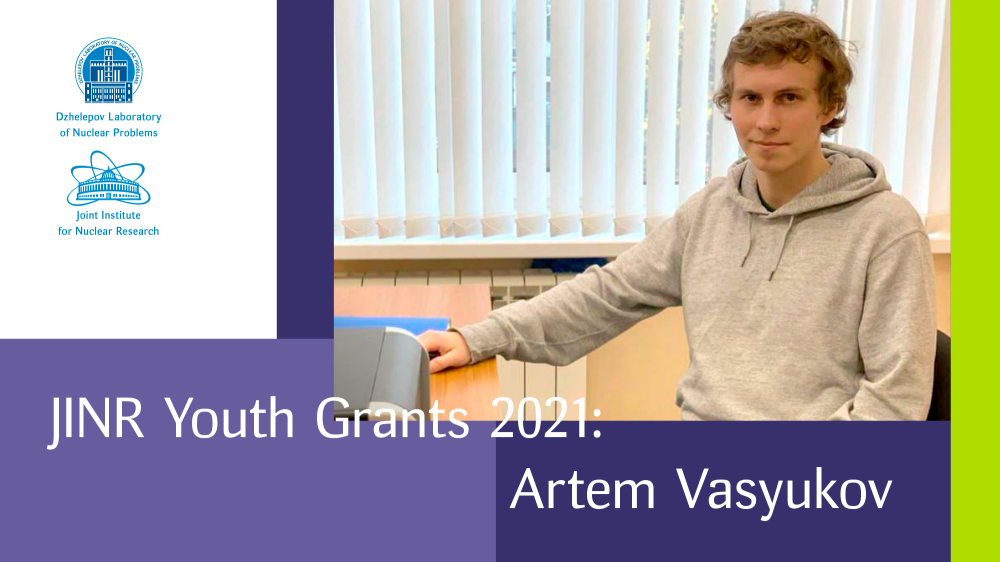
Artem Vasyukov | Photo by Irina Sidorova
– Artem, please tell us a bit about yourself.
– When I was studying at MIPT, each department collaborated with specialized organizations, whose staff members conducted admission interviews, gave lectures to students, and became scientific supervisors. My department, the Department of Fundamental and Applied Problems of Micro-world Physics, had JINR and IHEP as such supervisors. During my enrollment, Aleksandr Sergeevich Zhemchugov interviewed me, and since the second year, Georgy Aleksandrovich Shelkov gave lectures.
During one of the computing classes, Ivan Vladimirovich Eletsky, my current scientific supervisor, a senior researcher at the Sector for Theoretical Support of High Energy Physics Experiments of the DLNP Department of Colliding Beams came to us. He talked about his work at the Laboratory of Nuclear Problems, and it interested me. I first came to Dubna during my fourth year and started working at JINR as a laboratory assistant at the University Centre. After defending my bachelor's thesis, I actively engaged in scientific research in the field of data analysis within the ATLAS collaboration. Since 2018, I have been an staff member of the DLNP Department of Colliding Beams.
The main area of my scientific interests is hadron spectroscopy, where I am involved in the search for and study of multiquark hadronic states, such as tetraquarks and pentaquarks. The existence of these states was predicted by Murray Gell-Mann's quark model of hadrons in 1964. Their search has been ongoing since the 1960s, however, the first candidate for an exotic tetraquark state, χc1 (also known as X(3872)), was discovered only in 2003 by the Belle collaboration, and since then this field has been actively developing. Why am I interested in it?
Strong interactions at low energies are still poorly described from the point of view of quantum field theory due to the behavior of the interaction constant. Therefore, the main theoretical calculations are currently performed using numerical computations, lattice calculations. Theoretical models based on such calculations have insufficient accuracy and predictive power. Therefore, the experimental search for new hadronic states and the precise measurement of their parameters is a topical task in modern high-energy physics.
Currently, as a part of the group of researchers (which includes Ivan Vladimirovich Eletsky from JINR, Leonid Konstantinovich Gladilin from Moscow State University, and Konstantin Ivanovich Beloborodov from Novosibirsk State University), within the ATLAS experiment, I am analyzing data from the Run 2 session of the Large Hadron Collider (CERN) and preparing for the start of the Run 3 session.
We are studying the decays of B-hadrons, such as B0→J/ψKπ, Bs→J/ψKK, Λb→J/ψpK, with the aim of studying multiquark intermediate states. We are now completing the analysis of B0→J/ψKπ decays to study the properties of the tetraquark state of Zc(4200). During the study of these decays, other states such as Zc(3900) and Zc(4430) were also included in the analysis, and the measurement of their parameters is also planned within this analysis.
My area of activity also includes computing and mathematical statistics: they are directly related to data analysis.
In addition to data analysis and computing, I am involved in optimizing Level-1 topological triggers, which is my qualification task for authorship in the collaboration. I am also a postgraduate student at the University of Dubna.
– Which projects and works from the past and current year have you included in the grant application?
– I have included a number of tasks related to the analysis of B0→J/ψKπ decays for the search and study of the exotic Zc(4200) state in the grant work. This includes measuring the parameters of this state (mass, width, spin and parity), obtaining statistical and systematic uncertainties, calculating significance using the Toy Monte Carlo generation method or developing an alternative method, since the method using pseudo-data generation is too expensive in terms of computing resources.
The outcome of the work should be the confirmation of the analysis within the collaboration and the publication of a paper.
– How do you assess the preliminary results of the grant work for 2021?
– As part of the work for 2021, the parameters of Zc(4200) were measured. In the process, we also included Zc(3900) and Zc(4430) as intermediate states in the planned measurements, which, in my opinion, made this work more interesting. Certainly, the time to complete the task increased because of this, which is why we haven't been able to confirm the analysis within the collaboration yet. It is now practically completed and we expect that the next editorial board, which will take place at the end of the year, will confirm the analysis and approve the publication of the paper.
We also adapted an algorithm for determining the significance of the obtained result for our analysis, which does not require generating pseudo-data. We decided to abandon Toy Monte Carlo generation as too expensive in terms of computer resource usage, and are using a new method developed by ATLAS collaboration representatives Eilam Gross and Ofer Vitells.
Overall, I assess the results of the grant application work positively. The confirmation of the analysis in the collaboration and the publication of the paper have been somewhat delayed, but in the meantime, we have carried out an additional large volume of interesting measurements.
– Do you plan to apply for the 2022 grant?
– Yes, the grant helps structure the work and serves as additional motivation for completing tasks. I plan to continue work on hadron spectroscopy within the ATLAS experiment. An analysis of pentaquarks is ahead. Furthermore, the analysis of B0→J/ψKπ is coming to an end and the publication of results is planned for next year, 2022. Within the work plans for the next year, an analysis of Bs→J/ψKK decays is also being considered for the search and study of the strange tetraquarks Zcs(4000) and Zcs(4220), discovered this March.
News of the laboratory