JINR Youth Grants 2021: Andrey Maltsev
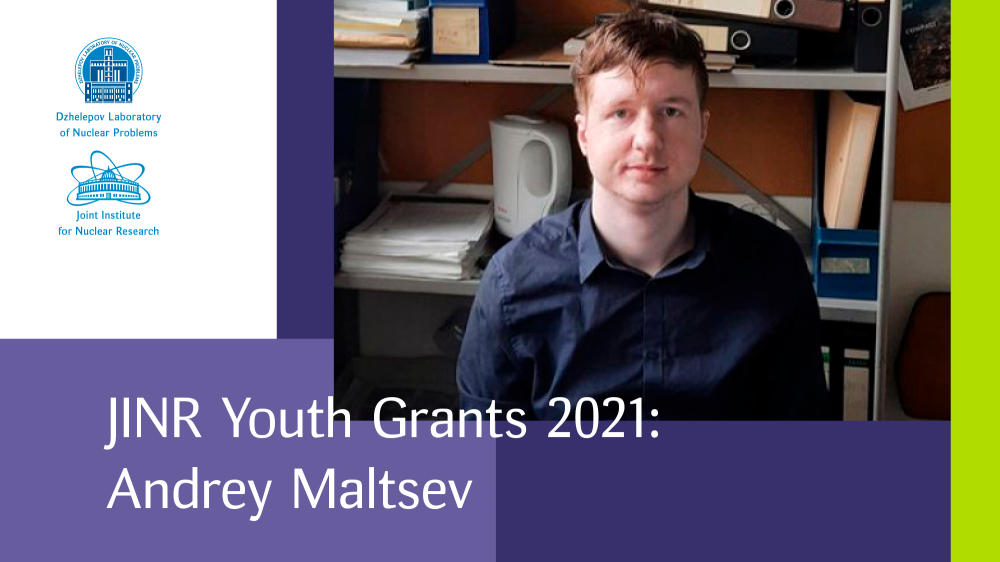
Andrey Maltsev | Photo from the personal archive
— Andrey, tell us, please, a little bit about yourself.
I began my scientific career at JINR in 2016, while I was still a fourth-year student at the Faculty of General and Applied Physics at MIPT (now the Landau School of Physics and Research) on the JINR-based department.
Under the supervision of Doctor of Sciences (Physics and Mathematics) Aleksei Vyacheslavovich Guskov, I began studying the process of electromagnetic scattering of a charged pion on a nuclear target in the COMPASS experiment. Initially, I was fascinated by the very process of obtaining new physical results from experimental data through programming. Data analysis, in particular the study of so-called Primakoff reactions for investigating the low-energy properties of pions and kaons, remains one of my main scientific interests to this day.
At the beginning of 2019, I started working on tasks related to the detection of neutral pions and photons in the electromagnetic calorimeter of the planned SPD facility at the NICA complex. This topic was not new to me, as in the COMPASS experiment I am engaged in a task related to photon detection. Initially, it involved simulating characteristics for different calorimeter configurations, such as spatial and energy resolution. After some time, I began developing algorithms for reconstructing the energy and trajectory of photons, and the corresponding software.
— What projects and work from the past and current year did you include in the grant application?
In the application I included work related to the reconstruction of signals from photons in the SPD electromagnetic calorimeter. I have two main objectives: to develop and implement algorithms for reconstructing photon energies and trajectories, as well as algorithms for separating single photons and neutral pions.
When developing the algorithms, it is necessary to take into account the specifics of the SPD facility related to its configuration and the requirements of physical measurements: the short flight distance of photons relative to the calorimeter cell size and photon energies, the need for good suppression of background from the decay of neutral pions into two photons, and the high angles of particle emission relative to the calorimeter plane.
— Какие проекты и работы за прошлый и текущий год вы включили в заявку на грант?
Я включил в заявку работы, относящиеся к реконструкции сигналов от фотонов в электромагнитном калориметре SPD. Передо мной стоят две основные цели: разработать и имплементировать алгоритмы восстановления энергий и траекторий фотонов, а также алгоритмы разделения одиночных фотонов и нейтральных пионов.
При разработке алгоритмов нужно учесть особенности установки SPD, связанные с конфигурацией и требованиями физических измерений: малое расстояние пролета фотонов относительно размера ячейки калориметра и энергий фотонов, необходимость хорошего подавления фона от распада нейтральных пионов на два фотона, высокие углы вылета частиц относительно плоскости калориметра.
— How do you assess the preliminary results of the grant work for 2021?
The first versions of the algorithms I developed have already been included in SPDROOT — the set of programs and libraries of the SPD experiment for simulation and data processing. This software package was developed by my colleagues on the basis of the ROOT package. I continue to refine the algorithms related to the electromagnetic calorimeter, its simulation, and reconstruction.
Regarding the algorithm for separating photons and neutral pions, at internal SPD collaboration meetings, I have presented attempts to apply neural networks for this task with good results. Subsequently, it is planned to explore the possibility of applying convolutional neural networks. The very idea of using convolutional neural networks is not unique; it has been used, for example, in the ATLAS and MPD experiments. Applying such networks within the SPD experiment is of interest because the distance between particles in the calorimeter is much smaller than in other experiments, so previously used approaches may not work. It is interesting to find out whether such a model can learn to distinguish between photons and neutral pions under the conditions of our experiment.
— Do you plan to apply for the 2022 grant?
Yes, it would serve as additional motivation for me to complete scientific tasks. I plan to continue working on computing for SPD, as well as to finalize my work in the COMPASS experiment by writing an article.
News of the laboratory