2021 JINR Grants for Young Scientists: Elizaveta Cherepanova
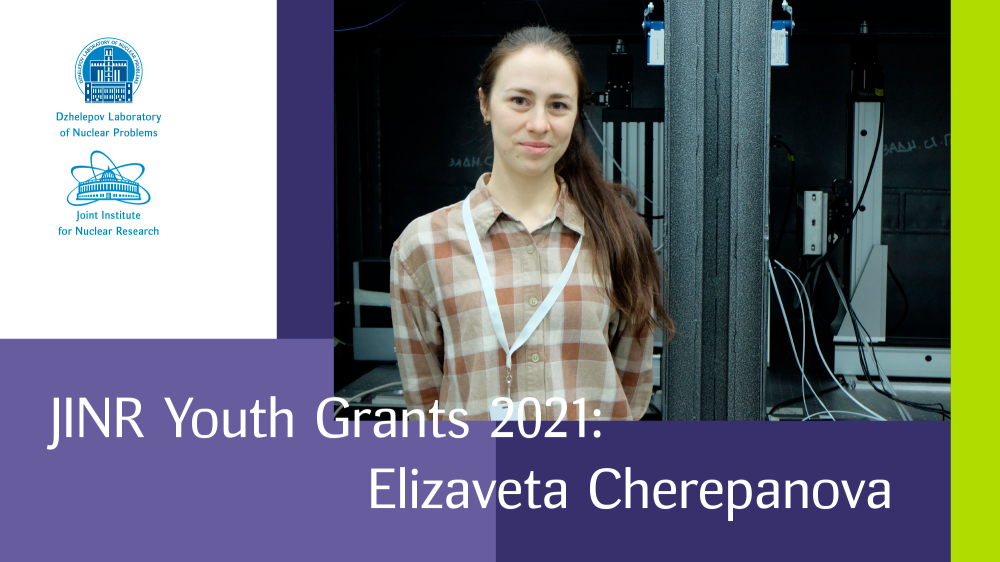
— Elizaveta, could you please tell us a bit about yourself.
I started working at JINR simultaneously with beginning my Master's degree at MIPT: in the Autumn of 2017. I defended my Master's thesis at DLNP under the supervision of Georgy Aleksandrovich Shelkov. It was dedicated to studying the radiation background in the ATLAS detector cavern at the Large Hadron Collider at CERN using semiconductor pixel detectors of the ATLAS-GaAsPix system with gallium arsenide (GaAs) sensors and the Timepix chip.
After completing my Master's degree, I continued this research. Later, work from other areas of pixel detector applications was added, particularly from tomography. Since the summer of 2019, I have been participating in the physical analysis of data from the ATLAS collaboration.
— Which projects and work from the past and current year did you include in your grant application?
In the grant application, I included work concerning various applications of semiconductor pixel detectors. One of them is the study of the radiation background in the ATLAS detector cavern mentioned before. The detectors of the ATLAS-GaAsPix system were installed in the Large Hadron Collider ATLAS detector cavern in 2016-2017. By that time, the ATLAS-TPX detector system was already operating there, the main difference of which was the use of silicon (Si) sensors. The use of GaAs in our detectors has several advantages compared to Si. The main advantage, which formed the basis for one of the methods for estimating the neutron background, is the ability of GaAs to be activated by neutrons. The developed method allows estimating the level of radiation background from neutrons based on the analysis of decay curves of As and Ga isotopes.
The proposed methodology does not use information about the shape and size of particle tracks left in the pixel detectors, which would provide a better understanding of the structure of the radiation background in the cavern. Therefore, one of the tasks became the development of an algorithm for track reconstruction in so-called twin detectors, which are assemblies of two detectors with sensors placed one above the other.
The second task was to refine the obtained results by irradiating the detectors of the ATLAS-GaAsPix system at the IBR-2 reactor.
Another area of pixel detector application is multi-energy computed tomography. The grant application included the task of setting up and calibrating Medipix3RX detectors with Si and cadmium telluride (CdTe) sensors for conducting measurements in the radiation-shielded Kalan-2 cabinet. The task included designing internal mounts for the setup components, creating software to control its parts, conducting the actual measurements, and developing methodologies for studying the composition of the scanned samples.
— How do you assess the preliminary results of the work under the 2021 grant?
I believe the preliminary results of the work are good. An article on the radiation background analysis was published at the beginning of this year. A patent was obtained for the method of measuring the intensity of radiation of unknown composition developed during the research. Initial algorithms for identifying MIP particles passing through both sensors of the twin detectors have been created. Unfortunately, we had to cancel measurements using IBR-2. This was influenced both by the coronavirus and by changing priorities within the group.
The Kalan-2 radiographic cabinet is fully equipped; software for controlling the X-ray tube and for processing data from the Medipix3RX detector has been written. The development of methodologies for studying the component composition of materials has begun and is ongoing.
— Are you planning to apply for the 2022 grant?
I'm still thinking about it. There is still a lot of work left on the project. But perhaps I should give others a chance to receive a grant?
Photo by Irina Sidorova.
News of the laboratory