JINR Youth Grants 2021: Nadezhda Rumyantseva
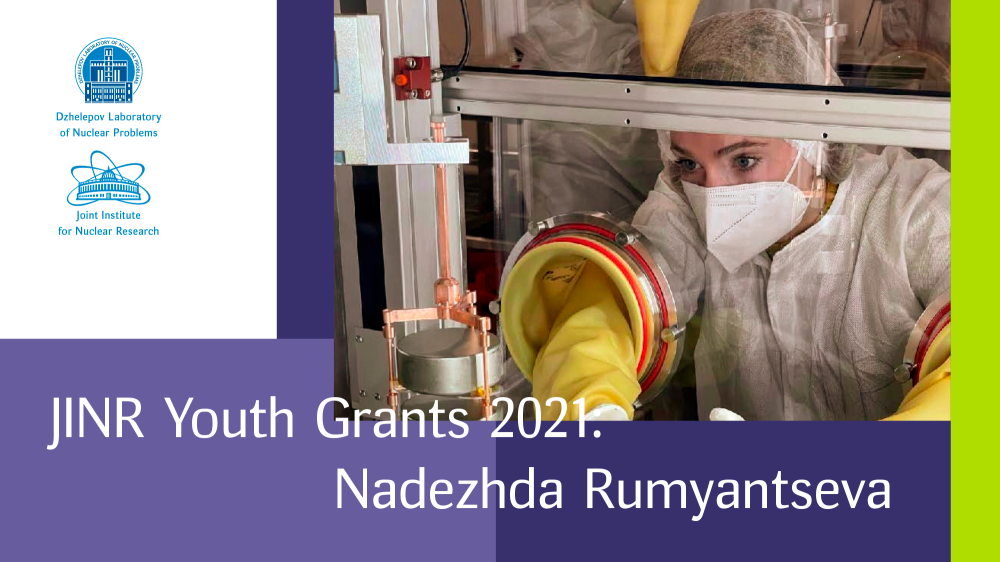
— Nadezhda, could you please tell us a bit about yourself.
In 2011, I graduated from the Physics and Mathematics Department of the Nekrasov State University specializing in Physics. I completed my scientific and industrial internship at the DLNP Department of Nuclear Spectroscopy and Radiochemistry, which culminated in a thesis titled: "Analysis of gamma-ray spectra accompanying the capture of negative muons by carbon nuclei".
My scientific supervisor is Konstantin Nikolaevich Gusev, candidate of sciences (Physics and Mathematics), senior researcher at the Department of Nuclear Spectroscopy and Radiochemistry, and leader of the LEGEND project at JINR.
My area of scientific interest is neutrino physics — neutrinos being one of the most mysterious particles. A neutrino is an elementary particle with a very small mass. It belongs to the lepton class and can participate only in weak and gravitational interactions. However, to this day, the question remains open: is a neutrino different from its antiparticle, or are they identical (i.e., is the neutrino a Dirac or a Majorana particle)? Experiments searching for neutrinoless double beta decay (0νββ) are, apparently, the only way to prove that the neutrino is a Majorana particle. One of the most successful experiments in the search for 0νββ decay was the GERDA experiment, in which I was directly involved. GERDA completed data taking in 2019, achieving an unprecedented lower limit on the half-life of 0νββ decay in Ge-76 of $T^{0\nu}_{1/2} > 1.8 · 10^{26}$ years, which in turn sets a limit on the effective Majorana mass ($m_{\beta \beta} < 79 - 180$ MeV). However, the search for 0νββ decay in Ge-76 will continue in the next-generation experiment LEGEND, which is currently in an active preparation stage for launch.
Furthermore, to calculate the effective Majorana mass, it is necessary to know the nuclear matrix elements (NMEs). Their theoretically calculated values differ noticeably from one another depending on the chosen nuclear model used for the calculation (hence the "corridor" of values in the limit on $m_{\beta \beta}$). However, the process of muon capture by nuclei can provide experimental information on nuclear structure, which can aid in NME calculations. One such experiment, in which I am actively involved, is MONUMENT.
— Which projects and works from the past and current year have you included in the grant application?
The grant application included work related to both the LEGEND and the MONUMENT experiments.
For the LEGEND project, this includes, for example, the search for, study of, and application of low-background materials, as well as manufacturing techniques for structural components, which are necessary to reduce the background index compared to the GERDA experiment. By selecting a low-background material with low density and moving to the application of new manufacturing technologies (such as 3D printing), the contribution of the detector system's structural elements to the overall background can be significantly reduced. Furthermore, the application included studies of new types of germanium detectors with large mass but good energy resolution and high efficiency for selecting useful events based on pulse shape.
For the MONUMENT experiment, this involves participation in processing the data obtained in the 2019 muon-capture study experiment at PSI (Paul Scherrer Institute, Switzerland) to determine muon capture rates. These results are necessary for assessing the applicability of various theoretical models in describing nuclear excitations, which is important, in particular, for NME calculations.
— How do you assess the preliminary results of the work under the 2021 grant?
At the moment, a significantly larger volume of work has been completed than was planned for both experiments. This is due to the fact that in 2021, business trips abroad became possible again, as both LEGEND and MONUMENT are international experiments located in Italy and Switzerland, respectively. Throughout this year, I have been actively involved in preparing the LEGEND experiment, participating in all stages of work related to germanium detectors (mounting detectors in holders, test-assembling detectors into strings, etc., including using 3D-printed structural elements made from the studied materials), as well as in creating a new active liquid argon veto system. Additionally, I have been engaged in preparing and assembling the detection setup at the negative muon beam at PSI for the MONUMENT experiment, which is currently taking data.
— Are you planning to apply for a grant in 2022?
Yes, I will participate in the grant competition for 2022. The LEGEND experiment is in an active preparation stage for the start of data taking; we have a lot of work ahead to launch the experiment. The beam time for the MONUMENT project in 2021 is coming to an end; however, we have processing of the accumulated data waiting to be done and, certainly, preparation of publications. A grant is an incentive to move forward without deviating from the planned course.
News of the laboratory