JINR Youth Grants 2021: Ilya Vasilyev
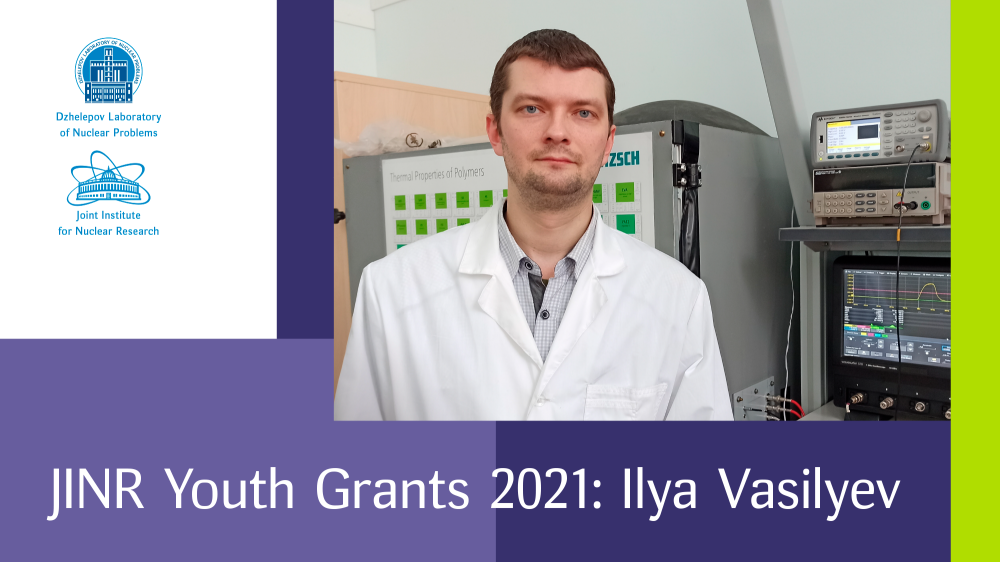
— Ilya, could you please tell us a bit about yourself?
— I was born and raised in Dubna, so from an early age I was familiar with the magical acronym "JINR". I don't know if it was because I grew up in a city of physicists or if it just happened by chance, but despite the fact that my parents have no connection to physics, in 2005 I entered the Faculty of Physics at Lomonosov Moscow State University and successfully completed my studies in 2011. I came to work at the Laboratory of Nuclear Problems in the summer of 2016 and since then have been engaged in the development and research of detector characteristics based on organic and inorganic scintillators, as well as studies of the properties of the scintillators themselves.
I participated in the creation of the muon veto system for the Mu2e experiment, worked on finding ways to increase light collection from the long scintillator strips that are part of this system. I also took part in the preparation for the creation of the Mu2e electromagnetic calorimeter, in particular, I studied the scintillation properties of CsI crystals, on which this calorimeter is based. My scientific supervisor is Yuri Ivanovich Davydov, head of the DLNP Department of Multiple Hadron Processes.
— What projects and work from the past and current year did you include in your grant application?
— I included two items in the grant application for 2021: a study of the radiation hardness of Yttrium-doped BaF2 scintillator crystals measuring 10x10x10 mm, and the creation of a prototype compact hodoscope based on square-section scintillating fibers.
— How do you assess the preliminary results of the work under the 2021 grant?
— Unfortunately, work on the first item had to be postponed for now: it became necessary to "play with different blocks". On a more serious note, our team, which includes staff members of the Department of Mutiple Hadron Processes, joined the work on upgrading the near detector of the T2K experiment (Japan), the main elements of which are polystyrene-based scintillator cubes measuring 10x10x10 mm. We needed to measure light leakage from one cube to another, as this characteristic is very important for correctly describing the detector in simulation programs, and we also needed to determine the effect of elevated temperature on the scintillation characteristics of the cubes and light leakage. We have now completed these measurements, and a publication is being prepared based on the results.
As for the second item in the application - the hodoscope prototype - I am pleased with the progress. The idea to create a device that could be used both for monitoring the electron beam at our LINAC-200 accelerator, and as a fast trigger for recording useful signals, and for detecting cosmic muon tracks, arose in our team several years ago. Only after several iterations, discussions with colleagues, and the creation of bulky prototypes, were we able to take into account everyone's wishes and comments and create a relatively compact device based on scintillating fibers and silicon photomultipliers. Now the two-coordinate hodoscope prototype has been tested with a collimated low-energy electron source and has shown good results in terms of spatial resolution. Plans include creating another two-coordinate hodoscope prototype, equipping the prototypes with next-generation electronics based on the CITIROC 1A / PETIROC 2A chip, developing software for data readout and processing, as well as testing the prototypes with cosmic muons and electron beams from the LINAC-200 accelerator.
— Do you plan to apply for the 2022 grant?
— Yes, I plan to submit an application for next year. The plans are to continue research on scintillator cubes for the T2K experiment, to create an automated test bench for testing long scintillator counters for the muon veto system of the COMET experiment, and to continue work on creating the hodoscope.
We thank Ilya for sharing your story. We wish him success in his work, interesting discoveries, and new scientific projects!
News of the laboratory