JINR Youth Grants 2021: Aleksandr Antoshkin
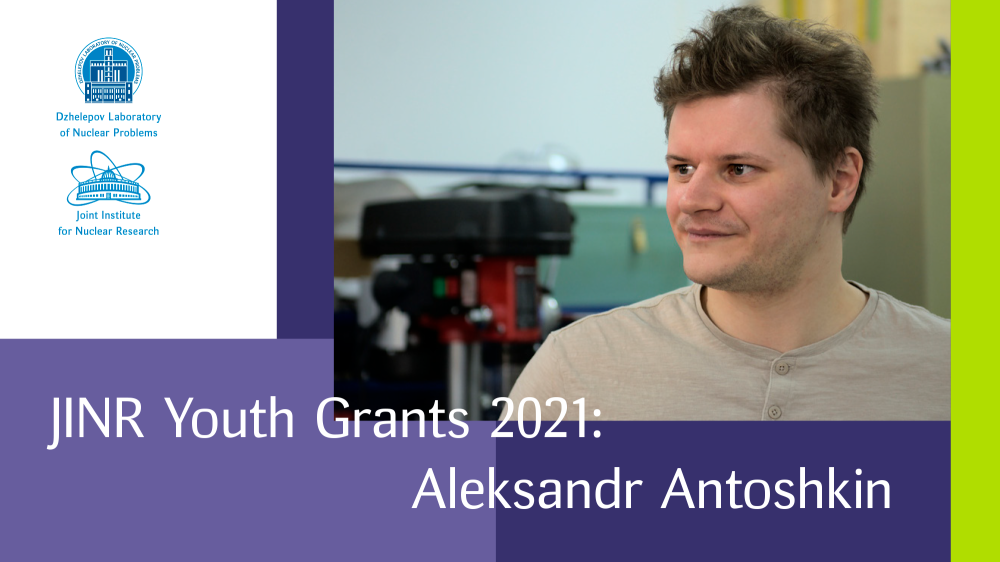
Aleksandr Antoshkin | Photo by Anastasia Malyshkina
— Alexander, could you please tell us a bit about yourself.
— I started working at JINR while studying at Skobeltsyn Institute of Nuclear Physics, Lomonosov Moscow State University; I defended my diploma thesis in DLNP under the supervision of I. A. Tyapkin. I completed my postgraduate studies at the Laboratory of Nuclear Problems and have been working here since 2014. Together with colleagues from the group of Z. V. Krumshtein and N. V. Anfinov, I worked on electromagnetic calorimeters for the COMPASS project (CERN), then joined the work on the NOvA experiment. In fact, that is my primary focus now.
My interests in the Laboratory could be called dual: I enjoy solving both technical and scientific issues. I started with work on the "hardware", taking measurements, and later became interested in analysis as well. This is very convenient: analyzing data when you fundamentally understand how the instruments work. A test stand with electronics for the NOvA experiment has already been assembled and debugged. Currently, I am assembling and testing a scintillator test stand for the NOvA experiment and, in parallel, working on physics tasks related to the search for magnetic monopoles and analyzing data.
— Which projects and tasks from the past and current year did you include in your grant application?
— In my application, I included the technical work with the scintillator test stand for the NOvA experiment and the analysis of data obtained from this stand, as well as developing a software trigger for the same experiment.
The NOvA detector is filled with liquid scintillator, a substance based on mineral oil with special additives. When particles pass through it, part of their energy is converted into light, which can be detected. This is convenient for studying neutral particles, as they can primarily be detected this way.
At our test stand, we measured certain parameters of the scintillator, for example, the Birks' coefficient. One of my tasks was to assemble a new configuration of the stand to additionally measure the Cherenkov light component in the light output.
The next item in the application is testing a trigger for the detector. This is a procedure that, based on given criteria, selects events interesting for analysis from the vast amount of data collected by the detector and saves them to a hard drive. It should be noted that before starting the tests, we had to ensure the correct operation of the software after updating the NOvA experiment's operating system, which took a lot of our time and effort.
After that, we began testing a new version of the trigger. Our tests showed that it works better (selects more events "interesting" for analysis and fewer obviously false ones) and is more stable than the previous version. From 2021 to 2025, we will be collecting data using it. However, the effect of its implementation will only be seen in the future because events selected by the new trigger version will be analyzed later.
And the third block of tasks in my application is data analysis. In 2016, we worked on the NOvA experiment with a low gain of the avalanche photodiodes (the main light-sensing element of the detector). We have already processed that data. In 2016, the gain of the avalanche photodiodes was increased to improve the detector's sensitivity (it became possible to detect lower particle energies). Our task is to process the data collected during this period. To do this, we are improving selection algorithms, adding extra variables and criteria to "extract" the data we are interested in from the collected data.
I also included an additional task in the application: administrative work to designate room 105 in building 4 as a radiation-hazardous area (RHA), so that radioactive sources can be used there and measurements can be taken on the scintillator test stand.
— How do you assess the preliminary results of the grant work for 2021?
— I believe they are quite good. We prepared our scintillator test stand for work with the NOvA experiment's scintillator, with the capability to measure the Cherenkov light component. We achieved correct software operation after the system update and successfully tested the trigger. We have almost completed the designation of room 105 in building 4 as an RHA; only some formalities remain. Therefore, for now, we have assembled the stand in the "Dark Room" of the Green Laboratory, not in the RHA room, and are testing the liquid scintillator not with gamma sources but with cosmic muons. As soon as the final formalities are settled, we will move the stand to the RHA room and will work with sources.
— Do you plan to apply for the 2022 grant?
— Yes, I plan to apply again. After all, the work stated for 2021 will continue in the future: we will collect and analyze data, improve selection algorithms, and study the properties of the scintillator.
We wish Aleksandr success in his scientific work and further success in competitions!
News of the laboratory