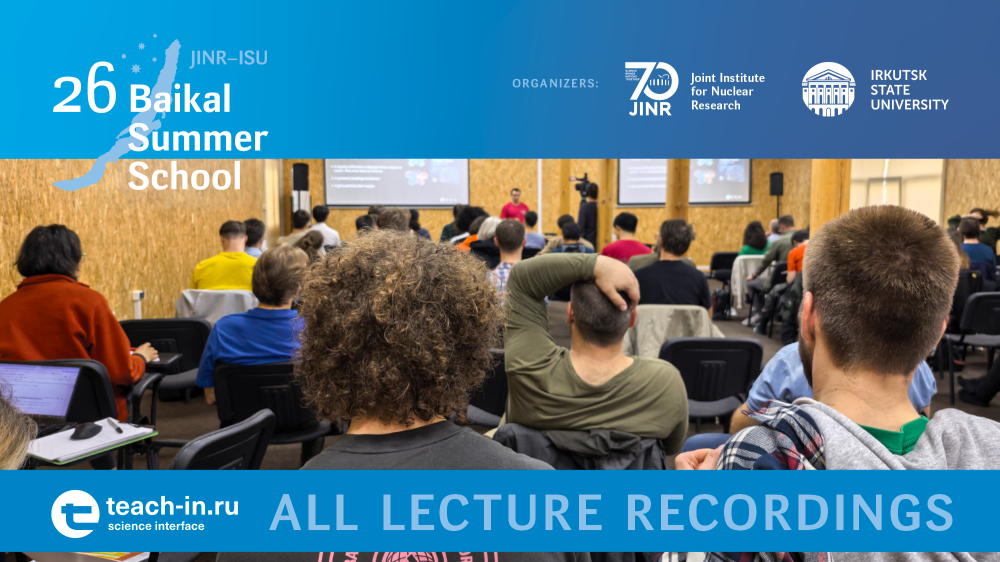
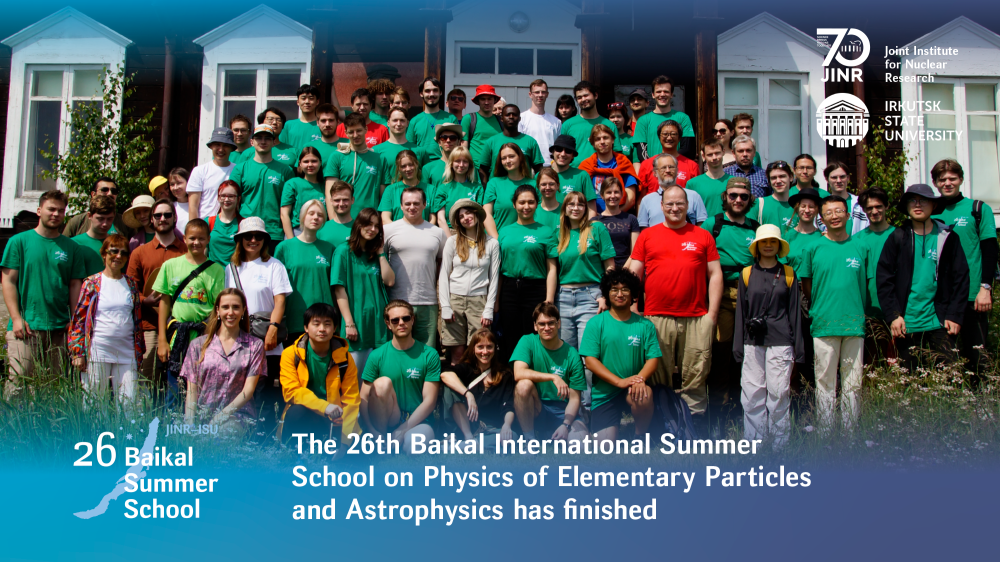
The 26th Baikal International Summer School on Physics of Elementary Particles and Astrophysics has finished
For the second consecutive year, the school has received sponsorship from the Autonomous Non-Profit Organization "Scientific and Methodological Center 'Teach-in'" provided for MSU students and school lecturers.
This year 99 participants from Russia, Belarus, Uzbekistan, Azerbaijan, and Rwanda. An extensive programme awaited them: lectures, student reports and a poster session, scientific discussions, projects under the guidance of supervisors. This year the lecturers of the school included: Dmitry Naumov (JINR), Dmitry Gorbunov (INR RAS), Sergey Troitsky (INR RAS), Grigory Safronov (INR RAS), Emil T. Akhmedov (MIPT, ITEP), Andrey Sheshukov (JINR), Liangjian Wen (IHEP, China), Junting Huang (SJTU, China), Zhi-zhong XING (IHEP, China), Dmitry Bylinkin (MIPT), Dmitry Karlovets (ITMO University), Maxim Barkov (INASAN), Evgeny Derishev (IAP RAS), and Elena Nokhrina (LPI). The conference topics were diverse: cosmology, introduction to particle physics, stars and new physics, gravitation, black holes, UHE neutrino telescopes, simulation software, neutrino physics, vortex states, etc.
“The Baikal School is not only a series of lectures delivered at a particular place. It is a comprehensive research and educational environment where students and young researchers listen to leading experts, discuss real-world problems in modern physics, work on group projects, and present their own scientific results. It is important that the school brings together particle physics, neutrino physics, astrophysics, cosmology, and simulation software and data analysis. It is this type of interdisciplinary training that is required today for participation in major scientific experiments.
The Baikal School is a school of life where young people see the attitude of senior colleagues towards science. Sometimes it is more valuable than the knowledge that can be obtained within a week,” Dmitry Naumov, Doctor of Sciences (Physics and Mathematics), DLNP Deputy Director, Co-chairman of the Organizing Committee of the School.
“This year the school went remarkably smoothly, with minimal logistical or technical issues. I believe such schools are vitally important. Over the years I have spent organizing them, I have often seen how the school has changed students' lives. It was here, on the shores of Lake Baikal, that partnerships formed between young researchers and respected mentors, partnerships that opened doors for these students to leading research centers around the world. But the most amazing thing is the lasting impression it leaves. You might arrive at a research institution thousands of miles from home, only to meet a colleague and realize: he is "one of us", a Baikal School student. We are all forever bound by an invisible yet incredibly strong thread of shared memories,” pointed out Irina Perevalova, Candidate of Sciences (Physics and mathematics), Co-chairman of the Organizing Committee of the Baikal International Summer School on Physics of Elementary Particles and Astrophysics.
For the reference. The Baikal International Summer School on Physics of Elementary Particles and Astrophysics was established jointly by Irkutsk State University and the Joint Institute for Nuclear Research (Dubna) under a cooperation agreement. The main objective of the School is to educate and train undergraduate and graduate students, as well as young scientists, in contemporary aspects of particle physics and astrophysics by leading theoretical and experimental physicists. It also aims to facilitate networking and help young specialists choose their research directions. For the second consecutive year, the school has received sponsorship from the Autonomous Non-Profit Organization "Scientific and Methodological Center 'Teach-in'".
The school is held annually in the small, picturesque village of Bolshie Koty on the shores of Lake Baikal.
Photo by A. Ivanova, A. Konovalov, M. Mishchenko, R. Monkhoev