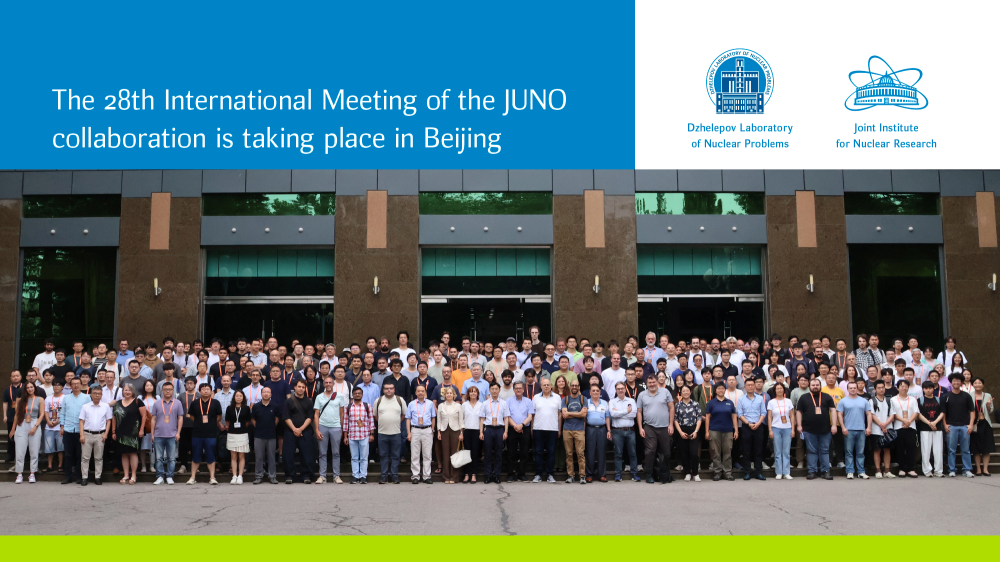
The 27th JUNO international collaboration meeting is being held in China

The meeting will address matters concerning the status of the JUNO detector and its current performance, the data acquisition and processing plan (including the planning of computational resource usage), and will schedule discussions on requirements imposed on future physics results and publications.
The experiment's first result, based on 59 days of data acquisition, was presented in November 2025. The neutrino oscillation parameters Δm²₂₁ and sin²θ₁₂ were measured with record precision.
Staff members from our laboratory have been actively participating in this project since its very inception. At the 27th collaboration meeting, nine of our colleagues represent the Laboratory of Nuclear Problems.
For the reference.
The main aim of the JUNO experiment is to determine the neutrino mass hierarchy. Owing to huge size of liquid-scintillator detector and high accuracy of energy measurement, experiment offers great opportunities for scientific research: from precision measurements of the mixing parameters of the Standard model lepton sector, geoneutrino detection, and observation of neutrino from supernovae to search for new physics, including the proton decay.
Photos by Yuexiang Liu, Anastasia Bolshakova
News of the laboratory