Alina Vishneva: “Saying ‘neutrino physics’, we are implying ‘Bruno Pontecorvo’”
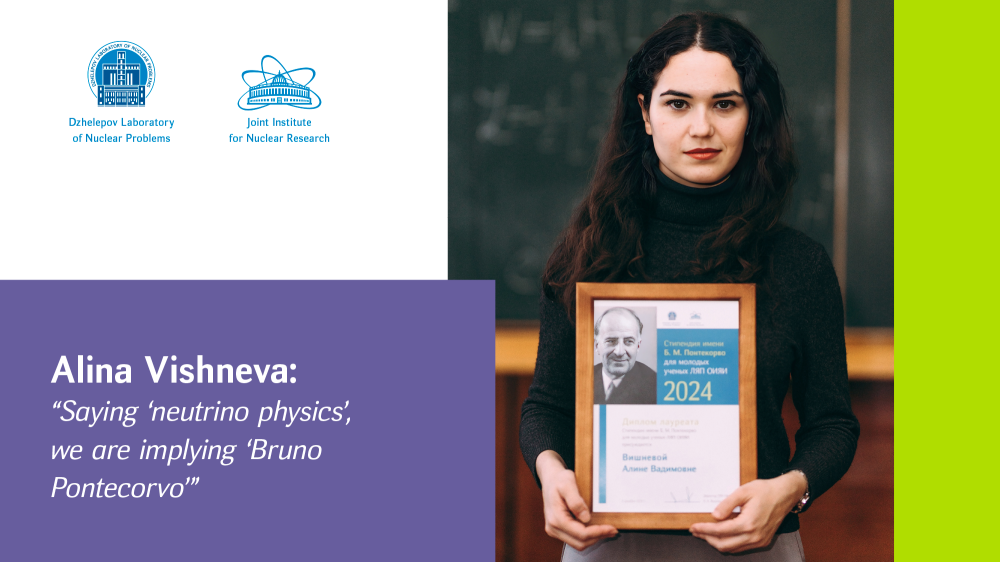
The Group of Scientific Communications asked Alina Vishneva about the experiments she participates in and her plans for the coming year. Alina is a member of the Borexino experiment group, one of the oldest in the experiment: DLNP staff members joined the collaboration at the stage of project discussion. Two years ago, the Borexino detector completed data collection and was shut down, but the analysis of the collected data continues.
In the Borexino project, Alina Vishneva is engaged in developing software for data analysis, as well as directly analyzing data as a part of measuring solar neutrino fluxes and searching for rare processes. Among her achievements, she highlights obtaining record results in the study of fundamental properties of leptons (the world's best limit on the electron lifetime and one of the best limits on the effective neutrino magnetic moment), as well as developing an analytical model of energy response of the Borexino detector. Alina is involved in improving this model so the collaboration can better describe the experiment's data.
A. V. Vishneva was nominated for the Scholarship by the Head of the DLNP Department of Particle Physics A. G. Olshevsky. The scholarship application included two papers on solar neutrinos, two on the analytical model and its implementation into the official Borexino software (using GPU computations), and three papers on rare processes. One of the rare process papers is dedicated to hypothetical electron decay, and the other two to studying the neutrino magnetic moment by detecting neutrinos in the detector and through the search for solar antineutrinos. All the work was carried out within the Borexino experiment.
During the scholarship year, Alina plans to continue her current work: together with the group, she will try to combine the processing of data from all three phases of the Borexino experiment. Previously, they were processed separately. Scientists plan to improve the analytical model of the observed energy spectrum to obtain more accurate measurements. These will be measurements of solar neutrino fluxes and, possibly, constraints on rare processes. Within the year, Alina expects to complete her work tasks in the Borexino experiment and switch to other projects.
"Receiving the Pontecorvo Scholarship is a great honor for me. Bruno Maximovich was one of the founders and pillars of neutrino physics at JINR: saying ‘neutrino physics’, we are implying ‘Bruno Pontecorvo’. I am proud to work in the same laboratory where the famous scientist worked and to continue his work in science."
News of the laboratory