Embassy of Japan in Russia visits JINR
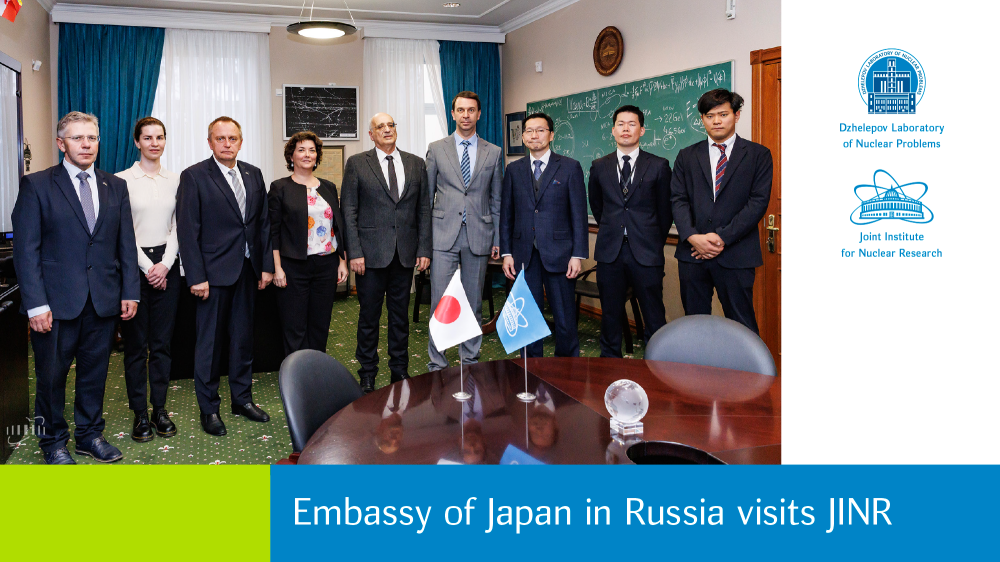
During the meeting with the JINR leadership, Ambassador Extraordinary and Plenipotentiary of Japan in Russia Akira Muto thanked the institute for its long-term participation in international projects with Japan, particularly in the T2K neutrino experiment. He also noted that the joint work with the RIKEN institute on the synthesis of the 113th element, nihonium, in the first half of the 2000s was a vivid confirmation of successful scientific partnership.
"Modern science cannot develop in isolation and requires global cooperation," said Director of the Laboratory of Nuclear Problems Evgeny Yakushev, "Cooperation with Japan, which holds leading positions in world science, is especially important for JINR. We want to exchange experience with colleagues, jointly create new experimental facilities, and conduct research both in Dubna and at Japanese scientific organizations."
Liudmila Kolupaeva, deputy head of the Department of Particle Physics at DLNP JINR, spoke about the specifics of fundamental research in particle physics. "The implementation of large-scale projects, such as T2K in Japan or NICA in Dubna, requires the combined efforts of large international collaborations. There is no country in the world capable of conducting such research alone," she emphasized, "JINR has unique experience in neutrino physics, which we are ready to share with Japanese colleagues."
In conclusion of the meeting, Grigory Trubnikov emphasized that the Joint Institute for Nuclear Research conducts exclusively peaceful fundamental and applied research, the results of which are equally accessible to all JINR Member States. Through the Embassy representatives, the director also invited Japanese specialists to cooperate in such areas as particle physics, materials science, theoretical physics, and information technology.
The visit of the Embassy of Japan delegation made it possible to determine steps for the further development of promising science and technology cooperation between JINR and Japanese institutes.
Source: JINR
News of the laboratory