JINR Youth Grant 2021: Dmitry Fedoseev
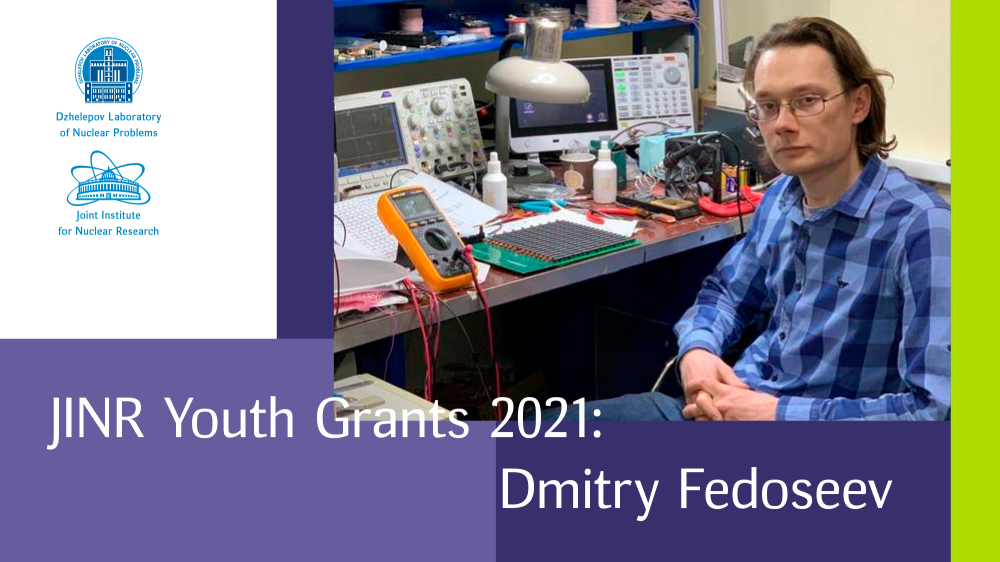
Dmitry Fedoseev | Photo by Irina Sidorova
— Dmitry, tell us, please, a little bit about yourself.
I was born and raised in Dubna. My introduction to the fundamentals of my future profession, like many of my colleagues, took place at the local Young Technician Club, whose teachers included staff members of the Joint Institute for Nuclear Research, willing to share invaluable experience with the younger generation. My mentor, who laid the foundation for my professional interests, was Doctor of Technical Sciences Yuri Ivanovich Romanov, a highly qualified specialist, author of several inventions, a talented and broadly educated man. Under his wise guidance, we learned to read diagrams, analyzed the operating principles of various mechanisms, designed and independently manufactured printed circuit boards, and assembled and tuned our own electronic devices.
After graduating from the high school, I enrolled at MIREA (Moscow Institute of Radio Engineering, Electronics and Automation), with the specialization “Industrial Electronics”. Soon after, in 2006, while still being a junior student, I started working at JINR, first as a laboratory assistant and, after some time, became an engineer.
From the very beginning of my work in the Laboratory of Nuclear Problems, I was engaged in the development and manufacturing of various instruments, devices, and parts necessary for testing and studying the characteristics of photomultiplier tubes (PMTs), semiconductor photodetectors, and particle detectors based on them. I participated in the work on creating a calorimeter for COMPASS: from testing individual technical solutions and various structural elements, components, and prototypes, to the final assembly of the detector at CERN. This required solving a wide range of tasks: besides design work, a lot of associated radio-electronic assembly and manufacturing of mechanical parts, bench and detector components was performed. This included using metal-cutting machines, the skills for which I learned from qualified specialists in our workshops. Undoubtedly, these skills are a serious asset both for an engineer and for an experimenter engaged in applied tasks, allowing them to be performed at a different, higher technical level.
Later, our team joined work on detectors for neutrino physics, the JUNO, TAO, NOvA, DUNE projects. We created equipment (scanning stations) for studying the zonal characteristics of large, twenty-inch PMTs for the JUNO experiment. Within this activity, I was involved in developing the rotating mechanical part holding the PMT, the scanning unit, as well as the electronic equipment for signal readout, pulse counting, controlling pulsed light sources, drives, etc. Currently, I am participating in work on creating the light readout system for liquid argon TPCs for the DUNE experiment and preparing a test stand for SiPM matrices for TAO. My area of responsibility is the front-end electronics of the light readout system. The main elements of the system are LСMs—Light Collection Modules, plates with wavelength-shifting fibers fixed on them. The surface of the fibers is coated with tetraphenylbutadiene (TPB) or a similar substance, enabling the detection of scintillations occurring in liquid argon. The fiber ends are bundled and connected to photodetectors—SiPMs. The latter generate electrical signals fed to the inputs of pre-amplifiers. The pre-amplifier boards are placed in close proximity to the light collection modules and the charge readout system boards inside the liquid argon chamber, imposing strict requirements on reliability, dimensions, and power dissipation. The electrical signals from the pre-amplifiers, after passing through micro-coaxial cable assemblies, go to the inputs of main amplifiers with variable gain and then to the ADCs. The 96-channel light readout system prepared at the beginning of the year was successfully tested as part of the Module 0 prototype. The module testing was conducted at the University of Bern, after which the module was sent to Fermilab. Currently, preparation of upgraded equipment for the next prototype, Module 1, is underway. In the future, our team plans to begin preparing for the production of equipment for 8000 channels.
— What projects and work from the past and current year did you include in your grant application?
The application for 2021 included work on NOvA/DUNE and JUNO/TAO: they are quite substantial and will continue into next year.
— How do you assess the preliminary results of the 2021 grant work?
Despite the difficult epidemiological situation which required adjustments and sometimes remote work, the preliminary results are quite good: PMT testing for JUNO is in its final stages. We assembled our own stand for studying light collection modules and coatings in liquid argon without sending it to Bern, and the first Module 0 chamber prototype was assembled and tested. Based on the test results, necessary improvements were made to the design of the next prototype, Module 1. We are preparing for new testing.
— Do you plan to apply for the 2022 grant?
Yes, I plan to apply for the 2022 grant. The plans include further work on the ArgonCube light readout system—preparation for the production of front-end electronics for 8000 channels, participation in the development and testing of full-scale prototypes. It is also planned to create a mass testing stand for SiPM matrices for the TAO project. All this work will undoubtedly require serious engineering and technical support.
News of the laboratory