JINR Youth Grants 2021: Mikhail Zarubin
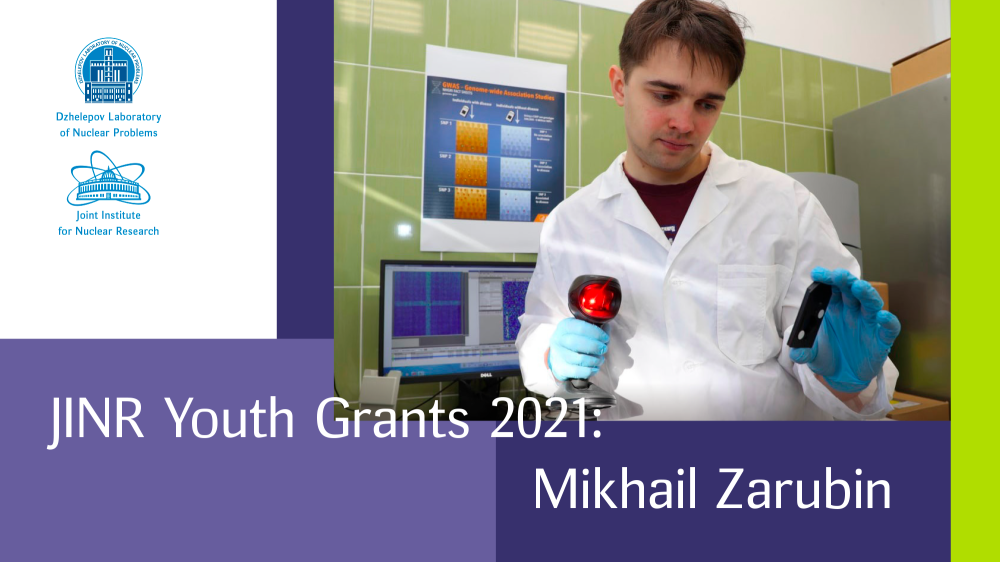
— Mikhail, could you please tell us a bit about yourself.
At university, I was engaged in scientific work at the A. N. Belozersky research institute MSU. I began working at the DLNP JINR in 2019 while pursuing my postgraduate studies in "Biophysics" at the Department of Bioengineering of the Faculty of Biology at Moscow State University. The main theme of my research is studying the mechanisms of extreme resistance of living organisms to various stress factors using molecular biological methods.
— Which projects and work from the past and current year did you include in your grant application?
For the 2021 grant, I included work on studying the response of organisms to a reduced natural radiation background. This is a rather unusual but actively developing field of research in recent years, explaining the occurrence of biological responses to chronic background levels of radiation. Such experiments require conditions with almost complete suppression of the natural radiation background, so we conduct this work in a unique location: at the Baksan Neutrino Observatory of the INR RAS (BNO). The observatory was created in the 70s of the last century for research in the fields of particle physics, atomic nuclei, cosmic rays, and neutrino astrophysics. The BNO consists of complexes of surface structures and underground laboratories located along two parallel tunnels in the thickness of Mount Andyrchi.
DULB-4900, the deepest of the underground laboratories, is located about 4 km from the tunnel entrance under the mountain, which minimizes the contribution of cosmic showers to the radiation background, and equipment with special chambers ensures the suppression of local radiation from the bedrock.
Our laboratory staff members are the first to conduct biological research at the BNO. In general, biologists work together with physicists in underground physics laboratories in different countries: in France (CNRS Modane), Italy (LNGS Gran Sasso), Canada (SNOLAB), and the USA (SURF), but we were the first in the BNO laboratories.
Our work most closely intersects with research conducted by biologists at the Gran Sasso National Laboratory (Italy). The conditions of the Italian experiment to identify biological effects from the suppression of the natural radiation background could be reproduced at DULB-4900 BNO INR RAS, which allowed us to partially compare our data. Furthermore, the biologists at Gran Sasso worked not with individual cells, like other researchers, but with complex model organisms—fruit flies, or Drosophila melanogaster. Such research is much more interesting because individual cells lack nervous, respiratory, and other systems. We also used fruit flies, and they are of the same genetic line as the Italian scientists.
In the Sector of Molecular Genetics of the Cell at DLNP, the most modern omics technologies are available for such research, for example, transcriptomic analysis. This was the novelty of our approach. The transcriptomic method we used allowed us to obtain a complete picture of changes in the regulation of all genes of the model organism and provide a detailed and precise answer to the question of the influence of a reduced radiation background on the life activity of organisms.
We found that in fruit flies after a two-week experiment in the DULB-4900 chambers, neuroregulation of responses to external stimuli, immune response, and primary metabolism changed compared to control groups located on the surface. Our data on Drosophila stress responses were used for comparative analysis with other Drosophila stress responses obtained in the work of other researchers through transcriptome analysis. The biological responses in our work turned out to be very small compared to classical responses to radiation exposure; also, the response was non-specific to a whole range of possible environmental stress factors (hypoxia, etc.).
We concluded that the model organisms in DULB-4900 experienced a chronic lack of natural physical stimuli necessary for full development and described the consequence of this.
— How do you assess the preliminary results of the work under the 2021 grant?
— I assess it positively: we are managing to complete the set tasks. This year, we published an experimental (Q1) and a review article (PEPAN) on the topic of biological effects from the suppression of the natural radiation background, we received feedback on the work from colleagues from Gran Sasso, and at their invitation, we made a poster for the Radiation Research Society's 67th Annual Meeting (USA). We have made good progress in understanding how to study chronic (i.e., extended in time) exposure to radiation and other stresses, and how to conduct comparative transcriptomic analysis.
In addition, I conducted a review of biological experiments taking place in underground laboratories around the world. This is a whole layer of research that I was not aware of at the beginning of the work. For example, active research is being conducted in China, where industrial production is planned to be located underground. There is even a whole new field of medicine, Deep Underground Medicine, which studies how prolonged deep underground stays affect human mental and physical health.
I would like to thank my scientific supervisor, Candidate of Biological Sciences E. V. Kravchenko, Deputy Director of DLNP for Scientific Work, Doctor of Sciences (Physics and Mathematics) D. V. Naumov (DLNP JINR), and Head of the Laboratory of the NRI BNO INR RAS, Candidate of Sciences (Physics and Mathematics) A. M. Gangapshev (BNO INR RAS), for the ideas and the opportunity to conduct such research.
— Do you plan to apply for the 2022 grant?
— Yes, I plan to. And we will continue biological research at the Baksan Neutrino Observatory, a unique base for interdisciplinary research.
We thank Mikhail for his story and wish him success in his scientific research and new discoveries!
News of the laboratory