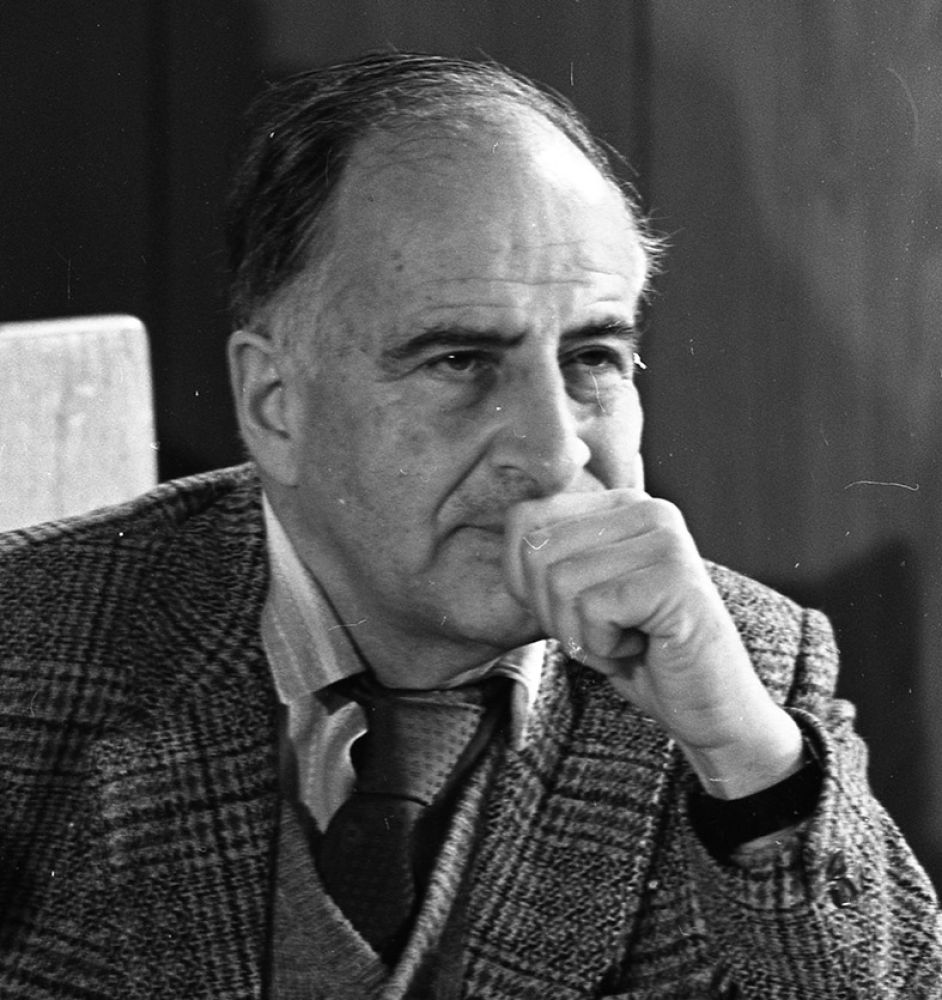
Bruno Pontecorvo Prize
Laureates
2025
Mikhail Shaposhnikov (Institute of Theoretical Physics, École Polytechnique, Lausanne, Switzerland)
for the development of theoretical and phenomenological aspects of the neutrino Minimal Standard Model stimulating its further experimental tests.
2020
Kimio Niwa (Nagoya University, Japan)
for the development of the high-resolution nuclear emulsion technique, which allowed identification of the tau neutrino and direct observation of tau neutrino oscillations.
2019
Fabiola Gianotti (CERN)
for leading contribution to the experimental studies of fundamental interactions and discovery of the Higgs boson."
2018
Francis Halzen (University of Wisconsin, Madison, USA)
for significant contribution to the IceCube detector construction and experimental discovery of ultrahigh-energy astrophysical neutrinos.
2017
Eligio Lisi (INFN, Bari, Italy)
for pioneering contribution to the development of global analysis of neutrino oscillation data from different experiments.
Gianluigi Fogli (University of Bari and INFN, Bari, Italy)
for pioneering contribution to the development of global analysis of neutrino oscillation data from different experiments.
2016
Koichiro Nishikawa (KEK, Tsukuba, Japan)
for outstanding contribution to the study of neutrino oscillation phenomenon and the measurement of the neutrino mixing angle $\theta_{13}$ in the Daya Bay, RENO and T2K experiments.
Kim Soo-Bong (Seoul National University, South Korea)
for outstanding contribution to the study of neutrino oscillation phenomenon and the measurement of the neutrino mixing angle $\theta_{13}$ in the Daya Bay, RENO and T2K experiments.
Wang Yifang (IHEP, Beijing, China)
for outstanding contributions to the study of neutrino oscillation phenomenon and the measurement of the neutrino mixing angle $\theta_{13}$ in the Daya Bay, RENO and T2K experiments.
2015
Gianpaolo Bellini (INFN and University of Milan, Italy)
for outstanding contribution to the development of low-energy neutrino detection methods, their implementation in the Borexino detector, and the important solar and geo-neutrino results obtained in this experiment.
2014
Grigory V. Domogatsky (INR RAS, Moscow)
for outstanding contribution to the development of neutrino astronomy and high-energy neutrino astrophysics; in particular, his pioneering work to develop a method for detecting high-energy neutrinos using an underwater detector and creation of an operational facility at Lake Baikal.
2013
Luciano Maiani (University of Rome, Italy)
for outstanding contribution to particle physics, particularly to neutrino physics and physics of weak interactions."
2012
Ettore Fiorini (University of Milan, Italy)
for outstanding contribution to the search for neutrinoless double beta decay, development of semiconductor and cryogenic technique of detecting this process.
2011
Stanley Wojcicki ( Stanford University, USA)
for outstanding contribution to the creation of the MINOS detector, for new results obtained in the field of particle physics and, especially, in the field of neutrino oscillations.
2010
Yoichiro Suzuki (University of Tokyo, Japan)
for outstanding contribution to the detection of atmospheric and solar neutrino oscillations in the Super Kamiokande experiment.
Sergey Petcov (SISSA/INFN, Trieste, Italy; Bulgarian Academy of Sciences)
for fundamental contribution to the study of the passage of neutrinos in matter.
2009
Henry W. Sobel (University of California, Irvine, USA)
for significant contribution to neutrino oscillation experiments.
Alexander D. Dolgov (Institute for Theoretical and Experimental Physics, Moscow, Russia)
for fundamental results on oscillations and neutrino kinetics in cosmology.
2008
Valery A. Rubakov
for essential contribution to the study of close interrelation among particle physics, astrophysics and cosmology, and to the construction of a fundamentally new theory of physical space."
2007
Antonino Zichichi (INFN, Bologna, and CERN)
for fundamental contributions to the development of the largest underground Gran Sasso National Laboratory and to the development of large-scale facilities for experimental studies of solar and accelerator neutrinos.
2006
Atsuto Suzuki (KEK, Tsukuba, Japan)
for the discovery of reactor electron antineutrino oscillations and detection of geoantineutrinos in the KamLAND experiment (Kamioka, Japan)."
2005
Lincoln Wolfenstein
for the prediction and study of matter effects on neutrino oscillations, known as the Mikheyev–Smirnov–Wolfenstein effect.
Alexey Yu. Smirnov (INR, Moscow, and ICTP, Trieste, Italy)
for the prediction and study of matter influence on neutrino oscillations, known as the Mikheyev–Smirnov–Wolfenstein effect.
Stanislav P. Mikheyev (INR RAS, Moscow, Russia)
for the prediction and study of matter effects on neutrino oscillations, known as the Mikheyev–Smirnov–Wolfenstein effect.
2004
Arthur McDonald (Queen's University, Kingston, Canada)
for the proof of solar neutrino oscillations in the SNO experiment ((Neutrino Observatory, Sadbery,
Canada).
2003
Yoji Totsuka (KEK, Tsukuba, Japan)
for outstanding contribution to the discovery of muon-neutrino oscillations.
2002
Samoil M. Bilenky
for theoretical research in the field of neutrino oscillations.
2001
Nicholas P. Samios (Brookhaven National Laboratory, NY, USA)
for outstanding contributions to particle physics.
2000
Vladimir Nikolayevich Gavrin (INR RAS, Moscow, Russia)
for outstanding contributions to solar neutrino research using the gallium-germanium method at the Baksan Neutrino Observatory.
Georgy Timofeyevich Zatsepin (INR RAS, Moscow, Russia)
for outstanding contributions to solar neutrino research using the gallium-germanium method at the Baksan Neutrino Observatory.
1999
Raymond Davis Jr. (USA)
for outstanding achievements in developing the chlorine-argon method for solar neutrino detection.
1998
Vladimir M. Lobashev (INR RAS, Moscow, Russia)
for outstanding contributions to the physics of weak interaction.
1997
Klaus Winter (Germany)
for experimental research in the field of accelerator neutrino physics.
1996
Lev B. Okun (ITEP, Moscow, Russia)
for theoretical research in the field of particle physics.
1995
Ugo Amaldi (Italy)
for a series of experimental results on the physics of weak interactions.
PONTECORVO PRIZE REGULATIONS
The Joint Institute for Nuclear Research has established the Bruno Pontecorvo Prize to commemorate an eminent scientist Academician B.M. Pontecorvo.
1. The Bruno Pontecorvo Prize is set up to distinguish scientists for the most significant research in elementary particle physics acknowledged by the international scientific community and predominantly related to neutrino physics and astrophysics.
2. The Bruno Pontecorvo Prize is awarded once a year to single scientists or groups of up to three scientists who have made a decisive contribution to solution of a major scientific problem.
3. To organize the contest, an international jury is set up by the order of the JINR Director, and its chairman is appointed. The term of the jury is valid until a new jury is set up.
4. The international jury makes nominations and discusses the nominees, and to this end, it may call additional experts and request opinions of the colleagues.
5. The jury also considers nominations from other scientists presented through one or several jury members.
6. The decision on awarding the Bruno Pontecorvo is taken by vote. The decision is considered accepted if the majority of the jury members have voted for it.
7. The chairman of the jury puts down the decision in writing and submits it to the JINR Directorate.
8. The decision of the jury is considered and approved by the JINR Scientific Council.
9. The Bruno Pontecorvo Prize is awarded to the winners at a session of the JINR Scientific Council.
10. Bruno Pontecorvo Prize winners get a diploma, a prize badge, and a money reward, which is determined at of the time of presenting the Prize by the DLNP Directorate.
11. The decision on awarding the Bruno Pontecorvo Prize is published in the press.